
Ford Radio Beacon Station
Share
share
In 1926, Henry Ford’s engineers developed a radio beacon that helped to guide the flight of aircraft over long distances, and during bad weather. This collection relates to the history of the original radio beacon station—once installed at Ford Airport, now on display inside Henry Ford Museum.
THF153075
Radio Goniometer Used at Ford Airport, circa 1927
The radio beacon may be Henry Ford's most important contribution to aviation. Early pilots depended on landmarks, preventing reliable navigation in bad weather. Ford's engineers developed a radio beacon that simultaneously transmitted the Morse code letter "A" (dot-dash) in one direction and the letter "N" (dash-dot) in another. The pilot steered until the separate signals merged into a steady hum.
View ArtifactRadio Beacon Transmitter Used at Ford Airport, 1927
The radio beacon may be Henry Ford's most important contribution to aviation. Early pilots depended on landmarks, preventing reliable navigation in bad weather. Ford's engineers developed a radio beacon that simultaneously transmitted the Morse code letter "A" (dot-dash) in one direction and the letter "N" (dash-dot) in another. The pilot steered until the separate signals merged into a steady hum.
View ArtifactRadio Beacon Transmitter, Patented by Ford Motor Company, 1928
In 1926, Ford Motor Company commenced regular freighting between Dearborn, Chicago and Lansing airports using their Tri-Motor aircraft. Eugene S. Donovan, a Ford radio engineer, invented this radio beacon. When an aircraft was safely over its landing destination, it communicated a signal to the pilot. Useful in inclement weather, these safety devices were adopted in airports across the nation.
View ArtifactRadio Beacon Station Building Used at Ford Airport, 1927
Early pilots depended on visible landmarks, preventing reliable navigation in bad weather. Henry Ford's engineers developed a radio beacon that simultaneously transmitted two Morse code letters. Pilots steered until the separate signals merged into one steady hum. The original beacon station building at Ford Airport was removed in 1933 and is now displayed in Henry Ford Museum of American Innovation.
View ArtifactDiagram for Radio Beacon Patent, #1,937,876, Granted December 5, 1933
The radio beacon may be Henry Ford's most important contribution to aviation. Early pilots depended on landmarks, preventing reliable navigation in bad weather. Ford's engineers developed a radio beacon that simultaneously transmitted the Morse code letter "A" (dot-dash) in one direction and the letter "N" (dash-dot) in another. The pilot steered until the separate signals merged into a steady hum.
View ArtifactRadio Station "WFO" License for Operating the Ford Aircraft Radio Beacon, October 1926
Early pilots depended on landmarks, preventing reliable navigation in bad weather. Ford engineers developed a radio beacon that used Morse signals to guide pilots; when an aircraft was over its destination, the beacon could also send a signal to the pilot. This radio station license allowed the operation of the radio beacon at Ford Airport.
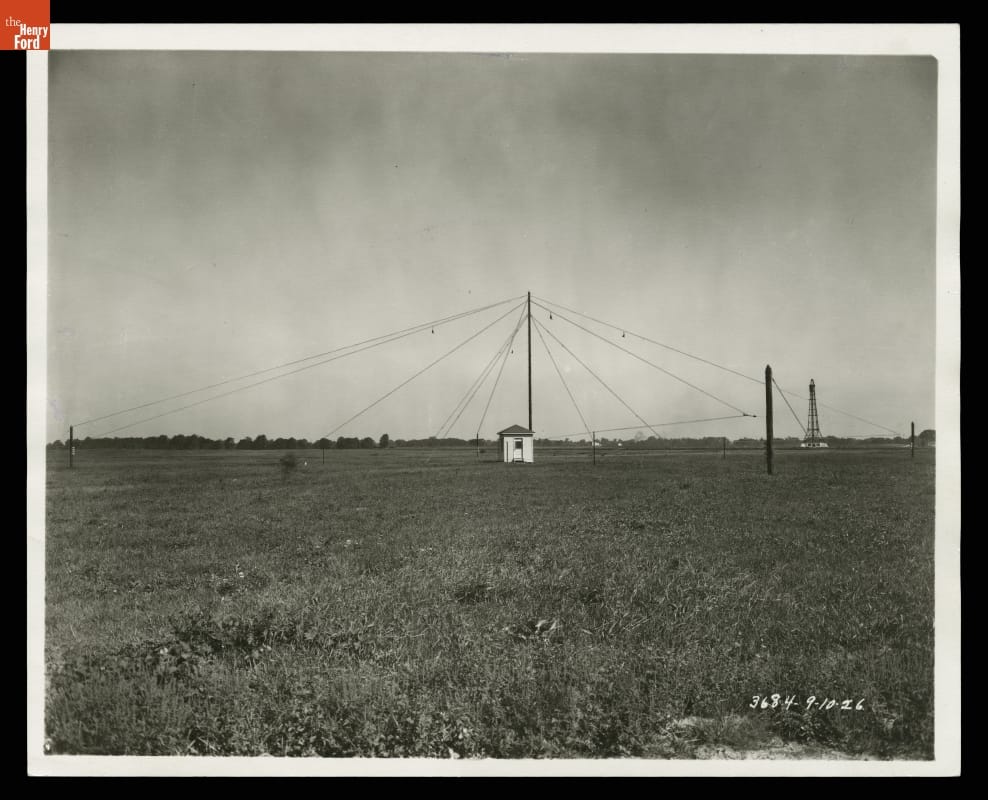
View ArtifactRadio Beacon Transmitting Station and Antennas at Ford Airport, 1926
Early pilots depended on landmarks, preventing reliable navigation in bad weather. Henry Ford's engineers developed a radio beacon that simultaneously transmitted two Morse code letters, allowing pilots to steer until the separate signals merged into a steady hum. The original beacon station at Ford Airport (shown here) was removed in 1933 and is now on display inside the museum.
View ArtifactDetail of Goniometer Used inside the Radio Beacon Transmitting Station at Ford Airport, 1926
Early pilots depended on landmarks, preventing reliable navigation in bad weather. Henry Ford's engineers developed a radio beacon that simultaneously transmitted two Morse code letters, allowing pilots to steer until the separate signals merged into a steady hum. The original beacon station at Ford Airport (shown here) was removed in 1933 and is now on display inside the museum.
View Artifact

