
Earle Ovington: “Air Mail Pilot No. 1”
Share
share
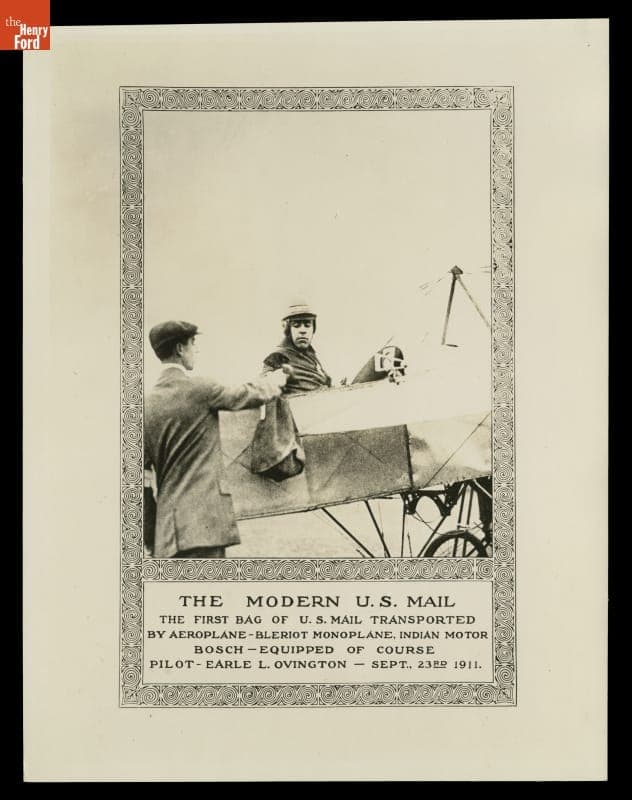
In 1910, while attending the first international aviation meet held in the United States, Earle Ovington (1879-1936) decided to become a pilot. During his short but successful career as an exhibition flyer, Ovington achieved an impressive string of aviation firsts – most notably, piloting the first U.S. Air Mail flight operated by the Post Office Department.
THF39664
1909 Bleriot XI Monoplane
Ovington trained at Louis Bleriot’s flight school in Pau, France, learning to fly at the controls of a Bleriot monoplane like this one. He received his pilot’s license on January 20, 1911 at age 32. Before returning to the United States, Ovington purchased and outfitted his own Bleriot – a racing monoplane with a powerful engine that he dubbed Dragonfly.
View ArtifactTHF15933
Roold Crash Helmet Worn by Earle Ovington, United States Post Office Department's First Air Mail Pilot, 1911
In France, Ovington experienced the dangers of flying firsthand, witnessing several accidents and injuries to fellow students. He made a habit of taking safety precautions, and purchased for himself this French Roold flying helmet made of lightweight cork. The distinctive headgear, typical among early European pilots, would set Ovington apart from other exhibition flyers in the United States.
View ArtifactTHF256664
Earle Ovington Flying a Bleriot Monoplane, Bridgeport, Connecticut, 1911
Ovington made his exhibition debut in May 1911, at a Bridgeport, Connecticut, aviation meet. The novice pilot made an early name for himself, beating prior attempts to take off from an almost impossibly short runway. This feat marked the beginning of a grueling American exhibition tour for Earle Ovington.
View ArtifactTHF95419
Aviator's Safety Belt Worn by Earle Ovington, United States Postal Service's First Air Mail Pilot, 1911
As aviation meets gained popularity throughout 1911, promoters sought to exceed public expectations. Event organizers staged riskier contests, such as competitive racing, and pilots attempted increasingly dangerous stunts. While up to these challenges, Ovington remained cautious. He always strapped into a safety belt hooked to the pilot’s seat, to secure him in the event of an accident.
View ArtifactTHF95418
Map of New York in Roller Case, Used by Earle Ovington, circa 1911
Cross-country races, introduced in the United States in 1911, challenged pilots’ navigation skills. Earle Ovington learned to steer not by landmarks, which were difficult to identify from the air at high speeds, but with a compass and map. Placed directly in front of the pilot’s seat, this roller case allowed Ovington to move the map as he flew.
View ArtifactTHF95421
Inclinometer Used by Earle Ovington, United States Postal Service's First Air Mail Pilot, 1911
To the right of his map and compass, Ovington could reference this inclinometer, or level indicator. The device showed Ovington whether he was climbing, descending, or flying horizontally and helped him determine when and how to adjust his tailplanes.
View ArtifactTHF95420
Altimeter Used by Earle Ovington, United States Postal Service's First Air Mail Pilot, 1911
To his left was this altimeter, which indicated the altitude at which the plane was flying. Ovington favored this remarkably sensitive instrument, which he’d conducted satisfactory pre-flight tests with on the stern of an oceangoing steamship and up and down a flight of stairs.
View ArtifactTHF46255
Trophy Presented to Earle Lewis Ovington, 1911
Earle Ovington impressed crowds throughout the 1911 exhibition season, winning several major events and performing a number of publicity stunts. Among other things, Ovington became the first to write a letter in the air and the first to fly to a dinner engagement – for which he received this trophy. In the early years of aviation, nearly anything new in flight captured public interest.
View ArtifactTHF15934
Policeman Doll, 1905-1909, Earle Ovington's Mascot "Treize"
Ovington boldly displayed the “unlucky” number 13 on his aircraft and flew with this mascot nicknamed Treize (French for “thirteen”). This apparent disregard for superstition had great publicity value, but it also revealed Ovington’s awareness of the inherent risk of flying. He believed that mentally preparing for the worst would improve his ability to survive if something went wrong in the air.
View ArtifactTHF256668
U.S. Postmaster General Frank Hitchcock Poses with Earle Ovington and the Bag Used to Carry the First U.S. Air Mail, September 1911
At a Long Island, New York, meet in September 1911, Postmaster General Frank Hitchcock had established a special airfield post office – a white tent labeled “U.S. Mail Aeroplane Station No. 1” – and set up 20 mail boxes for the crowds of enthusiastic spectators. Experiments with flying the mail had seen success in Europe, but not yet in the United States. Earle Ovington jumped at the opportunity to pilot the first U.S. Air Mail flight.
View ArtifactTHF131138
Earle Ovington in Queen Monoplane Receiving the First Mail to be Delivered by Air, September 23, 1911
On September 23rd, 1911, Earle Ovington was duly sworn in as "Air Mail Pilot No. 1." He took off from Garden City, New York, with a 75-pound sack of letters and postcards stuffed in the cockpit of his Bleriot monoplane. Three miles away, circling above a flag-waving postmaster at Mineola, Ovington hoisted the unwieldy mailbag overboard, successfully completing the first U.S. Air Mail flight operated by the Post Office Department.
View ArtifactTHF256666
Promotional Queen Monoplane Owned by Earle Ovington, First United States Post Office Air Mail Pilot, 1911
Flying the air mail would be Earle Ovington’s greatest claim to fame. After the 1911 season, Ovington retired from exhibition flying. Though he pursued other business opportunities, Ovington remained active in promoting the aviation industry – and continued to benefit from promotional sponsorships and product endorsements employing his name and reputation as "Air Mail Pilot No. 1."
View ArtifactTHF256674
"Couriers of the Clouds. The Romance of the Air Mail," 1930
Though Earle Ovington’s first short air mail flight in 1911 wasn’t much more than a publicity stunt, it previewed the beginning of regular air mail services in 1918. Flying the mail in the early years was a dangerous job. As the U.S. Air Mail Service expanded, advancing the commercial aviation industry with it, air mail pilots earned the same public admiration Earle Ovington had just a few years earlier.
View Artifact

