
Ford Tri-Motor: Production
Share
share
Early American airlines embraced the Ford Tri-Motor. It was rugged, built of metal rather than wood and fabric. It was reliable, able to land safely with just one of its three engines. And it was versatile. Tri-Motors flew passengers and freight for public carriers, and served as executive transports, traveling showrooms and aerial delivery vans for private companies. Ford built nearly 200 Tri-Motors from 1926 to 1933.
THF285001
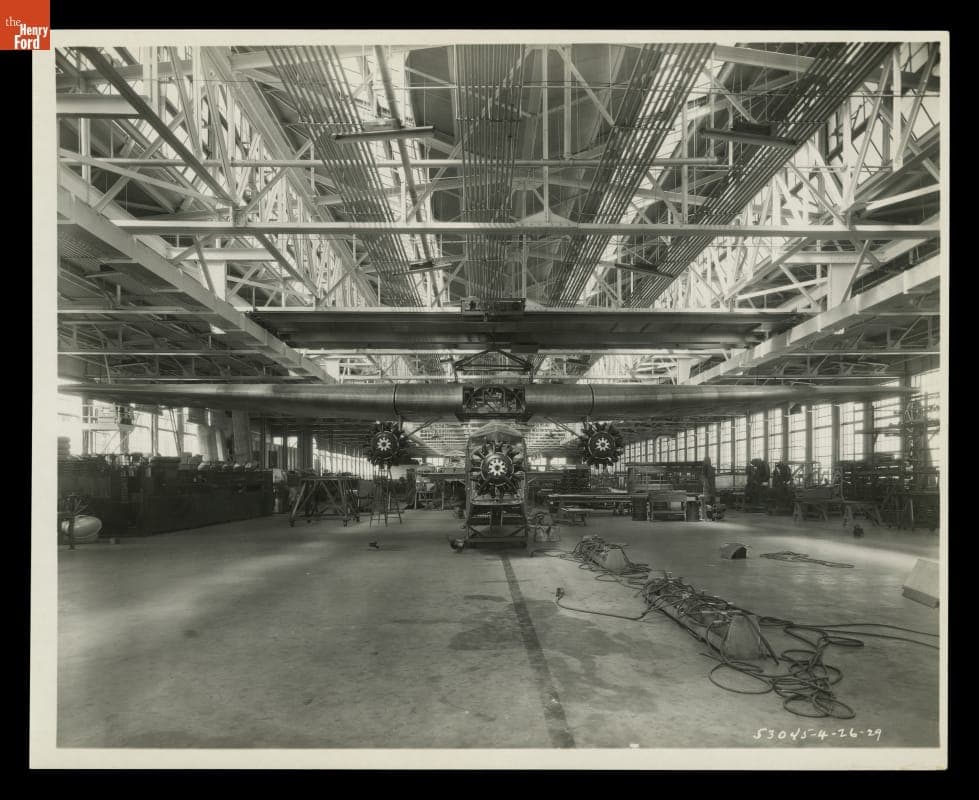
Ford Tri-Motor Airplane Being Constructed at the Stout Factory, Dearborn, Michigan, February 1929
Ford Motor Company's Tri-Motor, built from 1926-1933, flew in many early American airline fleets. The all-metal airplane was rugged, dependable, and equally adaptable to passenger and freight service. Tri-Motors were built with some of the same mass production techniques used in Ford's automobile plants. In this photo, the propellers are being connected to the fuselage or the main body of the airplane.
View ArtifactView of Ford Tri-Motor Bulkhead Assembly, 1929
Ford Motor Company's Tri-Motor, built from 1926-1933, flew in many early American airline fleets. The all-metal airplane was rugged, dependable, and equally adaptable to passenger and freight service. Tri-Motors were built with some of the same mass production techniques used in Ford's automobile plants. This photo reveals the assembly of a Tri-Motor bulkhead.
View ArtifactFord Tri-Motor Assembly inside Factory, Ford Airport, Dearborn, Michigan, 1929
Henry Ford attempted to apply automobile assembly line techniques to the manufacture of airplanes, and to build them in large numbers. Monthly production peaked at 25 planes in June 1929. The Great Depression forced Ford to re-focus on his core auto business, and the company's commercial aircraft production ended in May 1933.
View ArtifactFord Tri-Motor Airplane, Interior View of Fuselage Showing Construction Detail, September 1929
Ford Motor Company's Tri-Motor, built from 1926-1933, flew in many early American airline fleets. The all-metal airplane was rugged, dependable, and equally adaptable to passenger and freight service. Tri-Motors were built with some of the same mass production techniques used in Ford's automobile plants. The interior of the fuselage, or the main body of the airplane, is revealed in this photograph.
View ArtifactFord Tri-Motor 14-AT Airplane Wing before Being Joined to Fuselage, December 1931
Ford Motor Company's Tri-Motor, built from 1926-1933, flew in many early American airline fleets. The all-metal airplane was rugged, dependable, and equally adaptable to passenger and freight service. Tri-Motors were built with some of the same mass production techniques used in Ford's automobile plants. This photo reveals the internal structure of a wing awaiting attachment to a fuselage.
View ArtifactFord Tri-Motor 4AT-1 at Ford Airport, Dearborn, Michigan, June 1926
Model 4-AT airliners were designed and built by Stout Metal Airplane Company, a division of Ford Motor Company. The all-metal, multi-engine planes earned a reputation for being rugged and dependable. From the late 1920s into the 1930s, they were the backbone of the scheduled airline industry. The 4-ATs eased public concerns about the safety of air travel and revolutionized commercial aviation.
View ArtifactFord Tri-Motor Airplane Fuselage Being Constructed at the Stout Factory, Dearborn, Michigan, April 1929
Ford Motor Company's Tri-Motor, built from 1926-1933, flew in many early American airline fleets. The all-metal airplane was rugged, dependable, and equally adaptable to passenger and freight service. Tri-Motors were built with some of the same mass production techniques used in Ford's automobile plants. The fuselage, or the main body of the airplane, is constructed in this photograph.
View ArtifactFord Tri-Motor Assembly inside Factory, Ford Airport, Dearborn, Michigan, 1929
Henry Ford attempted to apply automobile assembly line techniques to the manufacture of airplanes, and to build them in large numbers. Monthly production peaked at 25 planes in June 1929. The Great Depression forced Ford to re-focus on his core auto business, and the company's commercial aircraft production ended in May 1933.
View ArtifactFord Tri-Motor 8-AT Airplane, Interior Cabin Designed to Transport Freight, October 1929
Ford Motor Company's Tri-Motor, built from 1926-1933, flew in many early American airline fleets. The all-metal airplane was rugged, dependable, and equally adaptable to passenger and freight service. Tri-Motors were built with some of the same mass production techniques used in Ford's automobile plants. This version, the 8-AT was used to transport freight so did not have passenger seating. This photograph shows the 8-AT's cabin interior.
View ArtifactFord Tri-Motor 14-AT Airplane Wing Interior Structure, December 1931
Ford Motor Company's Tri-Motor, built from 1926-1933, flew in many early American airline fleets. The all-metal airplane was rugged, dependable, and equally adaptable to passenger and freight service. Tri-Motors were built with some of the same mass production techniques used in Ford's automobile plants. In this photo, the interior of the 14-AT airplane wing structure is revealed.
View ArtifactConstruction of Ford Tri-Motor 14-AT Showing Center Hispano Suiza Engine, January 1932
Ford Motor Company's Tri-Motor, built from 1926-1933, flew in many early American airline fleets. The all-metal airplane was rugged, dependable, and equally adaptable to passenger and freight service. Tri-Motors were built with some of the same mass production techniques used in Ford's automobile plants. This version, the 14-AT, featured three Hispano-Suiza Engines. This photograph reveals the interior of the central engine.
View ArtifactFord Trimotor 4-AT-1 Airplane at Ford Airport, Dearborn, Michigan, 1926
Model 4-AT airliners were designed and built by the Stout Metal Airplane Company, a division of Ford Motor Company. The all-metal, multi-engine planes earned a reputation for being rugged and dependable. From the late 1920s into the 1930s, they were the backbone of the scheduled airline industry. The 4-ATs eased public concerns about the safety of air travel and revolutionized commercial aviation.
View ArtifactFord Tri-Motor Airplane Being Assembled at the Stout Factory, Dearborn, Michigan, May 1929
Ford Motor Company's Tri-Motor, built from 1926-1933, flew in many early American airline fleets. The all-metal airplane was rugged, dependable, and equally adaptable to passenger and freight service. Tri-Motors were built with some of the same mass production techniques used in Ford's automobile plants. Assembly plant workers are examining the bulkhead and engine in this photograph.
View Artifact

