
Ford Tri-Motor: Passenger Travel
Share
share
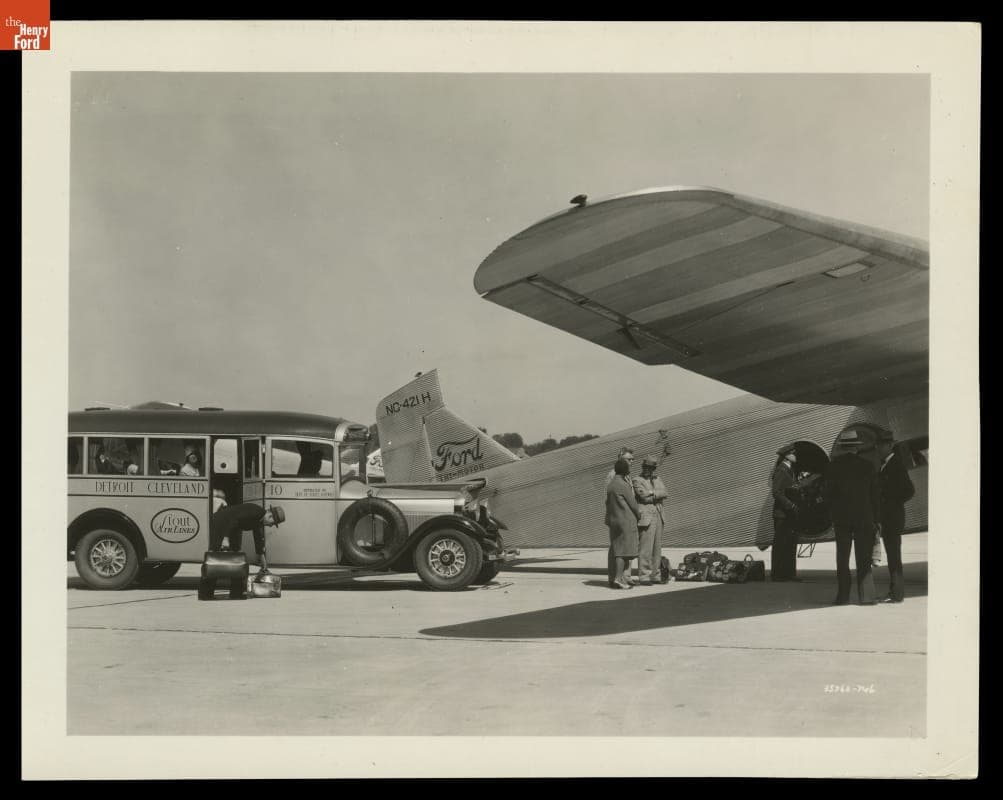
Early American airlines embraced the Ford Tri-Motor. It was rugged, built of metal rather than wood and fabric. It was reliable, able to land safely with just one of its three engines. And it was versatile. Tri-Motors flew passengers and freight for public carriers, and served as executive transports, traveling showrooms and aerial delivery vans for private companies. Ford built nearly 200 Tri-Motors from 1926 to 1933.
THF130330
Loading Passenger Luggage into Ford Tri-Motor 5-AT-81, Ford Airport, Dearborn, Michigan, 1930
Stout Air Lines advertised direct airplane service between Detroit and Cleveland, but this wasn't strictly true. Stout's "Detroit" terminal was, in fact, Ford Airport in Dearborn, ten miles west of the city. Passengers gathered at a station in Detroit and were shuttled by bus to the Dearborn airport where they boarded the actual plane.
View ArtifactTHF125978
Air Travel Brochure, "Fly to Detroit in 100 Minutes," circa 1928
Air travel cost more than train or bus transportation, but it was faster. One could fly from Cleveland to Detroit in just 100 minutes -- have your breakfast in Cleveland, spend the business day in Detroit, and be back in Cleveland for dinner, as this brochure colorfully explained it. The same trip took 3 hours and 50 minutes by railroad.
View ArtifactTHF285007
Ford Tri-Motor Airplane, Interior Passenger Cabin, June 1929
Passenger air travel was a completely new -- and perhaps fearsome -- concept for most Americans in the 1920s. National advertisements for the Ford Tri-Motor promoted "roomy and comfortable" wicker passenger chairs -- one of the many advertised amenities used to convince a skeptical public of the appeal of flying in a Ford plane. Later models of the Ford Tri-Motor featured almuminum seats covered with leather.
View ArtifactTHF116597
"Highways of the Sky," Advertisement Promoting Commercial Air Travel on Ford Tri-Motor Airplanes, 1928
As the United States expanded in the twentieth century, air travel became an efficient alternative for the transportation of goods, services, and people. This advertisement compares the early days of commercial aviation to the early days of transcontinental rail travel, and predicts that air travel will become hugely popular -- especially on the Ford Tri-Motor airplane.
View ArtifactTHF123510
Stout Air Lines Ford Tri-Motor 4-AT-34 Airplane at Ford Airport, October 1928
Model 4-AT airliners were designed and built by engineers of the Stout Metal Airplane Company, purchased from William Stout by Ford Motor Company. These rugged planes earned a reputation for being safe and dependable. Many commercial airlines -- including Stout's newly formed Stout Air Lines -- purchased 4-ATs for passenger travel. Here, one of his airliners takes on well-dressed passengers in Dearborn, Michigan.
View ArtifactTHF284999
Ford Tri-Motor Airplane, Interior Cabin Showing Steward Serving Passengers, September 1929
Passenger air travel was a completely new -- and perhaps fearsome -- concept for most Americans in the 1920s. National advertisements for the Ford Tri-Motor promoted "roomy and comfortable" wicker passenger chairs -- one of the many advertised amenities used to convince a skeptical public of the appeal of flying in a Ford plane. Later models of the Ford Tri-Motor featured almuminum seats covered with leather.
View ArtifactTHF732098
Air Show Poster, Inman Brothers Flying Circus, "Airplane Rides," 1936
The only thing more exciting than watching pilots perform aerobatic stunts was flying in an airplane yourself. Exhibition squads offered short flights at prices far lower than expensive commercial airline fares. Inman Brothers Flying Circus would take you into the sky for just 50 cents. For a dollar, you could enjoy an "extra long thrill ride."
View ArtifactTHF125982
Map of the Stout Air Services' Detroit-to-Cleveland Air Route, circa 1928
Stout Air Services offered scheduled passenger flights between Detroit and Cleveland in the late 1920s. The travel time was 100 minutes. Instead of flying directly across Lake Erie, pilots took the overland route seen on this map. This routing allowed pilots to navigate by visible landmarks and gave them places to land in the event of an emergency.
View ArtifactTHF121332
Ford Tri-Motor Airplane Advertisement, "First Time Up!," 1928
Air travel was something completely new for most Americans in the 1920s. Ford Motor Company offered an exciting -- and reassuring -- description of the experience in its advertisements for Ford Tri-Motor airplanes. Passengers "move twice as fast as the fastest express trains" secure in the knowledge that "if all three (engines) fail the plane has a gliding range of miles."
View ArtifactTHF285013
Ford Tri-Motor Airplane, Interior View of Passenger Cabin, October 1929
Passenger air travel was a completely new -- and perhaps fearsome -- concept for most Americans in the 1920s. Images like this, used in national advertisements for the Ford Tri-Motor, helped convince a skeptical public of the appeal of flying in a Ford plane. Airplane amenities included beautifully decorated interiors, food and refreshments served by an attendant, comfortable wicker chairs, and a toilet equipped with running water.
View ArtifactTHF98771
Passenger Seating inside Ford Tri-Motor 4-AT-4, 1927
Model 4-AT and 5-AT Tri-Motors were designed and built by the Stout Metal Airplane Company, a division of Ford Motor Company. These rugged planes earned a reputation for being safe and dependable; and in the late 1920s and 1930s they were the backbone of the scheduled airline industry. This photograph shows the interior of a 4-AT equipped with lightweight wicker seats used for passenger service.
View ArtifactTHF121334
Passengers Seated Inside a Ford Tri-Motor Airplane, October 1928
Americans initially wondered if air travel was safe. Fatal crashes by barnstorming pilots were well publicized, and wood and cloth airplanes did not inspire confidence. But when Henry Ford began making planes, the industrialist's solid reputation eased people's fears. Ford's all-metal Tri-Motors were rugged, dependable and safe. By the late 1920s these planes were the backbone of the budding airline industry.
View ArtifactTHF285019
Passengers Entering Ford Tri-Motor 4-AT Airplane, 1927
Passenger air travel was a completely new -- and perhaps fearsome -- concept for most Americans in the 1920s. Images like this, used in national advertisements for the Ford Tri-Motor, helped convince a skeptical public of the safety of flying in a Ford plane. These educational advertisements offered an exciting and reassuring description of the flying experience, emphasizing "well-designed, well-constructed machines handled by competent pilots."
View ArtifactTHF133701
Advertisement Promoting Commercial Flight in Ford Tri-Motor Airplanes, "Your Place...," March 1931
While air travel was not exactly an everyday experience by March 1931, when Ford Motor Company published this advertisement, it was certainly a regular feature of American life. Ford rightfully claimed some credit for that. Its all-metal Tri-Motor airplane, built from 1926-1933, was rugged, reliable, and widely used in both passenger and freight airline service.
View ArtifactTHF255293
Passengers Seated during Flight in Ford Tri-Motor Airplane, 1929
The Ford Tri-Motors were designed and built by the Stout Metal Airplane Company, a division of Ford Motor Company. These rugged planes earned a reputation for being safe and dependable; and in the late 1920s and 1930s they were the backbone of the scheduled airline industry. This photograph shows the plane's interior equipped with lightweight wicker seats used for passenger service.
View ArtifactTHF285021
Passengers Entering Ford Tri-Motor 4-AT Airplane, 1927
Passenger air travel was a completely new -- and perhaps fearsome -- concept for most Americans in the 1920s. Images like this, used in national advertisements for the Ford Tri-Motor, helped convince a skeptical public of the safety of flying in a Ford plane. These educational advertisements offered an exciting and reassuring description of the flying experience, emphasizing "well-designed, well-constructed machines handled by competent pilots."
View Artifact

