
The Wrights: Wowing the World
Share
share
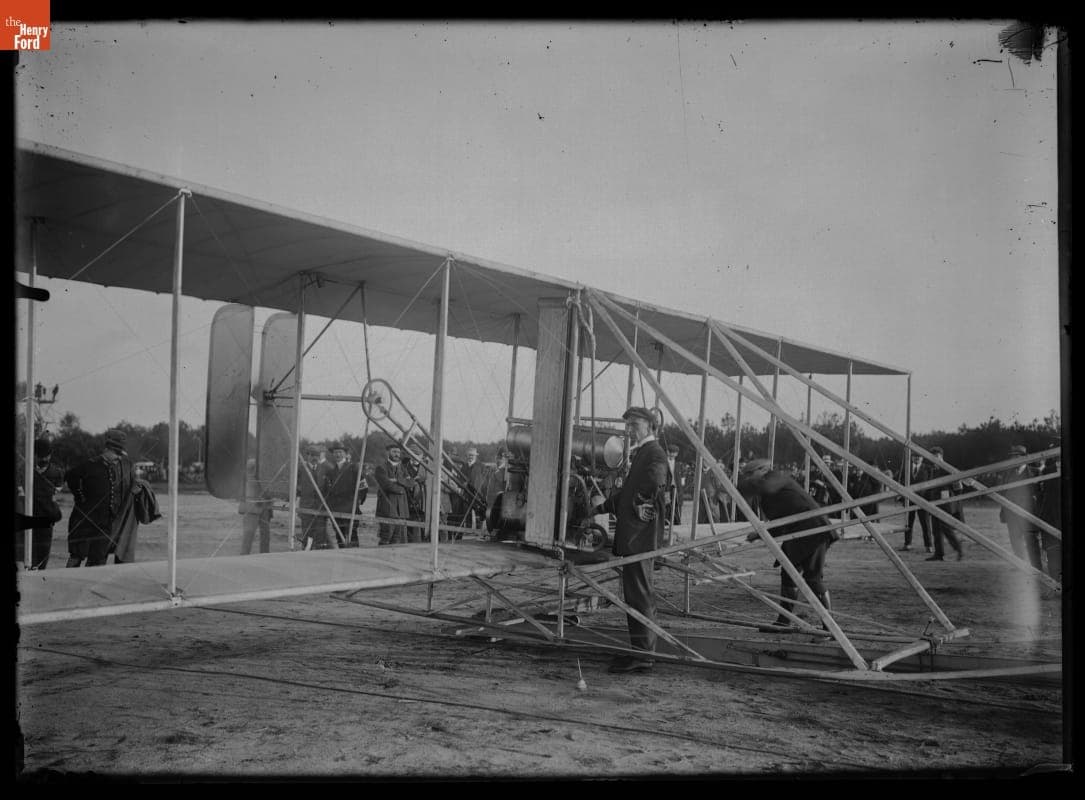
After their first flight at Kitty Hawk in December 1903, the Wright brothers spent five years in relative seclusion, testing, tweaking, and trying to patent their Flyer. While the brothers’ secrecy foiled copycats, it also led to doubts of their success. Skeptics were silenced when Wilbur Wright piloted the Flyer in a series of spectacular public demonstrations near Le Mans, France, in 1908.
THF242239
Crowd Gathered for Wilbur Wright Demonstration Flight at Hunaudieres Race Course, Le Mans, France, August 1908
Wilbur Wright's many demonstration flights in France in 1908 and 1909 were spectacular events. Some in Europe had begun to doubt the Wrights' achievement at Kill Devil Hills. When Wilbur took to the skies over Le Mans, demonstrating more control and achieving more distance than his rivals, crowds flocked to watch his apparent mastery of the airplane. The skeptics were silenced.
View ArtifactTHF2647
Wilbur Wright Seated in the Flyer, Camp d'Auvours, near Le Mans, France, 1908-1909
Worried that rivals would steal their yet-to-be patented designs, the Wright brothers stopped flying publicly for nearly three years in late 1905. People began to doubt that the Wrights had ever flown. Skeptics were silenced in August 1908 when Wilbur Wright made a series of spectacular demonstration flights at Le Mans, France, achieving more distance and control than anyone else.
View ArtifactTHF111053
Leon Bollee Sitting at the Controls of the Wright Flyer at Camp d'Auvours, near Le Mans, France, 1908-1909
Leon Bollee was a close and important friend to Wilbur Wright during Wright's airplane demonstrations in France in 1908. Bollee offered Wright workspace and a crew of mechanics in his Le Mans automobile factory, and he asked for nothing in return. Nevertheless, Wright repaid the favor by taking Bollee up for a flight.
View ArtifactTHF242293
Wright Flyer Connected to Launching Derrick, France, 1908-1909
The Wright brothers' early airplanes had no wheels, just simple landing skids. To achieve takeoff, they devised a clever catapult system. The airplane was attached, with cables and pulleys, to a weight suspended in a tower. When the weight fell, it pulled the plane along a wooden rail fast enough to generate the necessary lift.
View ArtifactTHF242291
Crowd Watching Wilbur Wright Preparing the Flyer, France, 1908-1909
Wilbur Wright's many demonstration flights in France in 1908 and 1909 were spectacular events. Some in Europe had begun to doubt the Wrights' achievement at Kill Devil Hills. When Wilbur took to the skies over Le Mans, demonstrating more control and achieving more distance than his rivals, crowds flocked to watch his apparent mastery of the airplane. The skeptics were silenced.
View ArtifactTHF242307
Wilbur Wright Piloting the Wright Flyer, France, 1908-1909
Worried that rivals would steal their yet-to-be patented designs, the Wright brothers stopped flying publicly for nearly three years in late 1905. People began to doubt that the Wrights had ever flown. Skeptics were silenced in August 1908 when Wilbur Wright made a series of spectacular demonstration flights at Le Mans, France, achieving more distance and control than anyone else.
View ArtifactTHF242292
Hauling the Wright Flyer on a Road, France, 1908-1909
French automaker Leon Bollee offered his factory and a staff of mechanics to Wilbur Wright prior to Wright's demonstration flights near Le Mans, France, in 1908. Moving the Wright airplane from Bollee's factory to the Hunaudieres race course -- and later to Camp d'Auvours, 11 kilometers from Le Mans -- required creative transportation. Once in place, Wright housed the plane in an on-site hangar.
View ArtifactTHF242296
Wilbur Wright Working on the Wright Flyer Motor, Camp d'Auvours, near Le Mans, France, 1908-1909
Wilbur Wright was a cautious pilot who never took unnecessary risks. During his demonstration flights in France in 1908-1909, Wilbur made a thorough, personal inspection of his airplane before each takeoff. The danger was real. Orville Wright was seriously injured, and passenger Thomas Selfridge was killed, in a crash at Fort Myer, Virginia, caused by a split propeller in 1908.
View ArtifactTHF111063
Wilbur Wright Flying at Hunaudieres Race Course, Le Mans, France, August 1908
Worried that rivals would steal their yet-to-be patented designs, the Wright brothers stopped flying publicly for nearly three years in late 1905. People began to doubt that the Wrights had ever flown. Skeptics were silenced in August 1908 when Wilbur Wright made a series of spectacular demonstration flights at Le Mans, France, achieving more distance and control than anyone else.
View ArtifactTHF111050
Wilbur Wright and Leon Bollee outside the Bollee Automobile Factory, Le Mans, France, probably June 8, 1908
Leon Bollee was a close and important friend to Wilbur Wright during Wright's airplane demonstrations in France in 1908. Bollee offered Wright workspace and a crew of mechanics in his Le Mans automobile factory, and he asked for nothing in return. Nevertheless, Wright repaid the favor by taking Bollee up for a flight.
View ArtifactTHF111043
Wright Flyer on Carrier inside Bollee Automobile Factory, Le Mans, France, 1908
Leon Bollee, a French automobile manufacturer, became one of the Wright brothers' most important friends in 1908 when he offered workspace and a crew of mechanics to Wilbur Wright during Wright's successful demonstration flights at Le Mans, France. The language barrier meant that Wright did most of the mechanical work on the airplane himself, but Bollee's assistance was much appreciated.
View ArtifactTHF242303
The Wright Flyer on the Ground near the Launching Derrick, France, 1908-1909
The Wright brothers' early airplanes had no wheels, just simple landing skids. To achieve takeoff, they devised a clever catapult system. The airplane was attached, with cables and pulleys, to a weight suspended in a tower. When the weight fell, it pulled the plane along a wooden rail fast enough to generate the necessary lift.
View ArtifactTHF242295
Preparing for a Demonstration Flight of the Wright Flyer, France, 1908-1909
Because the Wright brothers' early airplanes had no wheels in their landing gear, the planes required smooth, flat surfaces for takeoffs. The brothers created a wooden monorail track over which their airplanes could ride during launch. This photo shows sections of the track being moved during Wilbur Wright's successful demonstration flights in France in 1908-1909.
View ArtifactTHF111055
Wilbur Wright Adjusting the Canvas on the Flyer in France, 1908-1909
Worried that rivals would steal their yet-to-be patented designs, the Wright brothers stopped flying publicly for nearly three years in late 1905. People began to doubt that the Wrights had ever flown. Skeptics were silenced in August 1908 when Wilbur Wright made a series of spectacular demonstration flights at Le Mans, France, achieving more distance and control than anyone else.
View ArtifactTHF242302
Positioning the Wright Flyer on the Launch Rail, France, 1908-1909
The Wright brothers' early airplanes had no wheels, just simple landing skids. To achieve takeoff, they devised a clever catapult system. The airplane was attached, with cables and pulleys, to a weight suspended in a tower. When the weight fell, it pulled the plane along a wooden rail fast enough to generate the necessary lift.
View ArtifactTHF243944
Leon Bollee in the Wright Flyer, Camp d'Auvours, near Le Mans, France, 1908-1909
Leon Bollee was a close and important friend to Wilbur Wright during Wright's airplane demonstrations in France in 1908. Bollee offered Wright workspace and a crew of mechanics in his Le Mans automobile factory, and he asked for nothing in return. Nevertheless, Wright repaid the favor by taking Bollee up for a flight.
View ArtifactTHF242245
Crowd Gathered for Demonstration Flights by Wilbur Wright, France, 1908-1909
Wilbur Wright's many demonstration flights in France in 1908 and 1909 were spectacular events. Some in Europe had begun to doubt the Wrights' achievement at Kill Devil Hills. When Wilbur took to the skies over Le Mans, demonstrating more control and achieving more distance than his rivals, crowds flocked to watch his apparent mastery of the airplane. The skeptics were silenced.
View ArtifactTHF242283
Wilbur Wright and Frank Butler in the Flyer, Camp d'Auvours, near Le Mans, France, 1908-1909
After his impressive demonstration flights at Le Mans, France, in 1908, Wilbur Wright became one of the most celebrated men in Europe. Monarchs, politicians and business leaders came to see him fly, as did fellow aviators. Wright took more than 40 passengers up into the sky with him during his French flights, including Frank Hedges Butler, President of the Aero Club of England.
View ArtifactTHF242226
Interior of the Hangar at Camp d'Auvours, near Le Mans, France, 1908-1909
Just as he and his brother had done in North Carolina earlier in the decade, Wilbur Wright used a simple wooden hangar as his base of operations during his demonstration flights in France in 1908-1909. In addition to a workbench and tools for the airplane, the hangar included cooking utensils and a pantry stocked with canned goods.
View ArtifactTHF111059
Wright Airplane Flying near Launching Derrick, Camp d'Avours, near Le Mans, France, 1908
Worried that rivals would steal their yet-to-be patented designs, the Wright brothers stopped flying publicly for nearly three years in late 1905. People began to doubt that the Wrights had ever flown. Skeptics were silenced in August 1908 when Wilbur Wright made a series of spectacular demonstration flights at Le Mans, France, achieving more distance and control than anyone else.
View Artifact

