
Space: Our Quest to Understand
Share
share
In this set, a number of our staff highlight favorite space-related artifacts from The Henry Ford's collections. The objects they picked all speak to the underlying tools and technologies that have allowed our understanding of the universe to grow. Whether we are observing celestial bodies or venturing into space, humankind has designed innovative ways to overcome the many challenges of comprehending and exploring the cosmos.
THF228599
Sundberg-Ferar Space Station Interior Concept Drawings, 1984
Design firm Sundberg-Ferar conceptualized the interior of the International Space station after President Reagan directed NASA to proceed in 1984. Drawings showed astronauts at work, at rest, in the kitchen, in their bed chambers, and in pursuit of data. The first components of the space station went into orbit in 1998, but the ISS kitchen bore little resemblance to this uncluttered drawing. --Debra Reid, Curator, Agriculture & the Environment
View ArtifactTHF140490
Saurer Truck Transporting a 13-ton Girder to the Mount Wilson Observatory, Los Angeles County, California, 1916
The completion of the Mt. Wilson Observatory’s 100-inch telescope in 1917 enabled major advances in astronomy. The construction was also a great testing and advertising opportunity for Mack Truck and Saurer Motor Company, whose trucks hauled components of the telescope up the mountain. This photo captures the rugged road, the danger of the job, and the skill and ingenuity of the workers involved. --Brian Wilson, Sr. Manager, Archives and Library
View ArtifactTHF114242
Home Television Broadcast of NASA's Apollo 11 Moon Landing, July 20, 1969
"We can put a man on the moon, but we can't ___." Home video recording was not widely available in 1969, so people used the family camera to capture the moment. --Jim Orr, Image Services Specialist
View ArtifactTHF285375
Stereograph, "The Planet Uranus and Two of Its Moons," 1916
William Herschel discovered Uranus (the first planet discovered by telescope) in 1781--one his many important contributions to the field of astronomy. 135 years later, a graduate student named Edwin Hubble created this image showing Uranus through a telescope at Yerkes Observatory. Hubble went on to make his own significant discoveries, becoming one of the leading astronomers of the 20th century. --Saige Jedele, Associate Curator, Digital Content
View ArtifactTHF288386
Apollo 13 Astronauts Jack Swigert and Jim Lovell in a Parade, Chicago, Illinois, May 1, 1970
Apollo 13’s planned Moon landing ended with an oxygen tank explosion on April 14, 1970. Flight directors, engineers, technicians, and the astronauts themselves worked under intense pressure to return the crew safely to Earth. This photo, showing astronauts Jack Swigert and Jim Lovell parading through Chicago just two weeks later, captures the euphoria of the mission’s happy ending. --Matt Anderson, Curator of Transportation
View ArtifactTHF134577
Mechanical Lantern Slide, the Solar System, 1860-1900
An orrery, a 3D model of Earth's solar system, helps us understand how planets and moons move in space. This 2D orrery is a glass lantern slide. Before film or digital technologies, a light source behind the glass would have projected the rotating image of our solar system on a wall or screen, showing how planets revolve around our Sun. Click on the collections record for a rotatable view. --Ellice Engdahl, Digital Collections & Content Manager
View ArtifactTHF134290
Motor Controllers for the Telescope at the Yerkes Observatory, Williams Bay, Wisconsin, 1932
The motor controllers shown here rotated the dome and raised and lowered the floor of the Yerkes Observatory in Williams Bay, Wisconsin. The observatory houses the world's largest refracting telescope, which was used by many world-renowned astronomers and astrophysicists to aid in their research. Click through to the Digital Collections record to see the two controllers, also in our collections, under “Related Objects.” --Lisa Korzetz, Registrar
View ArtifactTHF123645
Richard E. Byrd Using a Sextant, circa 1927
Antarctica: the "final frontier" on planet Earth. Ocean-going vessels crossed the Antarctic Circle in 1773, and explorers first recorded sightings of the southernmost continent in the world in 1820. They, like Admiral Byrd, exploring a century later, used sextants and other navigational instruments to confirm their position on earth relative to the sun and other unexplored celestial bodies. --Debra Reid, Curator of Agriculture & the Environment
View ArtifactTHF139576
NASA Lunar Roving Vehicle (LRV) on Temporary Exhibit with Henry Ford's Quadricycle in Henry Ford Museum, May 1989
This Lunar Roving Vehicle--one of five built for the later Apollo missions--was exhibited from 1989-1996 in Henry Ford Museum alongside Henry Ford's own Quadricycle. The LRVs were the first automobiles driven on another world, but as the signage notes, they shared a "strong resemblance in form" to Henry's first car. --Jim Orr, Image Services Specialist
View ArtifactTHF285381
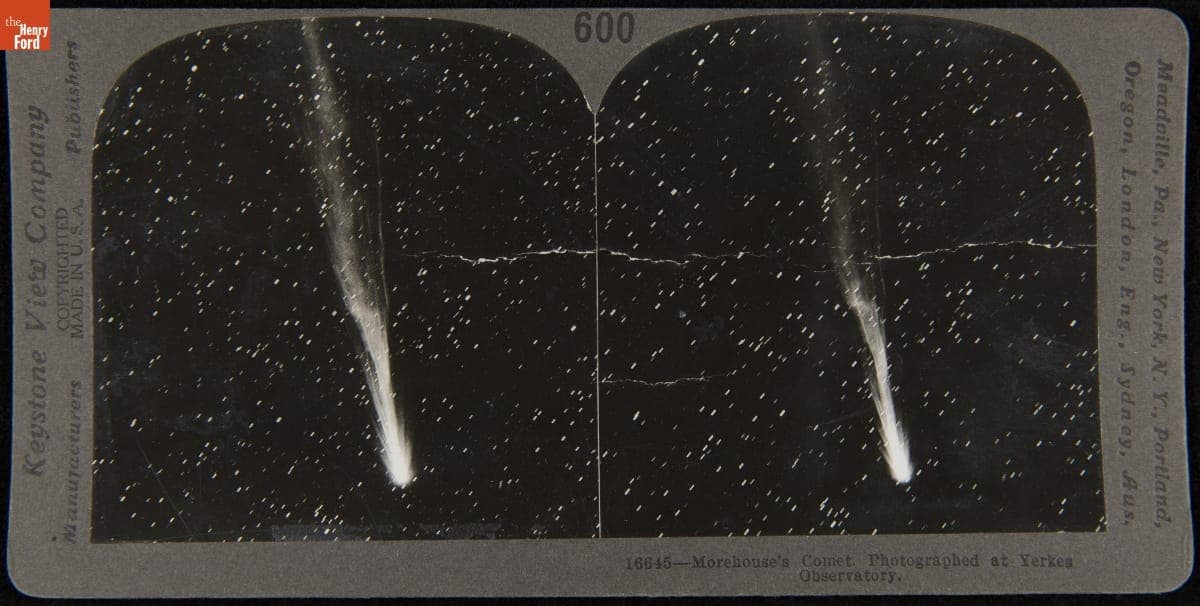
Stereograph, "Morehouse's Comet," 1908
Once in a million years! Daniel Walter Morehouse (1876-1941) first saw this comet with its spectacular trail in 1908. Cameras at the Yerkes Observatory in Williams Bay, Wisconsin, home of a telescope with a 40-inch refracting mirror, captured these views. The Keystone View Company packaged the stereograph for consumers around the world to see using their stereopticon, not a telescope. --Debra Reid, Curator of Agriculture and the Environment
View Artifact

