
McLoughlin Bros. - Color Printing Pioneers
Share
share
John and Edmund McLoughlin's publishing firm became well-known in the mid-1800s for its early adoption and skillful use of new color printing techniques. Realizing success in the emerging market for children's books, the brothers expanded their product line to include toys and games. Products bearing the McLoughlin Bros. name remained popular even after the company’s acquisition by Milton Bradley in 1920.
THF278518
Mother Goose's Melodies, 1850-1858
As a teenager in the 1840s, John McLoughlin, Jr. (1827-1905) learned wood engraving and printing at his father's New York publishing firm. Around 1850, he took over the business and began publishing books, like this copy of "Mother Goose Melodies," under his own name. Hand-colored illustrations accompany a few of the traditional nursery rhymes that fill the book's pages.
View ArtifactWatt's Songs Against Evil, 1858-1870
John McLoughlin's brother, Edmund (1833/4-1889), joined the firm in 1855. The partners were quick to put new color printing techniques to use, publishing picture books for children. Like most children's books at the time, the images and short poems in this McLoughlin Bros. book, "Watt's Songs Against Evil," reinforce the rewards of good behavior--and the consequences of "being bad."
View ArtifactMary Gray Paper Doll, 1864-1870
As color printing technologies improved and became more affordable in the second half of the nineteenth century, many book publishers also began printing playthings. By the 1860s, McLoughlin Bros. had expanded its product line to include games and toys, like paper dolls. McLoughlin's paper dolls reflected current trends and remained popular with consumers longer than other firms' less fashionable versions.
View ArtifactMagic Mirror Game, 1860-1880
Boxed games and toys presented multiple opportunities for McLoughlin Bros. to showcase its color printing prowess. This colorful box enticed people to purchase and play "The Magic Mirror, or Wonderful Transformations." Inside was a small, shiny optical toy and a series of indecipherable McLoughlin Bros. prints. When positioned in just the right way, the mirror "magically" transformed the distorted images into clear reflections of people or animal
View ArtifactPuzzle, "Criss Cross Spelling Slips," 1880-1890
By the end of the nineteenth century, many parents had come to believe that play -- controlled and in moderation -- could help children become happy, well-adjusted adults. Educational toys and games, like this McLoughlin Bros. spelling game with a box depicting two girls engaged in instructive play, appealed to attentive parents.
View ArtifactFish Pond Game, 1890-1900
McLoughlin Bros. patented a version of the "fish pond game" in 1890. The firm made clever use of the game box -- the interior depicts a pond full of multi-colored fish that children could hook using small wooden poles. A number printed on each fish indicated its value as competitors vied for the best catch.
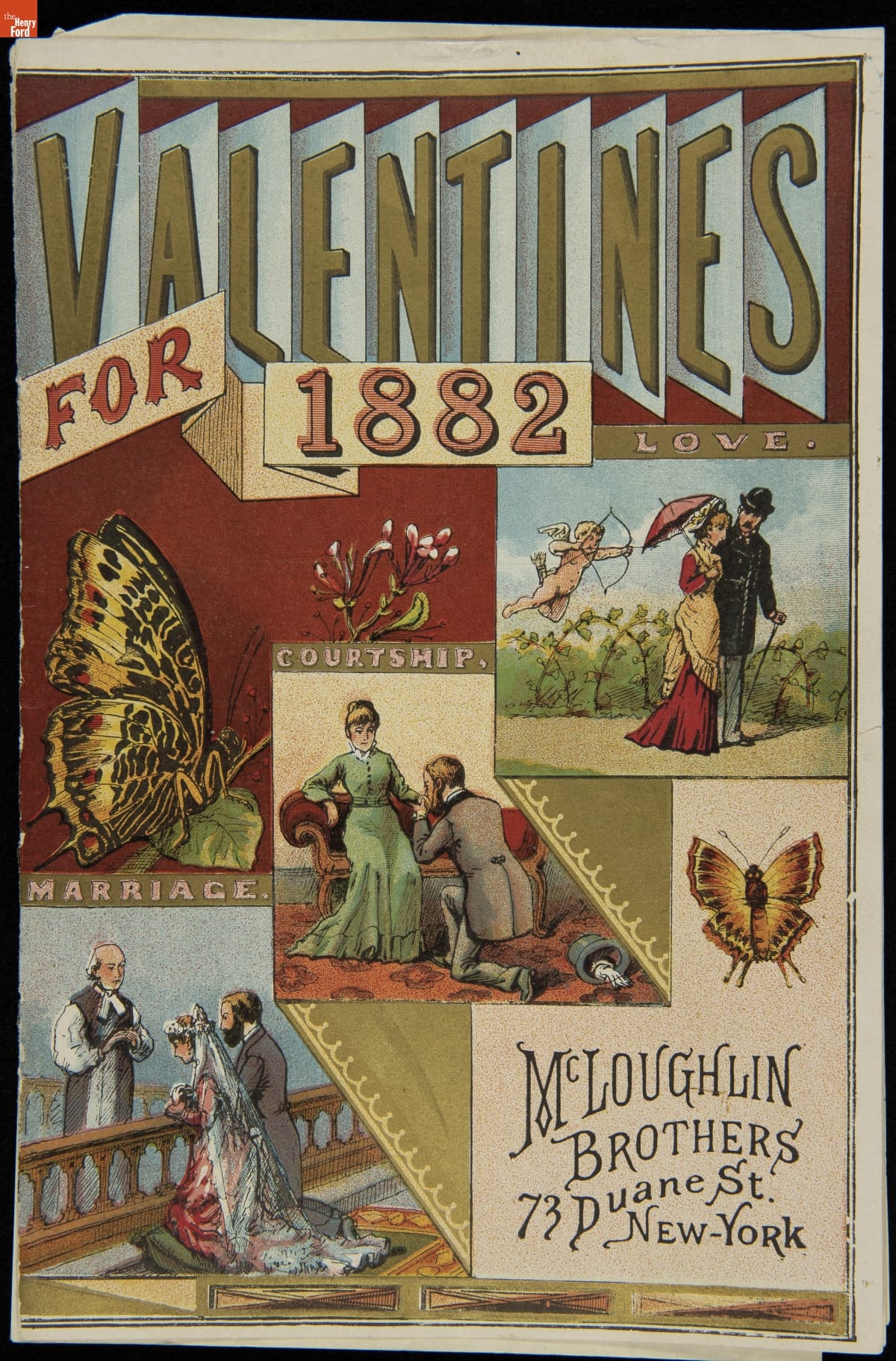
View ArtifactCatalog of Valentines for 1882, McLoughlin Brothers, 1882
John and Edmund McLoughlin's father had printed Valentine's Day greetings in the 1840s, and the brothers carried on the tradition. Valentines remained popular throughout the second half of the nineteenth century, when family members or sweethearts exchanged often frilly greetings depicting cherubs, birds, and flower garlands. This McLoughlin Bros. catalog lists a range of valentines on offer for 1882.
View ArtifactComic Valentine, "A Political Scamp," circa 1890
Among McLoughlin Bros.' sweet, sentimental valentine greetings were some that seem unusual today -- comic valentines. From the 1840s into the early 1900s, people sent these cards to chide, warn, and even insult recipients. Exaggerated cartoons and accompanying verses described and dismissed a range of character flaws or unacceptable behaviors. This one mocks "a political scamp" -- a dishonest, self-serving politician.
View ArtifactFold-out Book, "Cinderella," 1891
Edmund McLoughlin retired in 1885 and died just four years later, but McLoughlin Bros. continued experimenting with new printing techniques as well as new products. In 1891, the firm patented this theater-shaped variant of the rectangular "pantomime" books available at the time. Two cover flaps open to reveal a family watching from theater box seats as the pages of the book turn and the "play" unfolds.
View ArtifactThe Airship Book, 1905
"The Airship Book," published by McLoughlin in 1905, features detailed, brightly colored illustrations of famous balloons, airships, and airplanes. A representation of the highest technology -- both in the fields of color printing and aviation -- the book also marked McLoughlin Bros. decline. John McLoughlin, Jr., the company's visionary leader, died the same year it was published.
View ArtifactMother Goose Rhymes, 1920-1940
Leading game manufacturer Milton Bradley acquired McLoughlin Bros. in 1920. But the McLoughlin story didn’t end there. Milton Bradley continued publishing books -- including this perennial children's favorite, "Mother Goose" -- and other products through its McLoughlin division until World War II. Today, examples of the firm’s work, like these, help preserve McLoughlin's colorful history.
View Artifact

