
Soyfoods
Share
share
Henry Ford was an early promoter of soybean-based foods in the United States. Over the twentieth century, food made from protein-packed soybeans gained popularity among consumers and attained a distinct place in the American diet.
THF119278
"Recipes for Soybean Foods," circa 1931
In an attempt to unite agriculture and industry, Henry Ford financed large-scale soybean experimentation. He hired researchers to investigate industrial applications for soybeans, and to study their culinary potential. This booklet promoted the soybean as a nutritious food. It contains recipes that incorporate cooked soybeans, as well as soy-based milk, butters, and "cheese" (tofu).
View ArtifactTHF119248
"Soybeans in Family Meals," U.S. Department of Agriculture Home and Garden Bulletin No. 208, 1974
In the 1970s, scientific research linked diets high in saturated fat and cholesterol to health problems including heart disease and cancer. The United States government urged Americans to reduce their consumption of meat and encouraged alternative proteins. This recipe booklet introduced soybeans as a nutritious, versatile ingredient that provided quality protein with no cholesterol and less saturated fat than meat.
View ArtifactTHF119242
Cookbook, "The Book of Tofu: Food for Mankind," 1979
In the 1970s, scientific research linked diets high in animal protein to health problems including heart disease and cancer. Publications helped popularize soybeans as a nutritious meatless alternative that provided quality protein with no cholesterol and less saturated fat than meat. This book included historical information, preparation instructions, and recipes incorporating tofu, a versatile curd made from soybeans.
View ArtifactTHF119266
Cookbook, "The Soybean Cookbook: Adventures in Zestful Eating," 1974
In the 1970s, scientific research linked diets high in animal protein to health problems including heart disease and cancer. Publications helped popularize soybeans as a nutritious meatless alternative that provided quality protein with no cholesterol and less saturated fat than meat. This book describes a variety of soy-based cooking ingredients and includes more than 350 recipes incorporating the versatile soybean.
View ArtifactTHF119273
Book, "Cooking for Henry," 1993
Throughout the 1930s, Henry Ford promoted soybeans as a versatile crop with promising industrial and culinary potential. He also incorporated them into his own diet. Ford's personal pastry chef at that time was Jan Willemse. In this book, Willemse recounts his introduction to the soybean as an ingredient and provides a selection of soy-based recipes he prepared for Henry Ford.
View ArtifactTHF216399
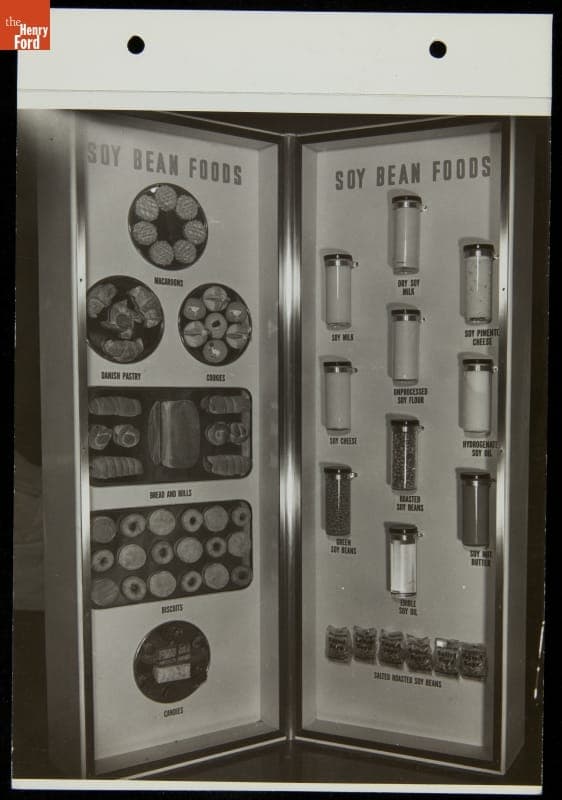
Soy Bean Foods Display, "Ford Cycle of Production," Ford Exposition, New York World's Fair, 1940
Ford Motor Company poured resources into the 1939-40 New York World's Fair, spending more than $5 million to construct and maintain its elaborate and well-attended exposition space. Ford's massive exhibition building attracted fairgoers with industrial demonstrations and informative displays. The huge, revolving "Ford Cycle of Production" - which explained how raw materials became Ford automobile parts - particularly impressed visitors.
View ArtifactTHF223249
"Recipes for Soy Bean Foods," Ford Motor Company, circa 1939
Throughout the 1930s, Henry Ford vigorously promoted soybeans as a versatile crop with industrial and culinary potential. This Ford Motor Company booklet touted soybeans as nutritious, inexpensive substitutes for traditional ingredients. It contains recipes that incorporate cooked soybeans, as well as soy-based milk, butters, and "cheese" (tofu).
View ArtifactTHF119296
Menu, "Dinner Served at Ford Exhibit, Century of Progress," August 17, 1934
Ford Motor Company's exhibition at Chicago's 1933-34 Century of Progress Exposition included the industrial barn. Here, exhibitions and demonstrations illustrated Henry Ford's belief that soybeans could unify agriculture and industry, building more profitable farms. A special dinner held on August 17, 1934, showcased the crop's wide-ranging culinary potential.
View ArtifactTHF305378
Book, "Diet for a Small Planet," 1975
Hippie lifestyles of the 1960s encouraged Americans to think vegetarian in the late 20th century. This cookbook, first published in 1971, gave tips for cooking with non-meat protein rich foods like grains, beans and peanuts rather than meat.
View Artifact

