
Political Jewelry: Beyond the Campaign Button
Share
share
Political jewelry goes beyond ordinary campaign buttons to express a fashion sensibility and make a statement. During an election, what voters pin to their lapels or place on their bodies tells people what they believe and whose side they are on. Every four years, supporters donning political jewelry make their presidential preferences known.
THF8282
George Washington Presidential Inauguration Button, "Long Live the President," 1789-1793
The first U.S. presidents produced few campaign items. Until the 1820s, candidates rarely campaigned at a grassroots level due to how presidential electors were chosen--mainly through state legislatures--and the notion that candidates should not actively seek office. Also, they viewed appealing to the masses for power as unseemly. Political items tended to be commemorative, like this clothing button honoring George Washington's inauguration.
View ArtifactTHF190383
"Harrison & Reform" Campaign Pin, 1840
During the 1840s, presidential campaign items--and political jewelry--proliferated. Voters attended rallies and parades, sang campaign songs, and bought materials adorned with slogans or images of their candidate. This "Harrison and Reform" pin contains depictions of a log cabin and a barrel of hard cider, recognizable symbols to supporters of William Henry Harrison.
View ArtifactTHF157417
William Henry Harrison Campaign Badge, 1840
Tokens were popular campaign items during mid-19th century elections. They were constant reminders of a voter's favorite candidate when carried in a pocket. But even better, if the token had a hole drilled at the top, voters could pin the token to the outside of a jacket or vest to publicly declare the wearer's political allegiance.
View ArtifactTHF8155
Presidential Campaign Medallion, "For President: Abraham Lincoln of Illinois," 1860
Some partisans even suspended tokens from colorful ribbons before pinning them to their clothes.
View ArtifactTHF189812
Taylor-Fillmore Campaign Medal, 1848
Americans relied on hand-colored lithographs and engravings for likenesses of presidential candidates in the era before the mass circulation of newspapers, magazines, and photographic prints. This small, simple medallion, which could be suspended around the neck by a ribbon or pinned to clothing, holds prints of the Whig Party candidate Zachary Taylor (front) and his running mate Millard Fillmore (back).
View ArtifactTHF101182
Abraham Lincoln and Hannibal Hamlin Campaign Button, 1860
In 1860, candidates capitalized on the latest innovation to connect with voters. Campaign badges, pins, and other wearable devices incorporated small tintypes. These photographic images were durable and relatively inexpensive to make--perfect for badges like this one that showed voters the face of their party's nominee.
View ArtifactTHF190762
Ulysses S. Grant Campaign Pin, 1868-1872
As photographic technology improved, less expensive paper photographs replaced tintypes on campaign badges and pins.
View ArtifactTHF189816
James Garfield Campaign Badge, 1880
Patriotic imagery stamped into a badge's metal shell often accompanied an image of the candidate. Republicans placed a tintype image of their 1880 presidential candidate, James Garfield, under an eagle and four American flags.
View ArtifactTHF189814
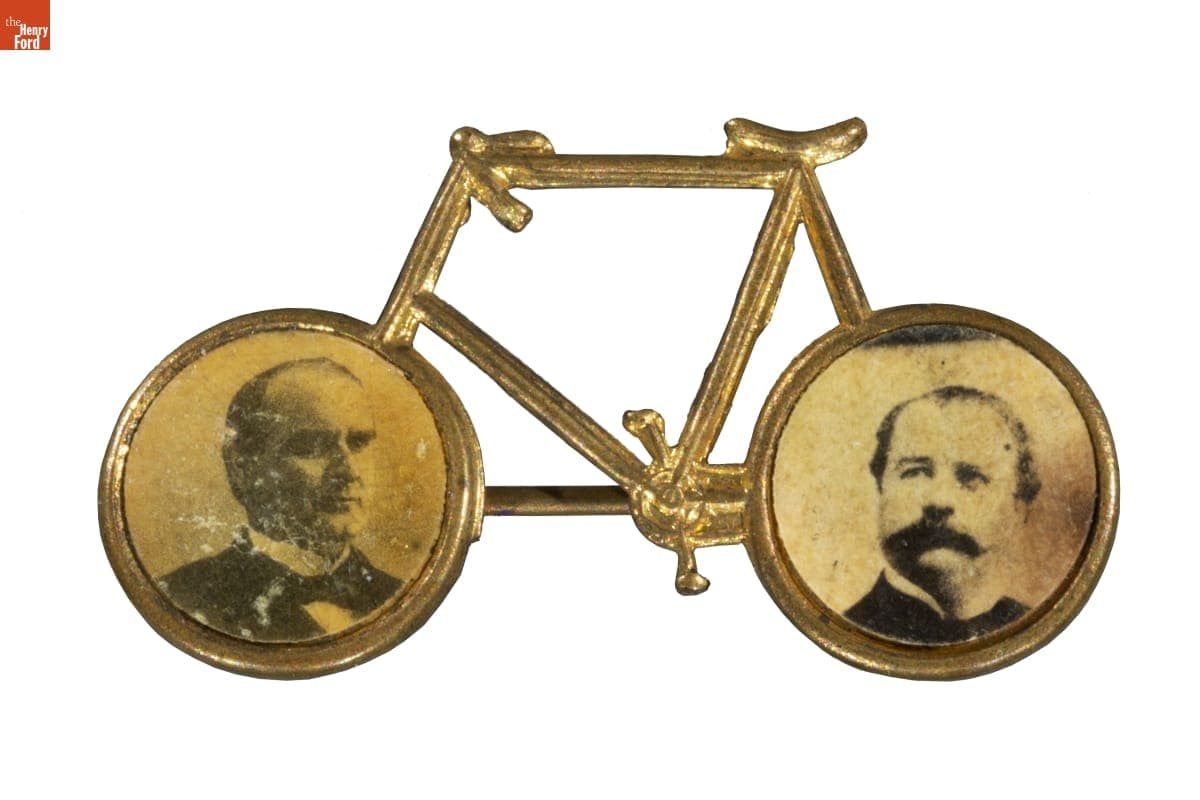
McKinley-Hobart Campaign Pin, 1896
While patriotic symbols were standard on many campaign items, some spoke more to the issues of the day. The person who wore this pin backed 1896 Republican Party candidate William McKinley and his running mate Garret Hobart. The voter may also have supported the Good Roads Movement--a favorite cause of bicyclists in the 1890s. The movement lobbied state and federal governments for funds to improve roads.
View ArtifactTHF156525
McKinley-Hobart Campaign Badge, 1896
The major political issue in the 1896 election was whether the U.S. should issue silver-backed currency. "Gold bugs"--typically Republican voters--wanted only gold-backed dollars, not an inflationary currency based on "Free Silver." The wings on this mechanical button are hidden beneath the insect's body. Pressing a spring releases images of the Republican presidential ticket, "gold bug" favorites William McKinley and Garret Hobart.
View ArtifactTHF164067
Harrison-Morton Campaign Ribbon, 1888
Political jewelry and other campaign wearables sometimes connected current candidates to past presidents. In 1888, Republicans exploited the political lineage of their candidate, Benjamin Harrison--grandson of the 9th U.S. president, William Henry Harrison. This ribbon exhibits slogans and symbols (a log cabin and barrel of cider) popular during his grandfather's successful 1840 race.
View ArtifactTHF157666
William Howard Taft Campaign Pin, 1908
This lapel pin depicts a "teddy bear"--a reference to President "Teddy" Roosevelt that most Americans recognized--embracing an image of William Howard Taft, the Republican presidential candidate in 1908. With Roosevelt still well-liked by many Americans but not running for reelection, voters wondered who he would support. Roosevelt chose Taft, and this pin reinforced Taft's connection to the popular president.
View ArtifactTHF156522
William McKinley Campaign Stickpin, 1896
Not all political jewelry was worn on the lapel. Stickpins kept ties and cravats in place. They also added a bit of flash to a man's wardrobe and disclosed the wearer's political ideology and presidential preference.
View ArtifactTHF151529
Kennedy PT-109 Tie Clasp, 1960
John F. Kennedy commanded the torpedo boat PT-109 in World War II. A Japanese destroyer rammed and sunk the vessel in 1943. Kennedy and the surviving crew swam to a deserted island before being rescued by the U.S. Navy. Campaign items depicting the PT-109 became a symbol of Kennedy's courage and perseverance. The 1960 Democratic presidential candidate and future president handed out tie clasps like this one to close friends and staff members.
View ArtifactTHF154460
Romney Tie Pin, 2012
This tie pin, with its stylized "R" in patriotic red, white, and blue colors, appealed to Republican voters in 2012. The three R's stood for the Republican Party and the alliterative last names of the party's presidential ticket (Romney/Ryan).
View ArtifactTHF189818
Roosevelt and Fairbanks Watch Fob, 1904
A decorative watch fob, dangling from a leather strap or metal chain, gave easy access to a person's pocket watch. It also became a way to express political preferences during election years. The names of the 1904 Republican Party presidential candidate Theodore Roosevelt and his running mate Charles Fairbanks are stamped into this simple metal fob.
View ArtifactTHF190767
Cleveland-Thurman Campaign Charm, 1888
Voters could attach small charms to watch chains or bracelets to show support for their candidate. This charm contains images of the 1888 Democratic Party candidate Grover Cleveland and his running mate Allen Thurman.
View ArtifactTHF157701
Dwight "Ike" Eisenhower Earring, 1952-1956
Voters also donned earrings, bracelets, and necklaces--jewelry worn on the body rather than attached to clothing--to proclaim their political preferences. In the 1950s, "Ike" earrings let others know that the wearer liked the Republican presidential candidate Dwight David "Ike" Eisenhower.
View ArtifactTHF190760
G.O.P. Lapel Pin, 1940
Some voters sported jewelry that incorporated a party's animal symbol and not the name of the party's presidential candidate. These figures became a quick way to show a person's party affiliation--no matter who ran. Democrats used a donkey, and Republicans--members of the Grand Old Party (GOP)--used an elephant. This elephant head pin made for the 1940 election signified the wearer supported the Republican Party candidate, Wendell Willkie.
View ArtifactTHF153509
Equal Rights Amendment Bracelet, circa 1972
Other enthusiastic partisans wore jewelry to show their support for specific issues rather than a political party. The person who wore this bracelet favored the passage of the Equal Rights Amendment to guarantee equal rights for all American citizens regardless of sex. Congress finally sent the amendment, first proposed soon after women won the right to vote in 1920, to the states for ratification in the 1970s.
View Artifact

