
Library of Congress
Share
share
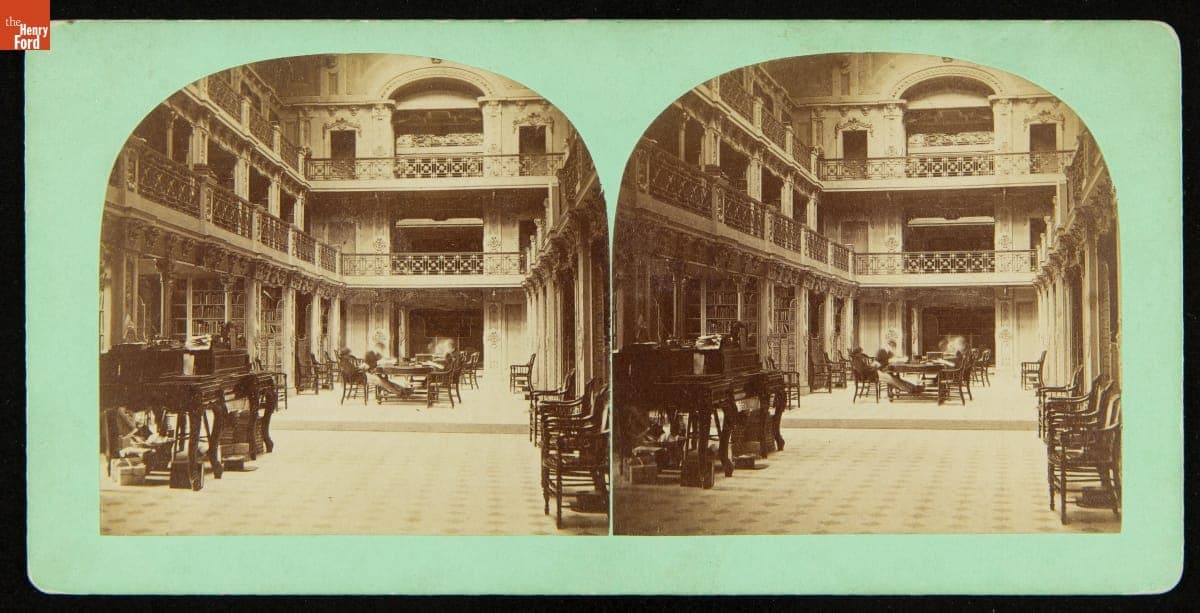
The Library of Congress initially began as a service to help members of the United States Congress make laws needed to run the country. Over the years, the Library's mission and its collections expanded. Today, the Library of Congress is one of the world's largest libraries, and it seeks to acquire knowledge from all over the world to share not only with the U.S. Congress but with all Americans.
THF733668
Lithograph, "John Adams: Second President of the United States," circa 1842
In 1800, the U.S. government moved from New York City, where legislators had access to large libraries, to the newly formed (and much smaller) city of Washington in the District of Columbia. That same year, Congress approved the purchase of books to start the Library of Congress. President John Adams approved the appropriation, and books arrived a year later. The collection of 740 volumes was stored in the U.S. Capitol--the Library's first home.
View ArtifactTHF8163
"Thomas Jefferson," 1890-1920
President Thomas Jefferson was essential to the Library's early success. Jefferson believed that legislators in a democracy required access to information and ideas to do their jobs. In 1802, he approved the first legislation regulating the new library. Under that law, Jefferson appointed the first Librarian of Congress. The law also extended access to the Library's collection to other government officials.
View ArtifactTHF705211
Monticello: The Home of Thomas Jefferson, Charlottesville, Virginia, The East Front, circa 1950
Thomas Jefferson's impact on the early years of the Library continued well after he left office. After the British burned the Capitol during the War of 1812 destroying the Library collection of three thousand books, Jefferson sold his personal library to the government to replenish the lost works. Jefferson's more than six thousand volumes doubled the size of the Library of Congress collection.
View ArtifactTHF628122
Congressional Library in the U.S. Capitol, 1862-1875
During most of the 19th century, the Library of Congress was housed in the U.S. Capitol. In 1851, disaster struck when a fire destroyed a large portion of the Library's collection. A year later, Congress approved funding for the acquisition of replacement books and the construction of a fireproof cast-iron room to house the Library. The dedicated space opened in 1853.
View ArtifactTHF628124
Stereograph, "The Congressional Library," 1880-1895
The Library of Congress was still relatively small in 1864 when President Abraham Lincoln appointed Ainsworth R. Spofford as the Librarian of Congress. Spofford envisioned the Library as a national institution. Under his leadership, the Library’s holdings steadily increased. By the end of his tenure in 1897, Spofford had made the Library of Congress the largest library in the United States.
View ArtifactTHF628046
Postcard, "Library of Congress, Washington, D.C.," circa 1916
Ainsworth Spofford also worked to secure congressional support for a separate building to house the ever-growing library collection. Congress finally authorized funds in 1886, but it would take more than ten years to complete the construction of the new building. The impressive Italian Renaissance-style structure opened in 1897.
View ArtifactTHF628094
Men Operating a Machine to Send Books from the Congressional Library to Senate and House Office Buildings, 1922
Even though the new Library was conveniently located across the street from the Capitol, members of Congress still wanted instant access to needed books and information. Planners devised a trolley system that passed through a tunnel connecting the Library with the Capitol. When members ordered a book, Library staff loaded the volume into a trolley car, which sped off to be delivered. The trolley system and tunnel are no longer in service.
View ArtifactTHF628090
Reading Room in the Library for the Blind at the Library of Congress, 1909-1922
In 1897, the Library of Congress inaugurated services for the visually impaired when it established a reading room containing about 500 books with raised characters. Services expanded when Congress directed the American Printing House for the Blind to begin depositing embossed books to the library in 1913. Congress later appropriated separate funds for books and services for blind U.S. residents in 1931.
View ArtifactTHF628082
Bookbinding Office in the Congressional Library, 1919-1920
This photograph from the early 1920s shows one of the bookbinding rooms in the Library of Congress. In these rooms--hidden on the library's lower floors--bookbinders repaired old and worn volumes. They also bound newspapers and created durable library works from books and pamphlets with flimsy paper covers. Not an easy task for one of the world's largest repositories of recorded knowledge.
View ArtifactTHF628078
Postcard, "Library of Congress and Annex, Washington, D.C.," circa 1940
Each year, the Library acquired hundreds of thousands of items. By the late 1920s, the Library of Congress was again running out of space. In 1928, Congress authorized a new annex building. The new building (seen in this postcard directly behind the original Library) opened in 1939.
View ArtifactTHF628098
Interior of the Library of Congress, 1921-1922
The Library of Congress has continued to grow since the mid-20th century. Librarians add thousands of items each day. Not only books and paper documents but recordings, photographs, films, and digital media are preserved. With all these new collections, staff size has increased, and public outreach and services have expanded. The library that began as a service only to members of Congress now serves the nation and the world.
View Artifact

