
Thinking Inside the Box: Board Games in America
Share
share
Board games have engaged Americans in friendly competition for two hundred years. Reaching their height of popularity from the late 1800s to the mid-1900s, board games remain a widespread leisure activity. Colorful graphics and a playful purpose belie their cultural significance, but a closer look reveals important shifts in American society.
Fox and Geese Game, 1870-1890
Many of the first board games Americans played, like Checkers, Parcheesi, and Lotto, had long histories within other cultures. Versions of the popular game Fox and Geese had been played for hundreds of years in Europe.
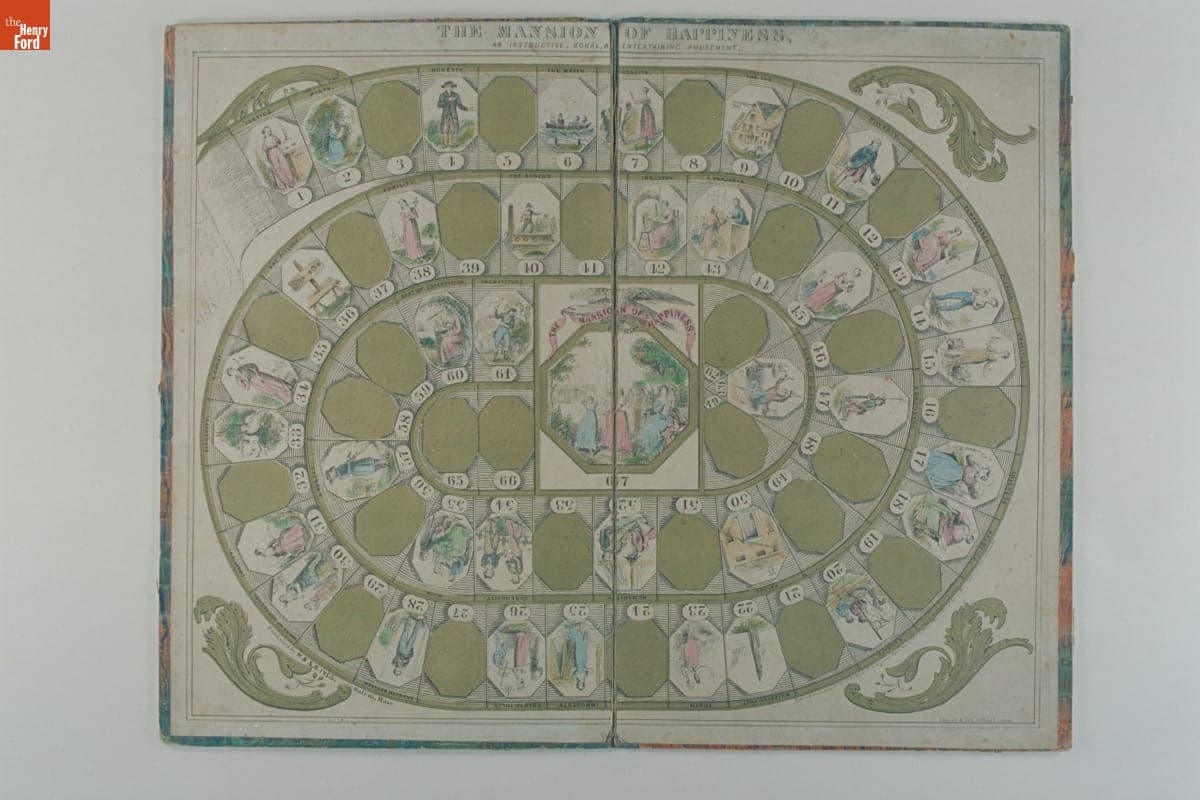
View ArtifactMansion of Happiness Gameboard, 1845-1880
One of the earliest American board games, Mansion of Happiness (1843), was derived from an English game. It was designed to teach morality and instill values like thrift, honesty, and industry. Later games reflected changing American ideals, focusing less on morals and more on materialism.
View ArtifactThe National Game of The Star Spangled Banner Gameboard, 1844-1850
Manufacturers increasingly introduced distinctly American games during the last half of the 19th century. Titles like the National Game of the Star Spangled Banner expressed Americans' national identity.
View ArtifactAmerican Heritage Game of the Civil War, 1961
Since the Civil War, games based on military conflicts have been perennially popular in the United States. This game was produced for the 100th anniversary of the start of the Civil War. It included an educational booklet outlining the history of the conflict.
View ArtifactThe Game of Politics: Race for the Presidency Board Game, 1887-1890
Games that taught political concepts or encouraged civic engagement reflected a belief that well-educated children would ensure the future of American democracy. Games of this type also reflected growing efforts to Americanize immigrants, who arrived in increasing numbers around the turn of the century. Sometimes subtly, other times overtly, many early board games expressed the prejudices prevalent among the people with the means to play them.
View ArtifactHumpty Dumpty Game, 1885-1895
Most titles produced around the turn of the 19th century were games of chance that required little skill to play. Manufacturers marketed these games to middle- and upper-class families, who had the time and money for such pursuits. Many games designed to entertain and educate young children featured familiar characters from fairy tales or nursery rhymes.
View ArtifactFish Pond Game, 1890-1900
Dexterity games encouraged the development of manual skills. Versions of Fish Pond, introduced around 1880, remained popular for decades. The concept of catching and removing pieces from the board is still the basis of some modern games.
View ArtifactToboggan Slide Game, 1890-1900
Other popular games reflected Americans' persistent fascination with sports and leisure activities. Most early titles of this type were "race" or "track" games in which players vied to reach a designated space first. In this simple version, Toboggan Slide, players raced to the bottom of a snow-covered hill.
View ArtifactVoyage Around the World Game, 1900-1930
At the start of the 20th century, many board games celebrated industrialization, technological innovations, and economic growth. Some reflected new and expanding transportation networks and opportunities for travel. These games allowed players to vicariously explore the increasingly connected world.
View ArtifactThe Flight to Paris Game, 1927-1930
Board games often reflected emerging technologies and current events, as evidenced by the radio- and aviation-themed games that gained popularity in the 1920s. The Flight to Paris Game capitalized on Americans' obsession with Charles Lindbergh's 1927 flight across the Atlantic Ocean.
View ArtifactEddie Cantor's "Tell it to the Judge" Game, circa 1936
As in other times of crisis, Americans turned to board games as a source of inexpensive entertainment and comfort during the Great Depression. The 1930s saw a revival of old games, especially Backgammon, and the introduction of new games--most notably, Monopoly (1935). This game, Tell it to the Judge, had little to do with comedian and radio personality Eddie Cantor, but its manufacturer counted on his celebrity endorsement to boost sales.
View ArtifactCandy Land Gameboard, 1950-1960
The board game industry recovered slowly after World War II as Americans funneled postwar resources into other pursuits. But some new titles, including Clue and Scrabble, found a ready market. Candy Land, a game created for young children who were not yet able to read, was first published in 1949. It became one of the best-selling and most beloved board games of all time.
View ArtifactAnnie Oakley Game, 1955-1965
The widespread popularity of television presented new promotional opportunities after World War II. Board game manufacturers advertised to TV audiences and published television-related games that capitalized on their interests. Games like this one based on the Annie Oakley Show appealed to fans.
View Artifact"Park and Shop" Board Game, 1960
Board games sometimes reflected infrastructural changes related to population shifts. The 1960 game Park and Shop centered around a suburban shopping center. Instead of downtown stores, Americans who had moved away from cities in the years following World War II increasingly frequented these developments that catered to a new suburban lifestyle.
View ArtifactThe Ungame Game, 1975
Not all board games are competitive. A woman who had struggled with vocal issues developed The Ungame in the 1970s to improve communication within her family. With no winners or losers, The Ungame encouraged listening and self-expression. It became a best-seller, popular among families and friends as well as teachers and mental health professionals.
View ArtifactTravel Edition Scrabble, 1987-1989
In addition to introducing new titles, manufacturers regularly updated existing board games to appeal to consumers' changing lifestyles. This miniaturized, portable edition of the popular game Scrabble was designed to be taken along and played on the road.
View ArtifactThe Settlers of Catan Board Game, circa 1996
By the 1990s, board games had become more than a family pastime. The German game The Settlers of Catan was introduced in the United States to high acclaim in 1996. With quick play, clear rules, and an ever-changing experience, it became a gateway for many players to a more complex style of board game. Conventions, clubs, and online play helped preserve and expand board games’ appeal into the 21st century.
View ArtifactChess and Checkers Set, 2003
To continue attracting customers, board game manufacturers constantly introduce updates. Packaging designs, place names and characters, and even the look of game pieces and boards have changed to reflect contemporary tastes and trends. Regardless of their looks, classic board games -- from the ancient to the relatively new -- may never go out of style.
View Artifact

