
Bandboxes
Share
share
In the early 1800s, bandboxes stored clothing, hats, accessories, and other small items for a growing number of American travelers. Box makers covered their products with swatches of colorful wallpaper or papers with vivid images and scenes specifically made to decorate the outside of the box. Bandboxes were affordable and expressed the traveler's taste. Today, we appreciate them as markers of travel, style, and the lives of early Americans.
THF162113
Bandbox, 1818
In the early 17th century, men and women placed their lace neckbands, or collars, into containers called bandboxes. By the early 19th century, bandboxes held more than neckbands; they became handy storage receptacles for clothing and personal items. Bandboxes reached the height of their popularity during this period.
View ArtifactTHF160928
Bandbox, 1846
Bandboxes were made of thin slices of wood or stiff pasteboard formed into various shapes and fitted with a bottom and lid. Bandbox makers often lined the interior with newspapers and then covered the exterior with scraps of wallpaper or printed papers made especially for these boxes.
View ArtifactTHF160954
Bandbox, circa 1835
By the early 1800s, a growing middle class had time and money to travel. Expanding modes of transportation--steamboats, canal boats, and railroads--provided opportunities to visit relatives who had moved away or to take short holidays to see cities, shrines, or countryside. Affordable bandboxes stored needed items for these excursions.
View ArtifactTHF160986
Bandbox, Made by Hannah Davis, 1832
Young, unmarried, working-class women in the Northeast also found bandboxes handy. Many of these women had left family farms to work at textile mills in nearby communities. Bandboxes became a convenient storage case in the meager accommodations provided by factory owners. Bandboxes also served as lightweight luggage when the millworkers traveled back home.
View ArtifactTHF162172
Bandbox, Made by Hannah Davis, circa 1831
Hannah Davis (1784-1863), a Jaffrey, New Hampshire, entrepreneur, created colorful, wallpaper-covered bandboxes and sold them to young migrant women and others. Davis's attractive and affordable bandboxes were ideal for millworkers.
View ArtifactTHF190589
Bandbox, 1820-1840
Bandboxes came in various sizes and shapes. This round three-inch diameter bandbox probably held small personal items. Someone wrote "Shaffers Money" on the inside of the lid.
View ArtifactTHF163301
Bandbox, 1810-1830
Some boxes stored specific items. This decorative bandbox with a large snowflake-like design held a man’s hat typical of the period.
View ArtifactTHF163100
Bandbox, circa 1830
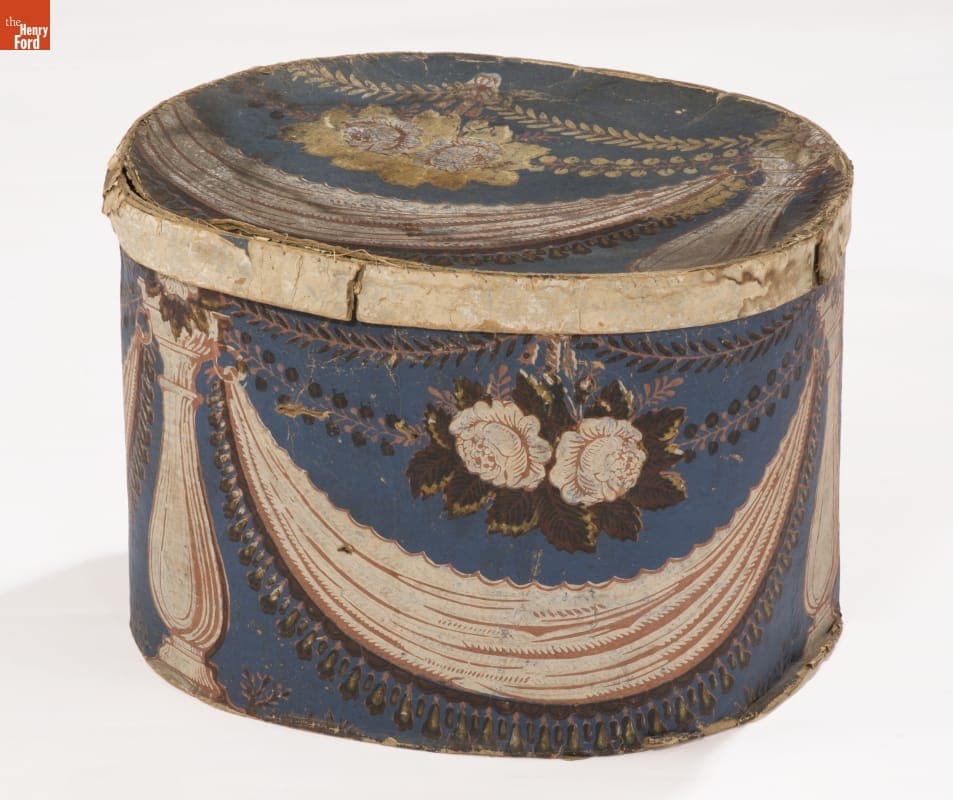
Bandbox makers covered the outside of these boxes with scraps of patterned wallpaper or papers with specially printed designs or memorable images. Swags and balusters were motifs familiar to Americans in the early 1800s--neoclassical symbols representing the country as an idealized new republic.
View ArtifactTHF160968
Bandbox, 1830-1840
Some bandboxes display recognizable buildings or places--perhaps a future, dreamed-of destination or a place visited by the bandbox's owners during one of their travels. The paper on this box depicts New York City's Castle Garden--the site of an early-1800s fort turned into an opera house and entertainment center for city residents.
View ArtifactTHF160980
Bandbox, circa 1835
Early 19th-century events, like a parade of city firefighters, appear on some bandboxes.
View ArtifactTHF160963
Bandbox, circa 1835
Bandboxes sometimes commemorate historic events. This scene depicts the celebrated flight of Richard Clayton in 1835. Clayton traveled more than 350 miles in a hydrogen-filled balloon (a record at the time), starting from Cincinnati, Ohio, and landing in what is now West Virginia.
View ArtifactTHF160921
Bandbox, Made by Hannah Davis, circa 1840
Some designs depict animals, birds, or other creatures. Hannah Davis covered this bandbox with a paper showing a couple of endearing squirrels.
View Artifact

