
A Selection of Hallmark Ornaments: Toys
Share
share
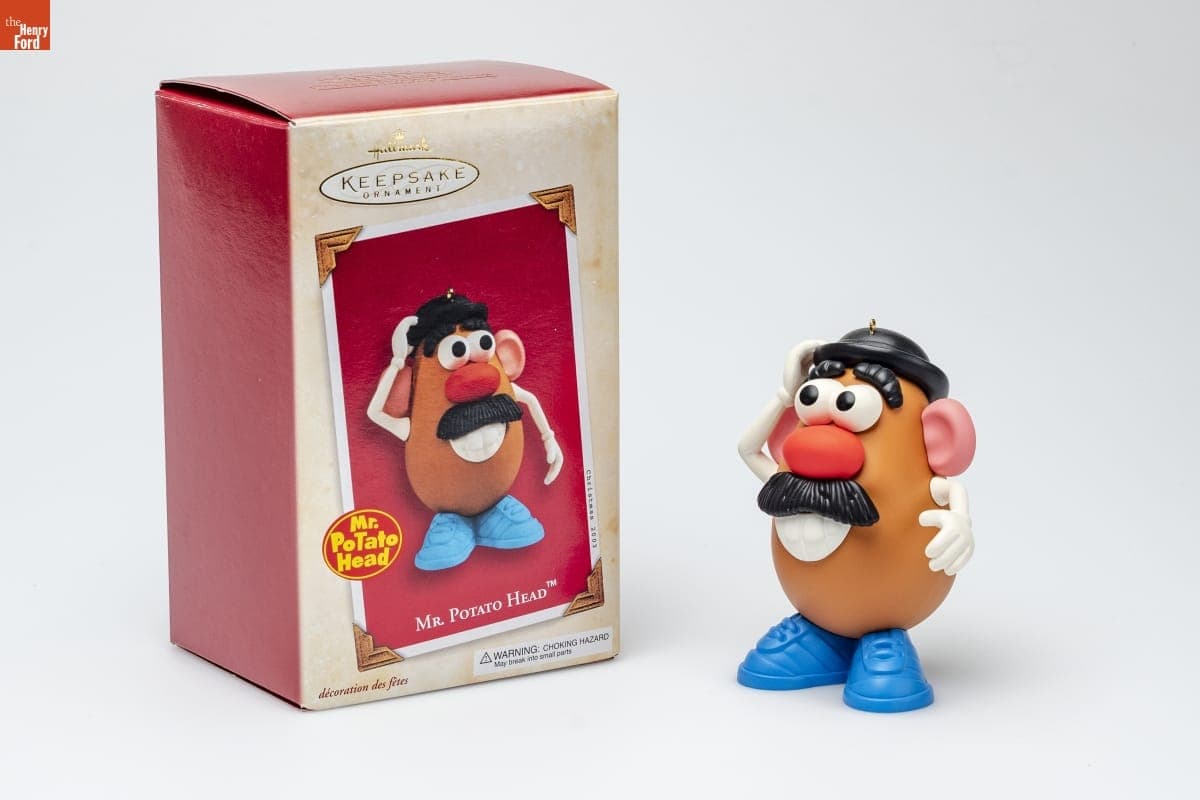
People enjoy purchasing Hallmark ornaments depicting the toys and games they played with as kids--and then hanging them on the Christmas tree year after year. These "miniature" versions have enduring emotional appeal, as they bring back memories of childhood.
Hallmark "Mr. Potato Head" Christmas Ornament, 2003
In 1952, Mr. Potato Head encouraged kids to play with food. The toy came with a variety of sharp-pronged plastic facial features and accessories--eyes, ears, noses, mouths, and hats that kids could stick into a real potato and arrange in endless variations. Kids were introduced to this new toy through TV--the first toy ever advertised on television. Since 1964, the toy has come with a plastic potato--a more sanitary and less wasteful choice.
View ArtifactHallmark "Disney's Mickey & Co.: The Mickey and Minnie Handcar" Christmas Ornament, 1998
Walt Disney Studios partnered with toy train maker Lionel Corporation in 1934 to create the Mickey and Minnie handcar. The key-wound toy traveled around a track with Mickey and Minnie merrily pumping the handcar, delighting children of all ages.
View ArtifactHallmark "See 'n Say" Christmas Ornament, 2007
Very young children are delighted by animals and by learning what sounds those animals make. Mattel's educational The Farmer Says See 'n Say took kids "down on the farm" to hear 12 farm animals "speak." It was the first talking toy that let kids choose the phrase to be heard rather than listening to one spoken at random. If the child pointed the farmer to the sheep and pulled the cord, the child heard baa.
View ArtifactHallmark "Rocking Horse Series" Christmas Ornament, 1981
Rocking horses are timeless playthings, providing the illusion of motion that sends a child galloping off into imaginative worlds on the back of a pretend horse.
View ArtifactHallmark "Tonka Mighty Dump Truck" Christmas Ornament, 1996
Tonka Toys began creating functional, realistic, and durable toy trucks and construction-related vehicles after World War II. Originally made from pressed steel with real rubber tires, children loved playing with these trucks that looked and acted like miniature versions of the real thing.
View ArtifactHallmark "Teen Age Fashion Model Barbie" Christmas Ornament, 2009
Introduced in 1959, the Barbie doll was a fashion model doll with a fabulous wardrobe of eye-catching fashions. With her own beautifully furnished home and a sports car, Barbie's lifestyle was far from that of the little girls who played with her, giving her owners the opportunity to imagine a hoped-for future of teenage freedom.
View ArtifactHallmark "View-Master" Christmas Ornament, 2008
View-Master, with its circular slide reels, thrilled children (and adults) with the wonders of 3-D images when it was first introduced at the 1939 New York World's Fair. This educational toy took generations of children on adventures around the world, teaching them about new and far-off places long before the internet.
View ArtifactHallmark "Monopoly Game: Mr. Monopoly" Christmas Ornament, 2000
Board games have enduring appeal for both kids and adults--whether played around the dining room table or on a dorm room floor, they are an especially great choice for cold or rainy days. Monopoly, which debuted in 1934, remains among the best-selling board games of all time. Players win by buying and developing real estate--allowing participants to "dabble" in real life situations as they vie for the most lucrative properties.
View ArtifactHallmark "G.I. Joe" Christmas Ornament, 2005
When Hasbro introduced the action figure G.I. Joe in 1964, it soon became a hit. Children could adjust G.I Joe into various poses--it has multiple moveable joints. Hasbro also created a variety of clothing, weapons, and accessories for the plastic soldier, allowing children to engage in all sorts of creative, action-oriented play. Action figures continue to spark the imaginations of boys, girls, and even adults.
View ArtifactHallmark "Matchbox Miniatures 50th Anniversary: 29-C Fire Pumper" Christmas Ornaments, 2002
A toy that could fit into a matchbox was the inspiration for Lesney Products' Matchbox vehicles. The English company's small, detailed, and affordable diecast vehicles were a hit in early-1950s England. Soon after, American kids, too, enjoyed an array of miniature realistic vehicles, easy for children to hold and take from one place to another.
View ArtifactHallmark "Chatty Cathy" Christmas Ornament, 2007
Chatty Cathy did something that no other doll could do in 1960--she "spoke" eleven phrases. With a pull string mechanism connected to a simple phonograph record inside, Chatty Cathy was the first successful talking doll. Though Chatty Cathy's randomly spoken phrases were limited, girls were delighted to have a more "realistic" doll who could talk!
View ArtifactHallmark "LEGO Fireplace with Santa" Christmas Ornament, 1995
Lego's simple, interlocking bricks have become a toy classic since they were first introduced in the mid-1900s. The colorful plastic bricks are easy to hold and put together. Pre-packaged sets let children build specific designs. But left alone, kids can create whatever they want, bringing their imaginations to life.
View ArtifactHallmark "Etch A Sketch" Christmas Ornament, 1994
The novel Etch A Sketch magic slate appeared on kids' wish lists beginning in 1960. By turning two white knobs at the bottom of the magnetic screen, a child could draw horizontal and vertical lines to "sketch." Curved lines were more challenging, mastered by more patient young "artists." Kids were mesmerized as gray lines magically appeared on the screen at their bidding. To erase the image? Just shake the Etch A Sketch back and forth.
View ArtifactHallmark "Rock 'Em Sock 'Em Robots" Christmas Ornament, 2007
Red and blue fists fly as two boxing robots battle it out inside a ring. Players mechanically manipulate their robots, trying to land a punch to "knock his block off" (make the opponent robot's head pop up). The game was simple--played without the aid of computers, batteries, or electricity.
View ArtifactHallmark "Jack-in-the-Box Memories Series: Pop! Goes the Teddy Bear" Christmas Ornament, 2006
A turn of the crank, a music box melody, and then--surprise, out jumps Jack! Jack-in-the-box toys have been delighting children as they wait in anticipation. And it never seems to get old--Let's do it again!
View ArtifactHallmark "Hot Wheels: Sooper Loop" Christmas Ornament, 2006
Excitement rules as fast little cars zoom down Mattel Hot Wheels' flexible, orange track. The cars feature a custom-car or fantasy look--unlike the more realistic diecast vehicles produced by other companies. And they were built for speed with low-friction "racing" wheels. Kids loved them, especially when sending the cars through a loop--a now famous symbol of the iconic brand.
View ArtifactHallmark "Player 1" Christmas Ornament, 2007
A video game controller puts power in the player's hands. Whether it is a simple joystick or the latest wireless pad with various directional and power buttons and ergonomic rounded grips, controllers let young and old play games to battle the forces of evil, overcome obstacles to find treasure, or outpace other race car drivers.
View ArtifactHallmark "Noah's Ark" Christmas Ornament, 2004
In the late 1800s, children in homes where Sunday was strictly observed might have a Noah's Ark--a toy sufficiently related to the Bible to be appropriate for play on an otherwise restricted day. Kids enjoyed pairing up animals from the familiar to the exotic, then moving them into the "safety" of the ark. Children likely appreciated having such a plaything on long, quiet Sunday afternoons.
View ArtifactHallmark "An American Girl: Josefina 1824" Christmas Ornaments, 2004
American Girl dolls let girls "time travel" through character dolls from different regions and time periods. Each doll is accompanied by historically accurate books that teach girls about that doll's era and culture. Introduced in 1997, Josephina Montoya immerses her owner in Mexican culture in southwest America. Josephina lives on a rancho (ranch settlement) in 1824 New Mexico, when the territory was under Mexican rule.
View ArtifactHallmark "Power Rangers Ninja Storm: Red Power Ranger" Christmas Ornament, 2003
The Power Rangers, a live-action superhero television series, provided hours of entertainment for American kids when it debuted in the early 1990s. Action figures released at the same time allowed boys and girls to connect with the youthful, color-coded heroes. Subsequent series and movies introduced new characters, reaching new generations of children wanting to save the world.
View ArtifactHallmark "LIONEL Train Series: 746 Norfolk and Western Steam Locomotive" Christmas Ornament, 1999
Lionel Corporation's imaginative electric trains, together with accessories like stations, bridges, tunnels, and towers, encouraged children to build entire miniature worlds. Lionel's popularity peaked in the 1950s before toy trains, like real railroads, fell out of favor.
View ArtifactHallmark "Adorable Adornments: Raggedy Ann" Christmas Ornament, 1975
Johnny Gruelle, a cartoonist and illustrator, created Raggedy Ann in 1915 when, according to family lore, he drew the now iconic features on a faceless rag doll his daughter Marcella brought down from their attic. The cloth doll's popularity started to soar in 1918 after Gruelle's first Raggedy Ann book was published. The huggable--and timeless--Raggedy Ann and her brother Andy are among the most enduring and beloved American dolls.
View ArtifactHallmark "School Bus" Christmas Ornament, 2009
Fisher Price's playsets encouraged toddlers and preschoolers to explore the world beyond their homes. In 1959, the company produced its first school bus with removeable passengers. Small children could "escort" students onto the bus and then see them safely to "school"--practicing for the time they themselves reach school age.
View Artifact

