
Sheep
Share
share
Sheep supply two items essential for human survival, wool for clothing and meat for food. This makes them a farm asset, but protecting sheep requires vigilance. Sheep are social animals with an instinct to move together as a flock. Shepherds use dogs to help protect their flock and herd animals from pens to pasture and back. The close bond conjures visions of a bucolic rural past, emphasizing human-animal relationships.
THF145516
"Shepherd and Flock of Sheep," circa 1880
Artists depicted rural settings in which sheep, shepherds and dogs interacted. Shepherds ensured that sheep had enough to eat by moving them to greener pastures. Dogs aided in this effort, protecting the flock from predators along the way. The combination protected the farmer’s investment in sheep, and the wool and meat that the flock produced.
View ArtifactTHF119074
"Sheep Herding in the West," circa 1905
Flocks size depended on available grassland. Open spaces in the American west encouraged big flocks. Shepherds remained integral to sheep care, but horses became the favored mode of conveyance. On horseback, shepherds had a wider view of their larger flocks.
View ArtifactTHF623050
"Rover" the Dog outside Cotswold Barn in the Snow, Greenfield Village, January 1931
These sheep came from the Cotswold region in England to add context to the cottage and barn that Henry Ford acquired and reconstructed in Greenfield Village. This photograph shows "Rover," the Newfoundland dog that guarded the sheep.
View ArtifactTHF134679
Cat Riding a Sheep at Cotswold Cottage in Greenfield Village, 1932
This photograph shows a patient sheep with a relaxed cat on its back. The sheep's long-staple wool and broad back make it the perfect resting place for the cat. Both animals seem content.
View ArtifactTHF701198
Checker Station Wagon, April 1964
Sheep in a station wagon?! Why is that? Someone may have staged this shot as part of a silly stunt at a local fair. Why do the sheep stay in the station wagon? Sheep have the natural instinct to follow one another and be part of a flock. Perhaps that’s why they seem in no hurry to leave the car, but when one decided to exit, the rest would follow!
View ArtifactTHF119103
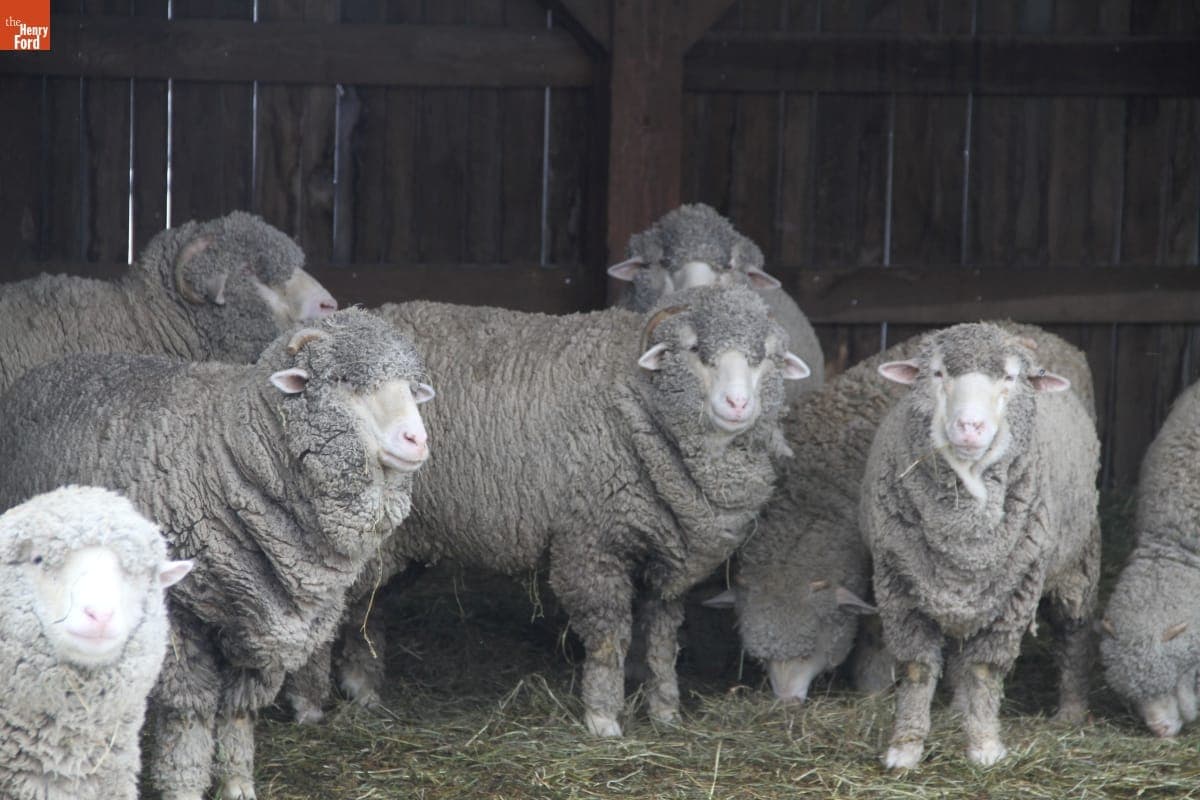
Merino Sheep Ready for Shearing at Firestone Farm in Greenfield Village, April 2014
The Firestone family raised Merino sheep, and Merino sheep have been part of Firestone Farm in Greenfield Village since the site opened in 1985. Merinos yield high-quality ultra-fine wool. These sheep have the added value of wrinkles that increase their skin surface and thus the amount of wool per sheep. Farmers shear sheep each spring, and the wool regrows, ready for the next year’s harvest.
View ArtifactTHF97283
Sheep Figurine, 1845
This realistic statue features a mother sheep (ewe) and its baby (lamb). It conveys the close relationship that existed between a mother and the instinct to feed its young.
View ArtifactTHF306002
Toy Lamb, 1875-1905
This toy lamb was a favorite among children who might not live on a farm. They could get a closer look and more realistic sense of the farm animal by engaging with the toy.
View ArtifactTHF33483
Sheep Bank, 1900-1930
This Sheep Bank was a creative method of teaching children how to save money. It could help make saving money, an essential money management skill, enjoyable.
View ArtifactTHF359251
Hallmark "Roly-Poly Ram" Miniature Christmas Ornament, 1989
This whimsical ornament depicts a sheep -- a "roly-poly ram" to be precise! It could add a sense of playfulness to family holidays and special occasions.
View ArtifactTHF359038
Hallmark "Joyful Lamb" Easter Ornament, 1994
This ornament honors the lamb as a symbol of spring and fresh starts. Lambs represent the start of the cycle of life and renewal in the natural world.
View ArtifactTHF184669
Hallmark "Playful Shepherd" Christmas Ornament, 1997
This ornament features a shepherd riding a sheep -- playful so long as the sheep cooperated. This sheep appears happy. And the combination offers a different interpretation to a holiday season associated with shepherds watching their flocks by night in anticipation of the arrival of the Christ child.
View Artifact

