
America's Canal Era
Share
share
In the early 19th century, Americans looked to canals for transportation. Artificial waterways carried people and goods over long distances with minimal power, extending water-borne commerce from seaports to inland communities. But canals were expensive to build and maintain, and floods, droughts and freezing weather interfered with operations. Railroads offered a better alternative and brought an end to America's canal era.
"Calne, from the Canal" (Small English Canal Lock depicted 1835-1840), Steel Engraving
The Netherlands, France and Great Britain built significant canals by the late 18th century. Britain in particular had a growing network that extended from London more than 300 miles north to Scotland. European techniques, technologies and engineers all made their way to the United States where, after the Revolution, politicians and merchants were eager to connect the new nation.
View ArtifactPortrait of George Washington, 1800-1820
George Washington was an early and enthusiastic canal advocate. He supported canal projects along Maryland's Potomac River and Virginia's James River, and he inspected additional waterway improvements in New York and Pennsylvania. Several of Washington's contemporaries, including Thomas Jefferson and James Madison, supported federal funding of canals across the country.
View ArtifactMap, "Falls of Ohio," 1812
Initial canal proposals were modest in length. In the early 1800s, promoters at Louisville in modern-day Kentucky suggested several plans for a short canal bypassing nearby rapids on the Ohio River. Funding and construction challenges delayed completion until 1833, but the canal remains in operation today, having been expanded multiple times to accommodate larger watercraft.
View ArtifactMap of "New York and Adjacent Country," 1826
No project was grander than the Erie Canal connecting New York Harbor with the Great Lakes. Geography supported the idea. The Hudson River provided a natural path from New York City to Albany, and its tributary Mohawk River pointed west through a natural break in the Appalachian Mountains -- the only such break between Maine and Georgia.
View Artifact"Ball Badge, Canal Celebration, Meeting of the Waters," 1825
Even so, construction was beyond the means of private capital. DeWitt Clinton, depicted here, served multiple terms as mayor of New York City and governor of New York State. He understood the Erie Canal's potential and became its greatest champion, convincing New York's legislature to fund the start of construction in 1817. Critics called the canal "Clinton's Ditch."
View ArtifactEntrance of the Erie Canal into the Hudson River at Albany, New York, circa 1827
The Erie Canal's route formally began at Albany, 150 miles north of New York City. It followed the Hudson River north to the Mohawk River and then turned west. Construction was managed in three divisions. The eastern division stretched from Albany to Rome, the middle division from Rome to Montezuma, and the western division from Montezuma to Buffalo.
View ArtifactEngraving, "Travelling on the Erie Canal," 1826
Actual construction started near Rome, New York, about 110 miles west of Albany. It was a calculated decision. There were no serious challenges through the easy landscape there, and officials realized that starting work in the middle division would speed progress and encourage further financial and political support for the more difficult eastern and western divisions.
View ArtifactCanal Boats at Buffalo, New York, circa 1900
There had been talk of building the canal to Lake Ontario, but that meant competing with Montreal on the St. Lawrence River. Buffalo, at the eastern end of Lake Erie, was closer to markets in Ohio, Indiana, Illinois, and Michigan Territory. New York legislators also realized that a Buffalo routing would encourage development in the western portion of the state.
View Artifact"Lockport from Prospect Hill," 1825
The finished Erie Canal was 363 miles long, with 83 locks to take it 571 feet above sea level by the time it reached Buffalo. Most impressive were the five stairstep locks that lifted the canal up the Niagara Escarpment ridge at Lockport. Eighteen aqueducts carried the canal across rivers and ravines along its path.
View ArtifactErie Canal Completion Medal, 1826 - 1
Lavish ceremonies marked the canal's completion in 1825. DeWitt Clinton and other dignitaries left Buffalo on October 26, floating east and making speeches en route. They carried Lake Erie water that, upon arrival in New York City on November 4, was poured into the Atlantic Ocean. Officials then shipped ocean water back to Buffalo to be poured into Lake Erie.
View Artifact"Western End of the Great Erie Canal, " 1828-1830
The Erie Canal reduced the cost of shipping goods between Albany and Buffalo tenfold, and it cut travel time by more than half. Grain and forest products moved east over the waterway, while manufactured goods and eager settlers headed west. Within ten years, user tolls paid back the canal's $7 million construction cost. The Erie Canal succeeded beyond all expectations.
View ArtifactMap of Canals and Railroads in Pennsylvania, circa 1837 - 1
Inspired by New York's success, Pennsylvania devised an elaborate but ultimately failed system to link Philadelphia with Pittsburgh. It included 273 miles of canals and 118 miles of railroads. The most difficult segment was the 36-mile Allegheny Portage Railroad, where cargo was moved from boats onto railcars and pulled over the Allegheny Mountains on a series of ten inclined planes.
View ArtifactWood Engraving, "Head of the Pennsylvania Canal at Easton," circa 1840
More successful was Pennsylvania's Delaware Canal, which ran alongside its namesake Delaware River from Easton to Bristol. The 60-mile waterway opened in 1832 to carry anthracite from northeastern Pennsylvania's coal region south to Philadelphia. Grain, flour, lumber, limestone, and iron moved over the canal too. The Delaware Canal was the most profitable waterway in Pennsylvania's system, operating into the 1930s.
View ArtifactWood Engraving, "Canal Locks at Manayunk-from a Drawing by Breton," circa 1835
Engineers in Pennsylvania opened a series of canals along the Schuylkill River in 1825. The 108-mile Schuylkill Canal system included 46 miles of slackwater navigation. Rather than cutting canals around rapids, dams were built to calm the waters, allowing boats to travel across large slackwater pools, in the river itself, between locks. The Schuylkill Canal closed in 1931.
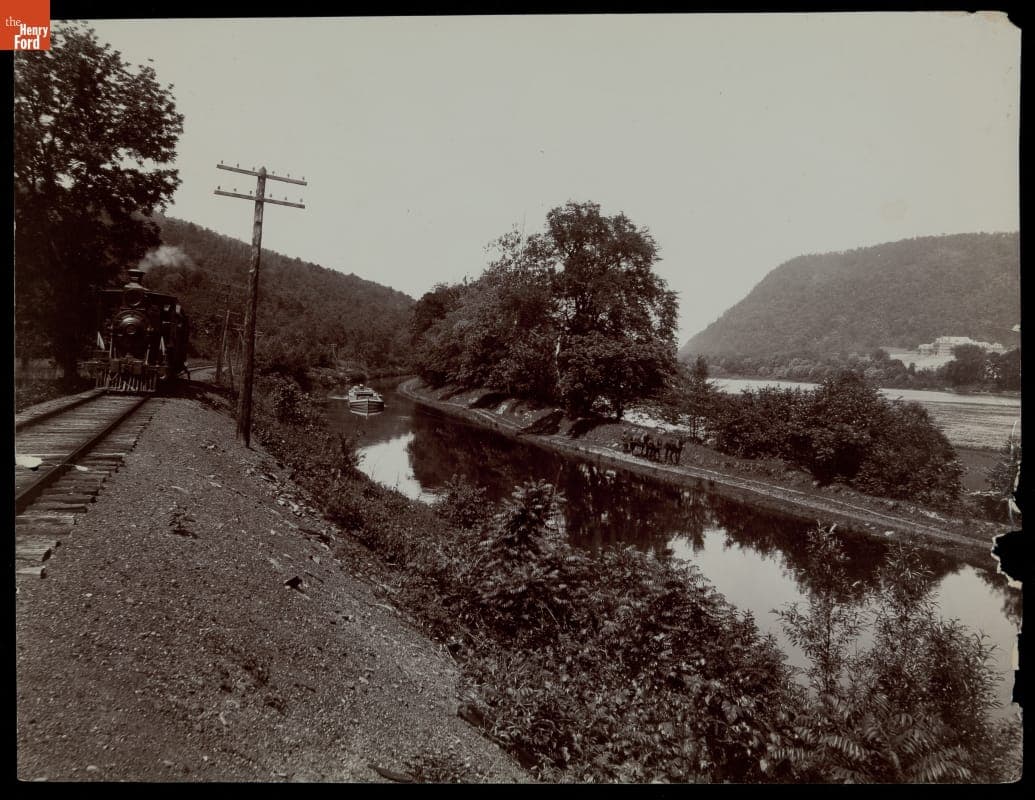
View ArtifactThe Susquehanna River and Canal near Shickshinny, Pennsylvania, 1885-1901
The Susquehanna River, flowing from New York through Pennsylvania and Maryland to the Chesapeake Bay, provided an obvious canal route. Pennsylvania's statewide canal system included locks and channels along the Susquehanna's main stem, and on its North and West branches. Coal and agricultural products represented most of the cargo shipped over these waterways.
View ArtifactMorris and Essex Canal, Waterloo, New Jersey, 1890-1901
New Jersey's Morris Canal connected Easton, Pennsylvania, with New York Harbor via terminals in Newark and Jersey City. Opened in 1829, the canal used inclined planes and locks to overcome 900 feet of elevation change along its 107-mile route. The canal primarily carried anthracite from northeastern Pennsylvania's coal region to New York City. The Morris Canal closed in 1924.
View ArtifactThe Lower Locks, Chesapeake and Ohio Canal, Washington D.C., 1910-1920
On July 4, 1828, President John Quincy Adams broke ground on the Chesapeake & Ohio Canal in Georgetown near Washington, D.C. Rooted in George Washington's earlier Potomac River improvements, the C&O was intended to follow the river to Cumberland, Maryland, before turning north toward Pittsburgh and the Ohio River. The route required carrying the canal over the Allegheny Mountains.
View ArtifactView of Harpers Ferry, Va., circa 1860
On that same 1828 Independence Day, officials in Baltimore broke ground on the Baltimore & Ohio Railroad, a rival project intended to connect Baltimore's harbor with the Ohio River. The railroad and the C&O Canal both followed the Potomac River, fighting for space in the narrows below Harpers Ferry, Virginia. The B&O reached the Ohio at Wheeling, Virginia, in 1853.
View ArtifactPotomac River at Williamsport, Maryland, 1900-1906
In 1850, the C&O Canal arrived at Cumberland, Maryland, some 185 miles from Washington. Construction never continued farther west due to rugged topography, strained finances, and railroad competition. Still, the canal found a steady business carrying coal downriver. It closed in 1924, but its towpath and remaining structures became a National Historical Park in 1971.
View Artifact"Profiles of the Erie, Ohio and Chesapeake & Ohio Canals and the Baltimore & Ohio Railroad," circa 1832
This profile map illustrates the Chesapeake & Ohio Canal's difficulties. While the Erie Canal had an easy climb to 571 feet in 351 miles, the C&O ascended 605 feet in 185 miles. Had it continued to the Ohio River at Pittsburgh, the C&O would have crossed the Allegheny Mountains through a tunnel some 1,800 feet above its starting elevation in Washington.
View ArtifactPacket Boat on the Miami Canal, Print, circa 1838
The 274-mile-long Miami & Erie Canal connected the Ohio River, via the Miami River near Cincinnati, with Lake Erie at Toledo. Completed in 1845 at a cost of $8 million, the Miami & Erie featured 103 locks and several feeder canals along its route. Never particularly successful, the waterway was abandoned after heavy damage in the Great Dayton Flood of 1913.
View ArtifactOld Canal Boats at Lockport, Illinois, 1900-1906
Illinois joined Ohio and Indiana among midwestern states with significant canals. The 96-mile Illinois & Michigan Canal, opened in 1848, connected the Great Lakes with the Mississippi River by way of the Chicago and Illinois Rivers. The canal's headquarters were in Lockport, Illinois, about 30 miles southwest of Chicago. The I&M Canal was replaced by the larger Illinois Waterway in 1933.
View Artifact"Process of Excavation, Lockport," 1825
The people who built canals worked by hand, with little more than animal power and blasting powder to help. In the north, American-born laborers toiled alongside newly arrived immigrants, while southern crews included enslaved people as well. Conditions were difficult, wages were low, and diseases like cholera and malaria were widespread. Strikes for better pay and treatment were broken with violence.
View ArtifactLithograph, "Deep Cutting," Lockport, New York, 1825
Construction involved skilled workers and craftspeople too. Surveyors and engineers plotted a canal's route. Contractors managed the building of individual sections. Stonecutters and masons created linings and walls for canal locks, cuts, aqueducts, and culverts. Blacksmiths made hardware for lock gates and machinery. Workers often moved from one canal project to the next, sharing and spreading their knowledge.
View ArtifactMorris and Essex Canal near Hopatcong, New Jersey, circa 1900
The canal's clay-lined bed, or prism, was wider at top than at bottom. The Erie Canal measured 40 feet wide on its surface and 28 feet at bottom, with water 4 feet deep. The Chesapeake & Ohio Canal measured 60 feet at top and 48 feet at bottom, with a depth of 6 feet -- the largest prism of its time.
View ArtifactCanal Boat Crossing a River Using a Viaduct, circa 1830
Canal boats were towed by a team of horses or mules. Each team worked about six hours. Tired animals could be traded for fresh ones at stables along the way. Sometimes a spare team was carried on the canal boat itself. Slow freight boats generally used two-animal teams while faster passenger boats had three horses per team.
View ArtifactAlong the Towpath of the Chesapeake and Ohio Canal, Washington, D.C., circa 1915 - 1
Tow animals and their handlers walked along a towpath that paralleled the canal on one side. Passing could be a delicate maneuver. One boat pulled to the side, its team stopped along the towpath, and the towlines were slackened and lowered into the water. The second boat could then float over the first boat's lines.
View Artifact"Perspective Views of Part of a Canal and Locks," 1808
Moving a boat from one level to another required a lock -- a chamber with two sets of watertight doors. To raise the boat, water from the upper level was sent into the lock through valves. To lower the boat, water was drained to the lower level through another set of valves. Gravity powered the process so engines and pumps weren't necessary.
View ArtifactBoat Ascending Inclined Plane of Morris and Essex Canal, Boonton, New Jersey, circa 1900
Where locks weren't practical, canal boats could be moved to different levels on inclined planes. Boats were floated onto large railcars and hoisted up or down ramps, typically with a water- or steam-powered winch and balanced by counterweights. But inclined planes were expensive and time-consuming to operate, and a broken towrope could be disastrous.
View ArtifactCanal Boat on the Chesapeake and Ohio Canal at Williamsport, Maryland, 1903
Canals generally paralleled rivers, which meant they had to cross tributaries feeding into those rivers. Sometimes a simple culvert would do, but wider tributaries were crossed with an aqueduct -- a bridge carrying canal water rather than a road. The Chesapeake & Ohio Canal's Conococheague Creek Aqueduct, seen here, cost more than $43,000 when built in the mid-1830s.
View Artifact"Canal Boats," Drawing for the Magic Lantern Slide Series "Transportation," 1881-1920
For passengers, canal travel could be pleasant. Boats moved smoothly and quietly, and riders enjoyed the passing scenery from the deck while taking care to duck under low bridges. At night, passengers crowded into sleeping berths in the stuffy cabin below. Meals were plain but filling. Boats moved around the clock at speeds near four miles per hour.
View ArtifactCanal Boats in Winter Quarters, New York City, 1900-1906
There was one natural obstacle canals could not overcome: winter. In northern states, freezing temperatures made wintertime operations impossible, forcing canals to shut down until spring. This photo shows a group of Erie Canal boats laid up for winter circa 1900. The return of warm weather often led to flooding that damaged canal structures.
View ArtifactWood Engraving of a Railroad Train, 1848-1852
Railroads doomed American canals. While entrepreneurs and politicians were skeptical of them at first, favoring time-tested water transport, trains quickly proved a superior technology. Railroads were less expensive to construct, faster in operation, and they could run year-round in all but the worst weather. Even by 1840, the railroad train's advantages over the canal boat were clear.
View ArtifactPacket Boats Rounding a Curve on the Erie Canal, Print, circa 1832 - 1
The grand canals of the 1800s were largely gone by the end of that century. Those that lingered into the 1900s depended on bulk commodities, like coal, well-suited to water transport. But the legacy of America's canals survives through preserved locks and aqueducts, towpaths converted into hiking trails, and the foundational role they played in the new nation's growth.
View Artifact

