
Posters from the Golden Age of the Circus
Share
share
Between 1870 and 1930, the circus was one of the most popular forms of American popular entertainment. Showmen like Phineas Taylor "P.T." Barnum, James Bailey and the Ringling brothers traveled across the United States and the world. They brought death-defying stunts, exotic animals, and fun to audiences everywhere. This collection of circus posters highlights the many facets of the Golden Age of the circus.
Children's Games, School, 1902
Circus advertisements were a common sight in the late 19th and early 20th centuries. Posters and handbills arrived on an advance train two to three weeks before the circus itself. They were plastered on walls, windows, and billboards and handed out to potential customers. Strobridge Lithographing Company, one of the best-known printers, produced over two million circus posters annually in the 1870s.
View ArtifactCircus Poster, Barnum & Bailey, A Child Dreaming of a Circus, 1896 - 1
Today we associate the circus with childhood fun, but in the 19th century, circuses were considered entertainment mostly for adults. Approximately 80% of circus attendees were adults during the 19th century. In last decades of that century, showmen tried to attract child audiences. Some advertisements emphasized clowns, animal acts, parades, and other experiences that might appeal to children.
View ArtifactCircus Poster, Barnum & Bailey Greatest Show on Earth, "A Realistic Picture of the Arrival of Our Four Trains," 1899
P.T. Barnum's circus first utilized the railroads for travel in 1872 thanks to his first circus business partner, W.C. Coup. Coup's innovation was to place circus trailers on flatcars, sometimes known as piggyback freighting. Train trips decreased travel time, so the show could stop in larger population centers. Customers from smaller communities traveled to bigger communities on the rail lines, making the circus a special occasion.
View Artifact"Mat. Wixom's Great R.R. Show Circus," 1893
Small circuses had large impacts on their communities. Martin Van Buren "Mat" Wixom was a Michigan-based showman. He and his sons operated a small, regional circus that traveled to mid-Michigan's rural communities between 1874 and 1897. Wixom would create a new gimmick for the circus every year to fuel the audience's anticipation. In 1893, he put up the Great Railroad Show and traveled on a 3-car train throughout the region.
View ArtifactCircus Poster, "Sells Brothers Enormous United Shows," 1893
During the Golden Age of the circus, shows would begin with a spectacle or "spec" in circus jargon. During the spectacle, the performers and the menagerie paraded around the big top tent and provided a preview of the coming show. Some showmen turned the spectacle into its own elaborate performance. For example, Adam Forepaugh--P.T. Barnum's biggest rival--presented a five-act Biblical tableau as his spectacle in the 1892 season.
View ArtifactCircus Poster, Sells Brothers Present a "Whole Menagerie and Aviary of Recently Imported Australian Animals and Birds," circa 1892
Showmen imported animals from around the world and publicized the rarity or quantity of specimen, as seen in this poster featuring Australian animals. These traveling menageries were the precursor of the modern zoo. They were initially standalone attractions, but in the 1830s, showman John Purdy Brown--already known for developing the big top tent--combined a menagerie with his circus, forever linking the two.
View ArtifactCircus Poster, Adam Forepaugh & Sells Brothers Present "The Natural Kingdom's Only Cosmopolitan Capital," 1896
In the 1820s-1840s, there was a moral backlash against circuses; some cities, states, and territories banned them outright. Traveling menageries countered the reputation of circuses as an immoral form of amusement. Menageries were perceived as educational experiences where audiences learned about natural history. Showman Adam Forepaugh put his menagerie in a separate tent from the show to attract pious anti-circus customers.
View ArtifactCircus Poster, Barnum & Bailey Circus Presents Mooney's "Giants," The Famous Elephant Base-Ball Team, 1913 - 1
The first elephants were brought to the United States at the turn of the 19th century, and they soon became synonymous with the circus. Elephants' large size wowed audiences, and their intelligence and dexterity made them ideal animal performers. They could be trained to execute tricks as simple as performing a handstand or as complex as playing baseball.
View ArtifactA Series of New and Most Astonishing Feats by The Best Trained & Greatest Herd Performing Elephants, circa 1890
As showmen expanded the size of their herds to compete with each other, elephant performers were subjected to unethical treatment. They were often at the mercy of both cruel training methods and crowds who hurt or provoke them. They were sometimes made to do heavy labor for the circus such as hauling tents. The use of circus elephants ended in the U.S. in 2016 when the Ringling Brothers circus retired their herd to animal sanctuaries.
View ArtifactCircus Poster, "Forepaugh & Sells Brothers Circus Great Shows Consolidated," 1900
Father and son duo James and Joseph Woodward were aquatic animal training pioneers. In 1888, after a decade as seal trainers, James and Joseph left their native England for the U.S. and trained the world's first performing sea lion, Frisco. In 1898, Joe developed an elaborate juggling act for multiple sea lions, demonstrating their trainability. The younger Woodward later trained sea lions to detect submarine activity for the Royal Navy.
View ArtifactCircus Poster, Barnum and Bailey Circus Presents: "Oriental India," 1896
The exhibition of people from what we now call the Global South was common at the circus. This harmful practice reinforced colonial ideas of Africa, Asia, and the Americas by juxtaposing the audience with the stereotyped "other." P.T. Barnum's version of this, known as the "Ethnological Congress," regarded human beings as scientific specimens that were, in Barnum's own words, "procured" or as "strange" curiosities, which this poster highlights.
View ArtifactAdam Forepaugh Shows - Historic Scenes and Battle of the American Revolution," circa 1893
At the turn of the 19th century, showmen began adapting staged military dramas for their circuses. Human and animal performers recreated historic and contemporary battles for cheering audiences. By the 1880s, battle re-enactments reached the height of their popularity, with Wild West shows being the most popular version of the genre. Re-enactments often perpetuated negative stereotypes about colonized people from Africa, Asia, and North America.
View ArtifactCircus Poster, "John Robinson's Circus," circa 1925
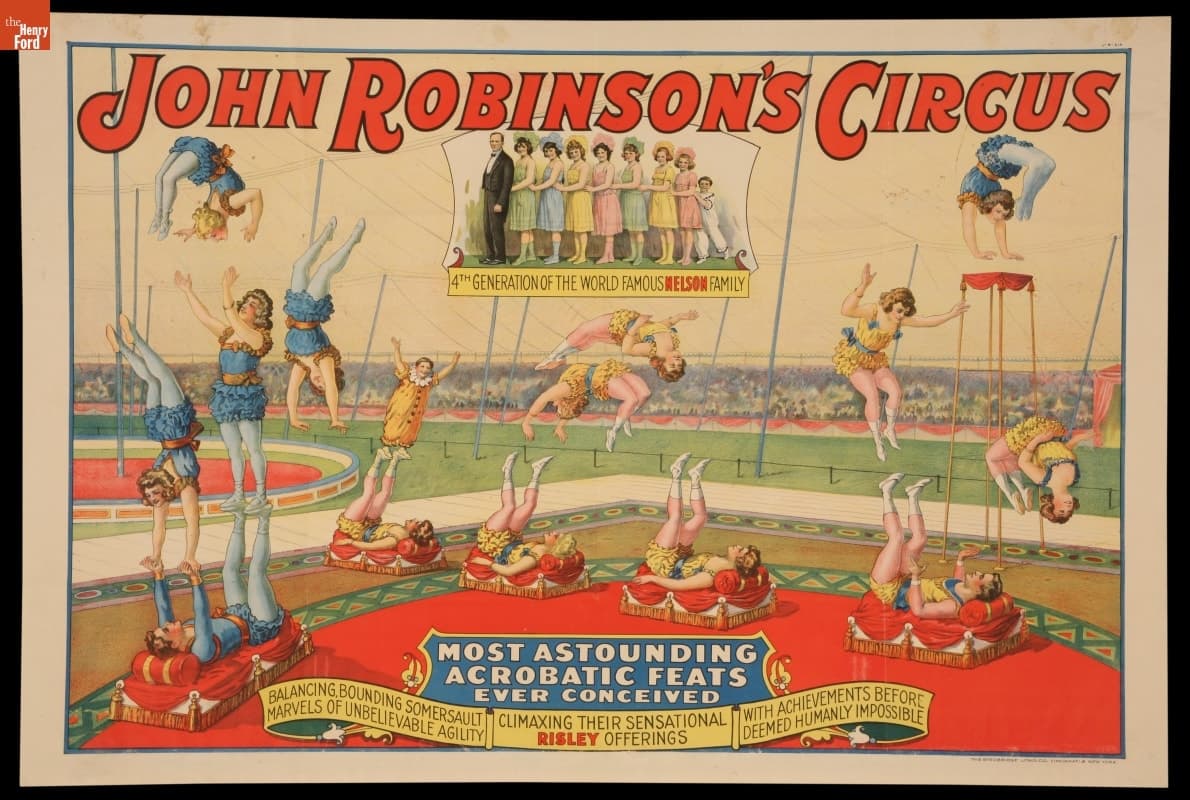
Circus ownership and acts could be intergenerational, as with the Robinson and Nelson families. Four generations of Robinsons operated the John Robinson's Circus starting in 1842. The circus retained the family name until the Ringling Brothers purchased it in 1929. The Nelsons were a renowned acrobat family for almost a century. They were famous for the "Risley Act," during which they juggled each other in the air using their feet.
View ArtifactCircus Poster, "The Barnum & Bailey Greatest Show on Earth, La Roche and the Mysterious Globe," 1896
Austrian contortionist Leon La Roche astounded audiences with his Mysterious Globe trick. La Roche would tuck himself into a metal ball and the ball would appear to ascend and descend a 30-foot-high spiral tower on its own. The stunt was incredibly popular. In 1906, French toymaker Ferdnand Martin created a tin lithograph toy based on the Mysterious Globe trick with a miniature tin La Roche.
View ArtifactCircus Poster, Adam Forepaugh and Sells Brothers Circus Present, "See the New Woman in a Novel Sphere," 1896
For female performers, the circus provided employment and independence from the gender expectations of 19th century. Some women, notably sideshow artists, outearned men in the same or similar acts. Others used their public visibility to spread awareness of the equal suffrage movement. Newspapers and advertisements linked women of the circus to the archetype of the New Woman who reflected the expanding role of women in the public sphere.
View ArtifactCircus Poster, Barnum and Bailey Present "Evetta the Only Lady Clown," 1895
Evetta was the most famous female clown of the 19th century. Born Josphine Mat[t]hews, Evetta grew up in a show business family; her father, mother, and sister were all circus performers. Evetta's act involved bicycling, juggling, tumbling, and raucous crowd work. She wore her signature loose pantaloons to highlight her athleticism and help her stand out from her fellow performers who wore leotards and tights.
View ArtifactCircus Poster, Barnum and Bailey Circus Presents "The Marvelous Zedoras and Alar the Human Arrow," 1896
The Marvelous Zedoras were a mixed-gender troupe of British flying trapeze artists who toured for four seasons with the Barnum and Bailey circus. The highlight of their act was young Pansy Murphy who went by the stage name Alar the Human Arrow. In her performances, Alar was shot from a human sized crossbow. After she sailed through a target, another member of the Zedoras caught her in mid-air on the other side.
View ArtifactBarnum & Bailey Circus Poster with Illustration of Duryea Motor Wagon, 1896
Audiences could experience the latest new technological curiosities at the circus alongside other acts. Early motion picture kinetoscopes could be found on the circus midways for customer's amusement, and early automobile demonstrations and stunts happened under the big top. The Duryea Wagon had recently won America's first auto race when the Barnum and Bailey circus added it to the show.
View ArtifactMovie Poster, "Adventures of Buffalo Bill," circa 1918
The Golden Age of circuses ended for several reasons. Among them was the rise of film during the early 20th century as direct competition. Some showmen produced larger and more expensive shows to lure audiences to the circus. Others embraced the new medium to stay relevant. Showman William "Buffalo Bill" Cody first adapted his popular Wild West show for the screen in 1897. He produced and starred in eight Wild West movies.
View Artifact

