
League of American Wheelmen
Share
share
In the late 1800s, cyclists faced many challenges. Poor road conditions made travel difficult, and even on passable roads, cyclists found themselves unwanted. Wagon and carriage drivers thought bicycles and bicyclists frightened their horses, while others believed cyclists posed a danger to pedestrians. In 1880, several cycling clubs formed the League of American Wheelmen to advocate for bicyclists' rights.
THF153407
Expert Columbia High-Wheel Bicycle, 1884
A bicycle craze in the United States began in the 1870s with the high-wheel ordinary. These large-front-wheel bicycles were expensive to buy and maintain, and cyclists needed certain athletic skills to ride them, often limiting bicycle ownership and riding to adventurous, well-to-do, athletic men. Still, cycling spread throughout the United States, and clubs formed for like-minded cyclists.
View ArtifactTHF228528
Portrait of Colonel Albert A. Pope, circa 1883
Albert Pope, who saw his first bicycle at the 1876 Centennial Exposition in Philadelphia, Pennsylvania, became the leading bicycle manufacturer in America. The large, high-wheel ordinary became a hit among athletic men who had money to purchase them. And Pope was more than eager to sell them. He also knew the value of a national bicycle organization and spurred the formation of a league that encouraged bicycle touring.
View ArtifactTHF102693
League of Amercian Wheelmen Membership Card, 1891
Bicycle club members throughout the United States gathered in Newport, Rhode Island, in May 1880 and formed the League of American Wheelmen. The focus of this new organization was "to promote the general interests of bicycling, to ascertain, defend, and protect the rights of wheelmen; and to encourage and facilitate touring."
View ArtifactTHF203354
Burley B. Ayers of the League of American Wheelmen, circa 1885
The League became an advocate for its members. It fought to overturn restrictive laws limiting or forbidding bicycles on public roads. The League also provided benefits for members. Wheelmen often received special hotel rates and other privileges, much like today's automobile membership clubs. Cyclist and Chicagoan Burley B. Ayers, an active League member, encouraged railroads to transport bicycles free of charge or for a minimal fee.
View ArtifactTHF206999
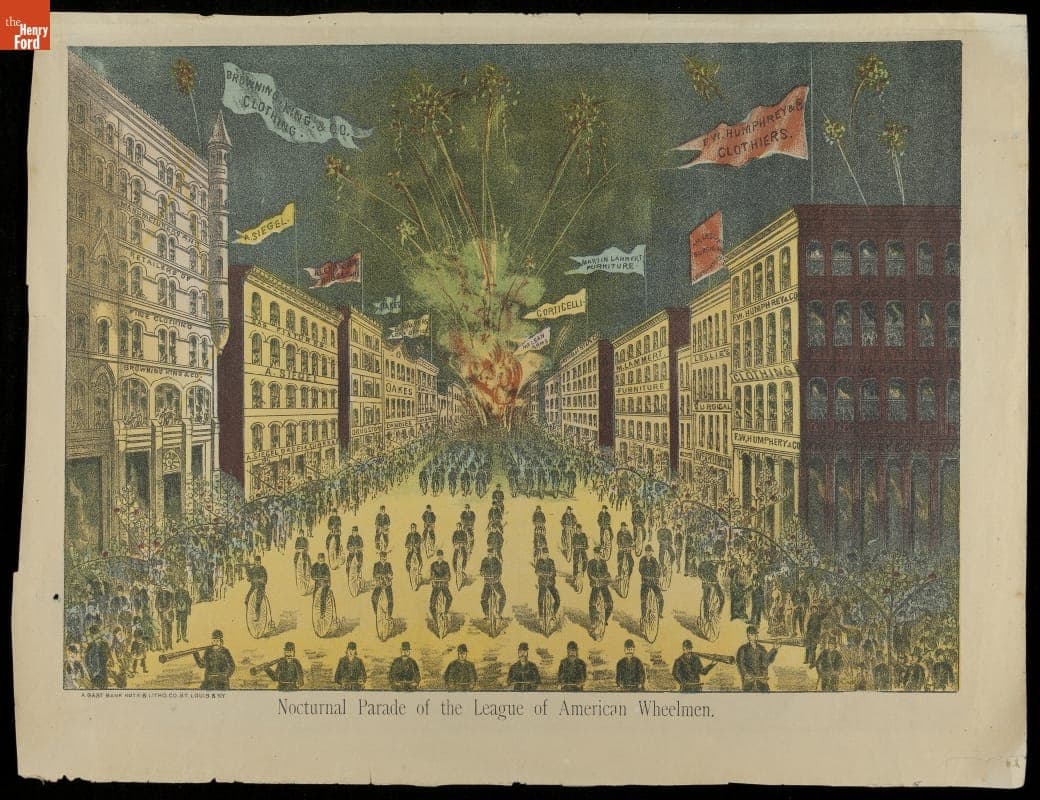
Print, "Nocturnal Parade of the League of American Wheelmen," circa 1885
The League of American Wheelmen also organized meetings and touring events for its members. This print depicts a large group of wheelmen parading down a street in St. Louis, Missouri. The number of cyclists -- some blaring horns -- and fireworks certainly brought attention to the organization and its causes.
View ArtifactTHF202280
"Good Roads Book and Rules of the Road Magazine," 1898
Touring cities and the countryside was a popular activity for League cyclists, and the organization issued area road maps for its members to reference. These publications usually listed road conditions and general guidelines for travel, along with any special rules and other valuable information bicycle tourists needed.
View ArtifactTHF203374
Howard E. Raymond, League of American Wheelmen, 1889
During its first twenty years, the League of American Wheelmen also instituted rules about professional and amateur bicycle racing for its members. It sanctioned races, appointed handicappers, and verified records, among other duties. Howard E. Raymond chaired the League's Racing Board in the mid-1890s.
View ArtifactTHF203380
William F. Murphy with High-Wheel Bicycle, circa 1890
William Murphy posed in front of an ordinary -- a high-wheel bicycle. In 1890, Murphy captured the League of American Wheelmen championship in the ordinary one-mile race. Murphy would later race "safety" bicycles -- chain-driven bicycles with same-size wheels. He would even team up with his brother, Charles, and pedal to several victories on a two-person tandem.
View ArtifactTHF108119
Rambler Bicycle, circa 1896
Membership in the League of American Wheelmen grew rapidly, especially after the introduction of the "safety" bicycle. By the 1890s, the mass-produced, easy-to-mount bicycle with equal-sized wheels, rear-wheel chain drive, and fitted with pneumatic tires made cycling more accessible and enjoyable. League membership grew until it peaked in 1898 at more than 100,000.
View ArtifactTHF201307
William F. and Charles M. Murphy, Tandem Bicycle Champions, 1891
Unfortunately, not all were welcome. In 1894, the League of American Wheelmen voted to prohibit membership of non-white people. Black cycling enthusiasts, including world bicycling champion Marshall "Major" Taylor, were barred from membership.
View ArtifactTHF102705
League of American Wheelmen Lapel Pin, circa 1900
Though bicycles improved and became easier to ride, the poor conditions of late 19th-century roads hampered bicyclists and their sport. Wheelmen became early champions of the "Good Roads" movement.
View ArtifactTHF207011
L.A.W. Bulletin and Good Roads Magazine for July 8, 1898
Good roads meant more cyclists (and more League members). Publications like this magazine highlighted the League's commitment to better and safer riding conditions for its members.
View ArtifactTHF201323
Isaac B. Potter, President of the League of American Wheelmen, 1916
Isaac B. Potter was the managing editor of Good Roads magazine in the 1890s. He constantly sought to educate wheelmen and others about the importance of improving American roadway infrastructure. He wrote articles, essays, and books and helped draft legislation promoting good-roads ideology. In 1897, he was elected president of the League of American Wheelmen.
View ArtifactTHF203400
Man with a Bicycle Decorated for a Parade, 1897
Members of the League of American Wheelmen found interesting ways to promote good roads. This wheelman decorated his bicycle for a parade. Even his dog agreed -- it wears a sign reading "I Want Good Roads."
View ArtifactTHF124095
"Fifth National Exhibition of Cycles, Automobiles and Accessories, Official Program," 1900
Membership in the League of American Wheelmen hit its peak in 1898. But the bicycle fad soon waned in America. By 1905, the League numbered less than 3,000 members and was essentially inactive. Bicycles remained, but the automobile had arrived. Cyclists found the roads increasingly crowded, and the growing number of automobile lovers became the leading advocates for road safety, auto touring, good roads, and vehicle special interests.
View Artifact

