
The Noah Webster Home
Share
share
In his New Haven, Connecticut home, Noah Webster wrote the first dictionary of the American English language. The house changed hands, serving as a private residence and dormitory for more than a century before coming to Greenfield Village in 1936.
THF236375
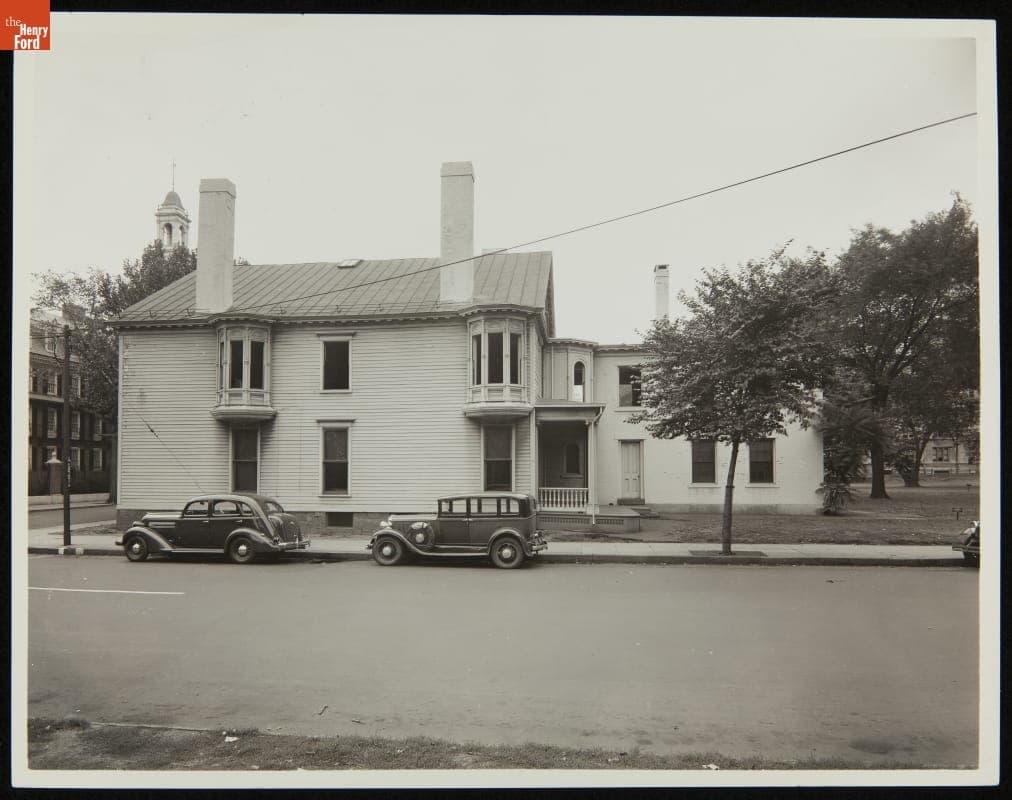
Documentary Photograph of Noah Webster Home before Dismantling and Relocation to Greenfield Village, 1936
This is textbook pioneer and spelling reformer Noah Webster's home on its original site in New Haven, Connecticut. Henry Ford admired Webster and recognized his house as an important piece of American history. Ford had the building moved to Greenfield Village - his historical outdoor museum in Dearborn, Michigan. This side view documents later additions not moved with the house.
View ArtifactTHF236377
Documentary Photograph of Noah Webster Home before Dismantling and Relocation to Greenfield Village, 1936
This is textbook pioneer and spelling reformer Noah Webster's home on its original site in New Haven, Connecticut. Henry Ford admired Webster and recognized his house as an important piece of American history. Ford had the building moved to Greenfield Village - his historical outdoor museum in Dearborn, Michigan. This view documents the original back porch and additions not moved with the house.
View ArtifactTHF127165
Noah Webster Home at Its Original Site, New Haven, Connecticut, circa 1912
This is textbook pioneer and spelling reformer Noah Webster's home on its original site in New Haven, Connecticut. Henry Ford admired Webster and recognized his house as an important piece of American history. Ford had the building moved to Greenfield Village - his historical outdoor museum in Dearborn, Michigan. This view documents side and rear additions not moved with the house.
View ArtifactTHF236369
Noah Webster House at its Original Site, New Haven, Connecticut, circa 1927
This is textbook pioneer and spelling reformer Noah Webster's home on its original site in New Haven, Connecticut. Henry Ford admired Webster and recognized his house as an important piece of American history. Ford had the building moved to Greenfield Village - his historical outdoor museum in Dearborn, Michigan. This view documents side and rear additions not moved with the house.
View ArtifactTHF236367
Noah Webster House at its Original Site on Temple Street in New Haven Connecticut, circa 1927
Noah and Rebecca Webster built their comfortable home in a fashionable middle-class neighborhood of New Haven, Connecticut, during the early 1820s. They lived only a few blocks from New Haven's town green and very near Yale College. The house, shown here (far right) about 1927, was situated close to the street, as were most urban homes of the early 19th century.
View ArtifactTHF236363
Noah Webster House at its Original Site, New Haven, Connecticut, March 31, 1934
This is textbook pioneer and spelling reformer Noah Webster's home on its original site in New Haven, Connecticut. Henry Ford admired Webster and recognized his house as an important piece of American history. Ford had the building moved to Greenfield Village - his historical outdoor museum in Dearborn, Michigan. This view documents architectural details, including second floor bay windows not moved with the house.
View ArtifactTHF1882
Noah Webster Home
Noah Webster and his wife Rebecca had this comfortable New Haven, Connecticut, home built in their later years to be near family and friends, as well as the library at nearby Yale College. While living in this house, Webster published his famous American Dictionary of the English Language in 1828. His dictionary aimed to capture distinctively American words and spellings for the first time.
View Artifact

