
Abraham Lincoln: Getting Re-elected, 1864
Share
share
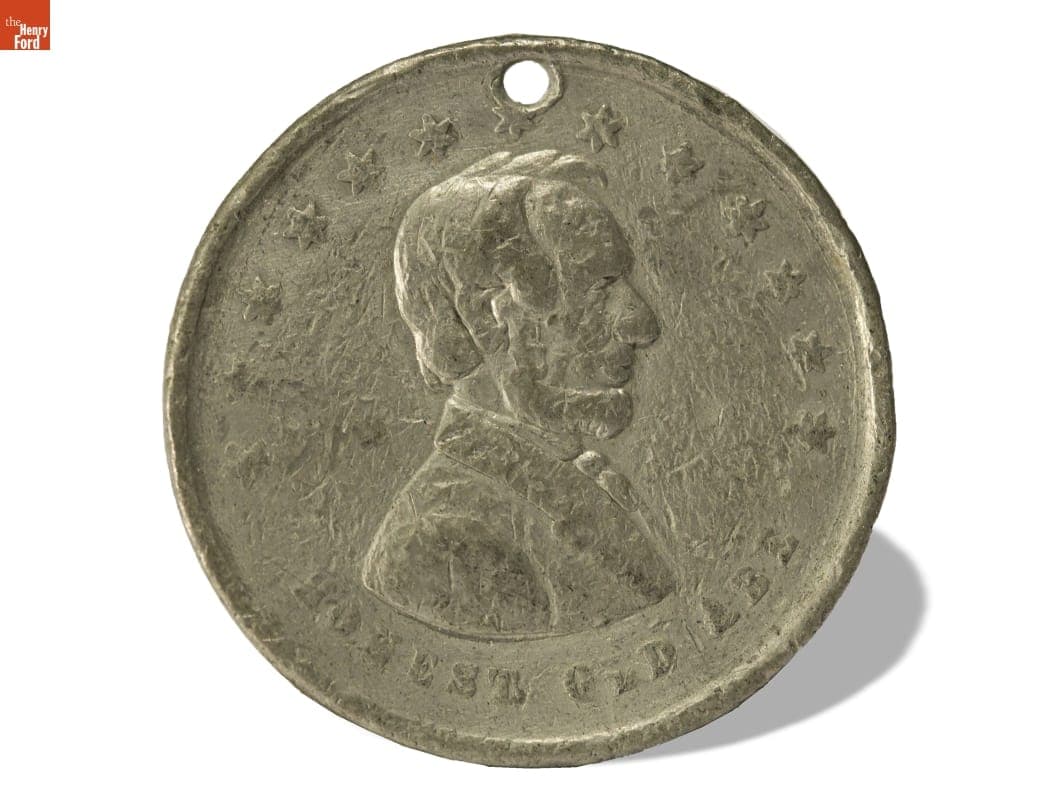
After a gloomy summer of Union defeats and casualty lists, President Lincoln’s re-election hopes seemed slim. But, at long last, news of several victories in the South gave him the public support he needed to win the election by a landslide.
THF156540
Abraham Lincoln Campaign Badge, 1864
The possessor of this small token supported Abraham Lincoln for president in 1864. Trinkets, such as this one, reminded American citizens why they backed certain parties and candidates. Most tokens were just that -- small coins carried around in purses or pockets. This token, however, could be attached to a ribbon or pin and became an outward display of support for the Republican candidate.
View ArtifactTHF121346
Ohio National Union Party Ticket for the 1864 Presidential Election
After a gloomy summer of Union defeats and casualty lists, President Lincoln's re-election hopes seemed slim. But finally, several Union victories gave him the needed public support to win the 1864 election by a landslide. The phrase "Rally round the Flag, Boys!" was part of a Lincoln-Johnson campaign song modified from the 1862 patriotic song, "The Battle Cry of Freedom."
View ArtifactTHF121351
1864 Presidential Election Ballot with Union Party Ticket for Dearborn, Michigan
After a gloomy summer of Union defeats and casualty lists, President Lincoln's re-election hopes seemed slim. But finally, several Union victories provided the public support to win the 1864 election by a landslide. The phrase "Rally 'round the Flag, boys" was part of a Lincoln-Johnson campaign song modified from the 1862 patriotic song, "The Battle Cry of Freedom."
View ArtifactTHF121348
National Union Party Presidential Election Campaign Card, 1864
In 1864, incumbent President Lincoln and former Democrat Andrew Johnson ran on the National Union Party ticket--so named to attract War Democrats and Border State Unionists who would not vote Republican. After a gloomy summer of Union defeats and casualty lists, Lincoln's re-election hopes seemed slim. But, finally, several Union victories gave him enough support to win the election.
View ArtifactTHF121350
National Union Party Election Day Handbill, November 8, 1864
In 1864, incumbent President Lincoln and former Democrat Andrew Johnson ran on the National Union Party ticket--so named to attract War Democrats and Border State Unionists who would not vote Republican. After a gloomy summer of Union defeats and casualty lists, Lincoln's re-election hopes seemed slim. But, finally, several Union victories gave him enough support to win the election.
View ArtifactTHF155750
McClellan Presidential Campaign Lantern, 1864
Late-nineteenth-century political parties rallied their supporters by holding torchlight parades. In the evening, marchers lit up the street carrying torches, lamps and lanterns. Inexpensive paper lanterns glowed with the image or name of the party's candidate or other patriotic imagery. In 1864, backers of General George McClellan used lanterns like this to call for the defeat of the "Old Joker," President Abraham Lincoln.
View ArtifactTHF155740
Presidential Campaign Lantern, 1864-1868
Late-nineteenth-century political parties rallied their supporters by holding torchlight parades. In the evening, marchers lit up the street carrying torches, lamps and lanterns. Inexpensive paper lanterns glowed with the image or name of the party's candidate or other patriotic imagery. Backers of the Union would proudly carry a lantern like this at parades during and just after the Civil War.
View ArtifactTHF11616
"Grand National Union Party for 1864"
In 1864, incumbent President Lincoln and former Democrat Andrew Johnson ran on the National Union Party ticket--so named to attract War Democrats and Border State Unionists who would not vote Republican. After a gloomy summer of Union defeats and casualty lists, Lincoln's re-election hopes seemed slim. But, finally, several Union victories gave him enough support to win the election.
View ArtifactTHF159007
Abraham Lincoln Campaign Stickpin, 1864
After a gloomy summer of Union defeats and casualty lists, President Lincoln's re-election hopes seemed slim. But, finally, several Union victories gave him the needed public support to win the 1864 election by a landslide. This unusual campaign stickpin holds a ferrotype (or tintype) portrait of Abraham Lincoln.
View ArtifactTHF59567
Abraham Lincoln and Andrew Johnson Campaign Torch, 1864
Late-nineteenth-century political parties rallied their supporters by holding torchlight parades. In the evening, marchers lit up the street carrying torches, lamps and lanterns. Many of these political lanterns glowed with slogans and patriotic symbols. Supporters of President Lincoln and the Union would have carried this torch during the 1864 campaign.
View Artifact

