
1913 Herschell-Spillman Carousel
Share
share
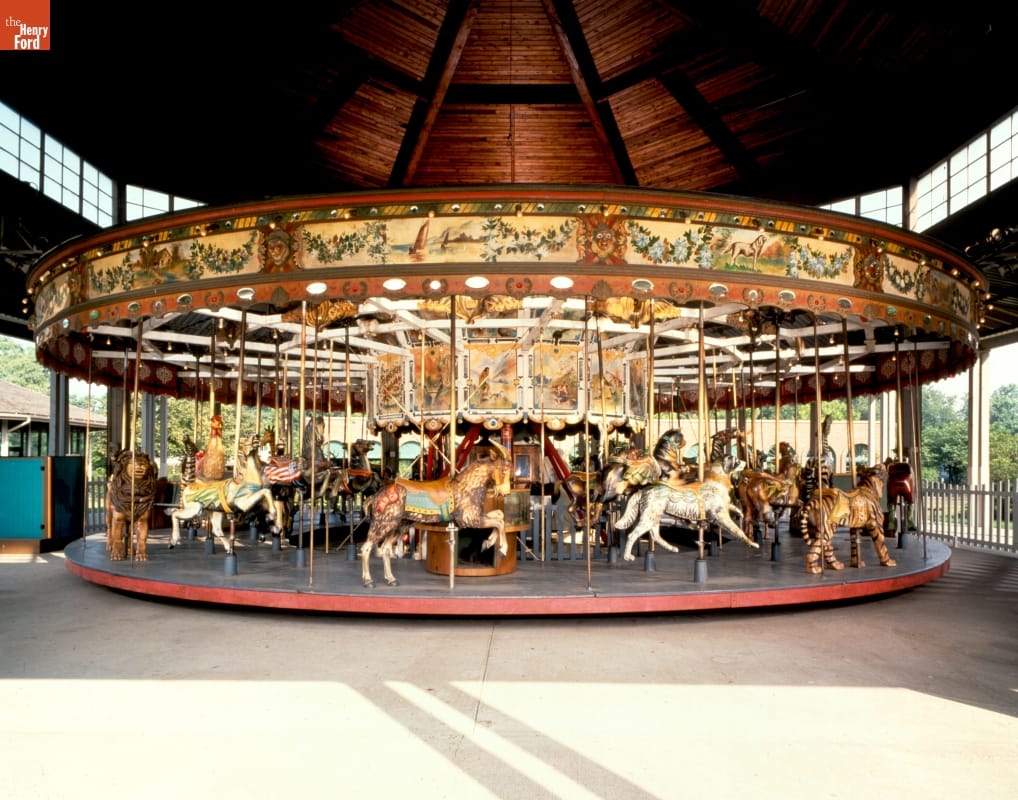
Combining steam engine knowhow with shop production methods, the Herschell-Spillman Company became one of the most popular and successful American carousel manufacturers of the early 20th century. Herschell-Spillman carousels are known for their variety of carved wooden animals. The 1913 example operating in Greenfield Village features a colorful menagerie of “jumpers” and stationary animals, along with chariots and a lover’s tub.
THF5584
Herschell-Spillman Carousel
Colorful carousels were at the height of their popularity during the early 1900s and could be found all across America in amusement parks, city parks, and seaside resorts. Built in 1913, this "menagerie" carousel's hand-carved animals include storks, goats, zebras, dogs, and even a frog. Although its original location is uncertain, this carousel operated in Spokane, Washington, from 1923 to 1961.
View ArtifactCatalog for Herschell-Spillman Company, "Improved Merry-Go-Round," 1913
This catalog highlights the products of Herschell-Spillman Company, from portable merry-go-rounds to large stationary "carousselles." This company, one of the most popular and successful American carousel manufacturers of the early 20th century, combined a method of shop production to produce carved wooden animals with their expertise in steam engines and boilers for efficient operation of their merry-go-rounds and carousels.
View ArtifactCarousel Figure of a Goat, 1910-1914
This hand-carved figure was made by Herschell-Spillman, the largest U.S. carousel manufacturer between 1904 and 1920. This figure was stationary, remaining in place as the carousel revolved. Carousels were extremely popular in amusement parks and seaside resorts at this time. They often included animals other than horses. This figure is on an operating carousel in Greenfield Village.
View ArtifactCarousel Figure of a Zebra, 1910-1914
This hand-carved figure was made by Herschell-Spillman, the largest U.S. carousel manufacturer between 1904 and 1920. Called a "jumper," the figure moved up and down as the carousel revolved. Carousels were extremely popular in amusement parks and seaside resorts at this time. They often included animals other than horses. This figure is on an operating carousel in Greenfield Village.
View ArtifactCarousel Figure of a Horse, 1910-1914
This hand-carved figure was made by the Herschell-Spillman Company, the largest U.S. carousel manufacturer between 1904 and 1920. Carousels were extremely popular in amusement parks and seaside resorts at this time. Called a "jumper," the figure moved up and down as the carousel revolved. It is part of an operating carousel in Greenfield Village.
View ArtifactCarousel Figure of a Dog, 1910-1914
This hand-carved figure was made by Herschell-Spillman, the largest U.S. carousel manufacturer between 1904 and 1920. Called a "jumper," the figure moved up and down as the carousel revolved. Carousels were extremely popular in amusement parks and seaside resorts at this time. They often included animals other than horses. This figure is on an operating carousel in Greenfield Village.
View ArtifactRocking Chariot Carousel Seat, 1910-1914
This hand-carved rocking "chariot" was made by the Herschell-Spillman Company, the largest U.S. carousel manufacturer between 1904 and 1920. Carousels were extremely popular in amusement parks and seaside resorts at this time. The seat was designed to rock back and forth as the carousel revolved. It is part of an operating carousel in Greenfield Village.
View ArtifactCarousel Figure of a Cat, 1910-1914
This hand-carved figure was made by Herschell-Spillman, the largest U.S. carousel manufacturer between 1904 and 1920. Called a "jumper," the figure moved up and down as the carousel revolved. Carousels were extremely popular in amusement parks and seaside resorts at this time. They often included animals other than horses. This figure is on an operating carousel in Greenfield Village.
View ArtifactCarousel Figure of a Frog or "Hop-toad," 1910-1914
In the early 20th century, amusement park goers dressed in their Sunday best climbed aboard colorful, hand-carved animals to enjoy a carousel ride. Horses were most common, but riders could choose from more exotic creatures found on some carousels. Herschell-Spillman made this whimsical frog -- the only carousel manufacturer to do so. It's the only American carousel animal you'll see wearing human clothing.
View ArtifactCarousel Figure of a Rooster, 1910-1914
This hand-carved figure was made by Herschell-Spillman, the largest U.S. carousel manufacturer between 1904 and 1920. Called a "jumper," the figure moved up and down as the carousel revolved. Carousels were extremely popular in amusement parks and seaside resorts at this time. They often included animals other than horses. This figure is on an operating carousel in Greenfield Village.
View ArtifactCarousel Figure of a Horse, 1910-1914
This hand-carved figure was made by the Herschell-Spillman Company, the largest carousel manufacturer in the United States between 1904 and 1920. Carousels were extremely popular in amusement parks and seaside resorts at this time. This figure was stationary, remaining in place as the carousel revolved. It is part of an operating carousel in Greenfield Village.
View Artifact

