
Nikola Tesla
Share
share
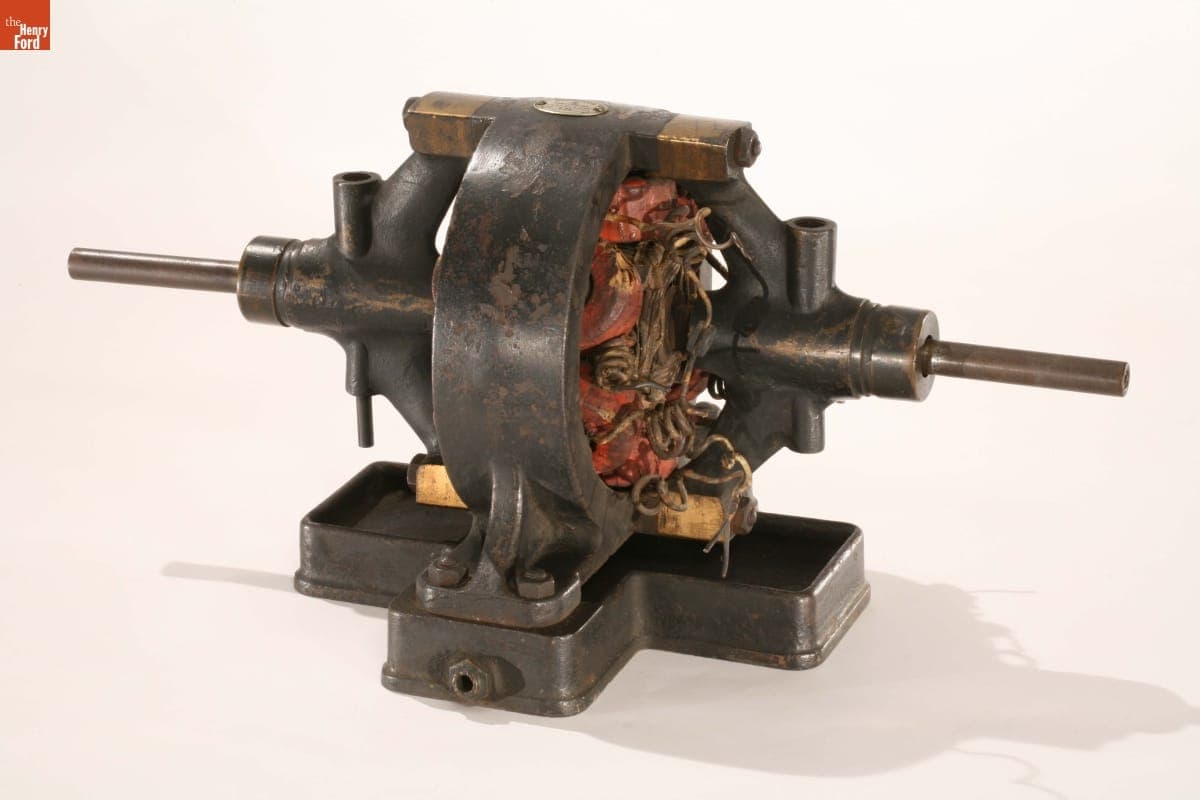
After brief employment by Thomas Edison, inventor and engineer Nikola Tesla worked to improve the alternating current (AC) electric supply system. Tesla’s patented AC induction motor and transformer were licensed by Edison rival George Westinghouse.
THF75024
Laboratory Model of Tesla Motor, circa 1895
Nikola Tesla's name is inseparable from the development of alternating current electricity--particularly with regard to polyphase transmission, but especially with regard to the induction motor. His motor, patented in 1888, was the first practical AC motor. George Westinghouse licensed Tesla's motor patents that same year--enabling the Westinghouse AC lighting system to become a real competitor with direct current systems.
View ArtifactTHF154123
Laboratory Model of Tesla Motor, circa 1889
Nikola Tesla's name is inseparable from the development of alternating current electricity--particularly with regard to polyphase transmission, but especially with regard to the induction motor. His motor, patented in 1888, was the first practical AC motor. George Westinghouse licensed Tesla's motor patents that same year--enabling the Westinghouse AC lighting system to become a real competitor with direct current systems.
View ArtifactTHF93591
Westinghouse Induction Motor, 1888-1900
Nikola Tesla's name is inseparable from the development of alternating current electricity--particularly with regard to polyphase transmission, but especially with regard to the induction motor. His motor, patented in 1888, was the first practical AC motor. George Westinghouse licensed Tesla's motor patents that same year--enabling the Westinghouse AC lighting system to become a real competitor with direct current systems.
View ArtifactTHF95531
Westinghouse Induction Motor
Nikola Tesla's name is inseparable from the development of alternating current electricity--particularly with regard to polyphase transmission, but especially with regard to the induction motor. His motor, patented in 1888, was the first practical AC motor. George Westinghouse licensed Tesla's motor patents that same year--enabling the Westinghouse AC lighting system to become a real competitor with direct current systems.
View ArtifactTHF123997
Portrait of Nikola Tesla, circa 1895
Nikola Tesla (1856-1943) is one of the greatest figures in the history of electrical power and telecommunications. His alternating current induction motor and pioneering work with polyphase electricity were fundamental to the development of today's electric power grid systems. Tesla's later experiments explored high frequency electricity, radio wave technology and wireless transmission of energy.
View ArtifactTHF123995
Portrait of Nikola Tesla, 1933
Nikola Tesla (1856-1943) is one of the greatest figures in the history of electrical power and telecommunications. His alternating current induction motor and pioneering work with polyphase electricity were fundamental to the development of today's electric power grid systems. Tesla's later experiments explored high frequency electricity, radio wave technology and wireless transmission of energy.
View ArtifactTHF124759
Letter from Nikola Tesla to George Sylvester Viereck, December 17, 1934
Nikola Tesla (1856-1943) is one of the greatest figures in the history of electrical power and telecommunications. In the early 1900s, the overworked inventor suffered a breakdown due to severe mental stress while trying to develop a method of wireless transmission of electric power. Tesla recounts his state of mind during this period in a 1934 letter to his friend, George Viereck.
View ArtifactTHF136930
Death Mask of Nikola Tesla on Pedestal, 1943
Nikola Tesla (1856-1943) is one of the greatest figures in the history of electrical power and telecommunications. His alternating current induction motor and pioneering work with polyphase electricity were fundamental to the development of today's electric power grid systems. This death mask, made of electroplated copper, was created at the request of Hugo Gernsback -- a publisher, writer, and friend of Tesla.
View ArtifactTHF124773
"A Warning from the Edison Electric Light Company," 1887
The late-nineteenth-century "War of Currents" pitted the backers of direct current (DC) against those who believed alternating current (AC) was the best way to transmit electricity. In this partisan publication the Edison Electric Light Company touted the advantages of their DC system, fueled the public's fear by reprinting reports of horrific deaths caused by high-voltage AC, and attacked the backers of AC who, company officials believed, misled investors.
View ArtifactTHF109865
Westinghouse Type A Polyphase Wattmeter, 1903-1906
In the late 1800s, companies that supplied electricity to consumers needed a way to measure how much customers used -- and then charge them accordingly. Paul McGahan, a Westinghouse electrical engineer created a practical polyphase wattmeter in 1899 to measure electric power usage. This design was adopted by other companies and remained a standard well into the mid-1900s.
View ArtifactTHF122208
AC Generator, Used by the International Harvester Company, circa 1895
By the late 1800s, manufacturers began using electricity to power their factories. Individual machines or groups of machines could be powered by motors -- instead of mechanical drive by networks of lineshaft. Electric generators also powered lights that added hours to the production day. The Milwaukee Harvester Company purchased this alternating current generator in 1895.
View ArtifactTHF124560
Edison Machine Works, Goerck Street, New York, New York, 1881
In 1881, Thomas Edison formed the Edison Machine Works to produce dynamos that would generate the electricity used to light homes and businesses outfitted with his newly invented incandescent lamps. In addition to making direct current generators, Edison Machine Works employees designed, and tested new equipment. Nikola Tesla worked there for six months in 1884 before leaving to develop an alternating current arc lighting system.
View Artifact

