
From Sketch to Sky: How Leonardo da Vinci Thought Like an Inventor
| Written by | |
|---|---|
| Published | 4/9/2026 |
From Sketch to Sky: How Leonardo da Vinci Thought Like an Inventor
| Written by | |
|---|---|
| Published | 4/9/2026 |
Leonardo di ser Piero da Vinci (1452-1519) was heavily reliant on his notebooks, now called the codices, where he sketched, wrote, and diagramed everything from his shopping lists to early drafts of his paintings; they serve as a gateway into his creative and innovative process. His notebooks were an outlet for his thoughts on engineering, and his observations about mathematics and physics led him to sketch conceptual devices. Da Vinci, born in the 15th century, described and drew many ideas that bear a remarkable resemblance to real inventions that were commonplace by the end of the twentieth century like diving suits and parachutes. Da Vinci's notes probably did not directly influence or inspire later innovators, but many of the same concepts that da Vinci hypothesized were crucial to the development of their inventions.
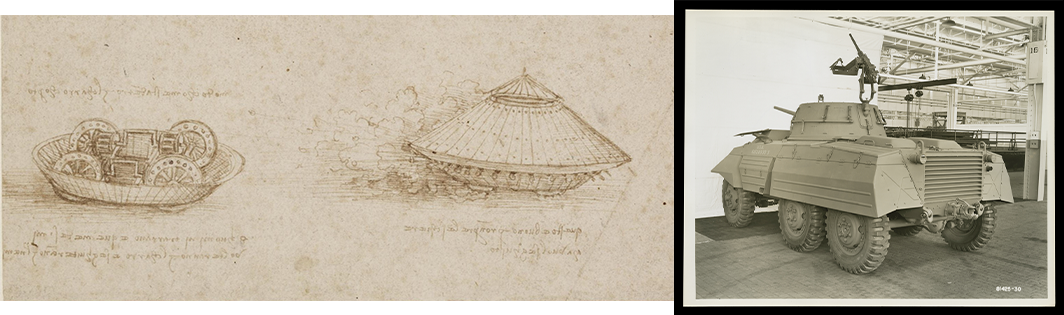 Da Vinci drew this design of an armored vehicle for his patron, Ludovico Sforza, who was the regent of Milan from 1480 until he ascended to the role of Duke in 1494. Compare da Vinci's design to this M8 armored car built at the Ford Motor Company Twin Cities Assembly Plant (1945). Like da Vinci's machine, the M8 provided coverage from enemy fire and had space for soldiers who could steer the vehicle and shoot from it. / via the British Museum © The Trustees of the British Museum (left) and THF147664 (right)
Many of the artist's more fanciful ideas were linked to his relationship with his then-patron Ludovico Sforza, the regent of Milan, and ongoing conflicts between the Italian city-states. Da Vinci's famous 1487 armored vehicle design was for Sforza and the Milanese army. Inventors and military strategists tried for centuries to create vehicles that could be used to both protect their soldiers and advance troop movement; da Vinci is a part of that legacy that came to fruition during the First World War. In comparing a twentieth-century tank to da Vinci's, one sees how he considered the need to withstand artillery through the slant of the armor and the need to fire at as many angles as possible. Through the patronage of Sforza and others, da Vinci had the resources to envision ideas that seem almost prophetic.
Famously da Vinci's tank design would not have worked; the machine would have been too heavy for eight men to operate, and the gears would have caused the front and back wheels to spin in opposite directions. In fact, most of da Vinci's drawings were only theoretical, and historians are unsure which ideas made it off the page and into the real world.
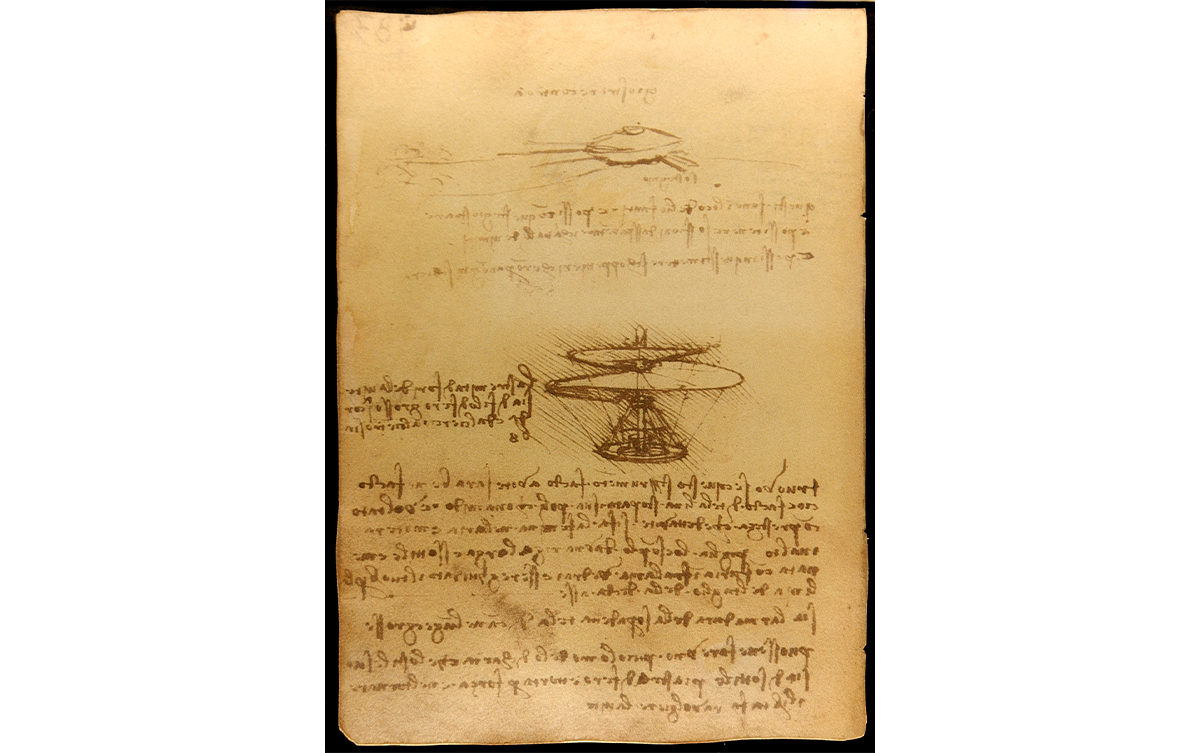 Da Vinci drew this aerial screw in the late 1480s and included it in his sketches of possible inventions for Ludovico Sforza. / Wikimedia Commons

Take, for example, da Vinci's aerial screw concept. Some scholars believe that he built a scale model of this invention as a novel toy or theater prop. But da Vinci wanted to use this vehicle for aerial surveillance for Ludovico Sforza; it would have been powered by four men rotating its mast and corkscrew sails with a crank. Da Vinci found inspiration in maple tree seeds and an irrigation machine called an Archimedes screw, which move in a helicoid shape, or three-dimensional helix. In his theory, the screw would force air downward and lift the vehicle up. That same lift force was key to the development of vertical flight in the 1930s.

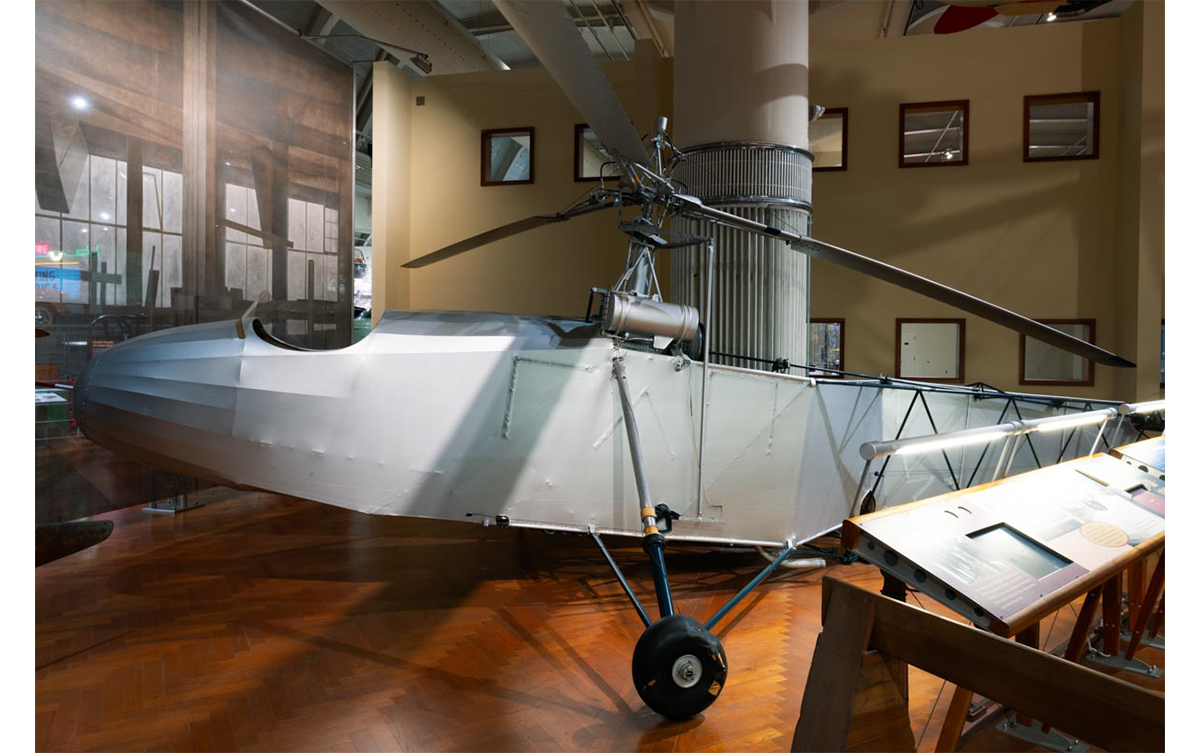 Sikorsky VS-300A helicopter, 1939. / THF198442
Kiev-born American inventor Igor Sikorsky spent most of that decade developing the first practical helicopter, which uses spiral force to fly like da Vinci envisioned. Sikorsky's invention created lift from rotor blades that spin, pushing the air down; when the rotor mast is engaged at the correct angle of attack, the helicopter rises into the air. In order for all of this to occur, a tremendous amount of power must be generated. A far cry from the force generated by four men, Sikorsky's first helicopter had a four-cylinder 75-horsepower Lycoming engine running the rotor mast and blades.
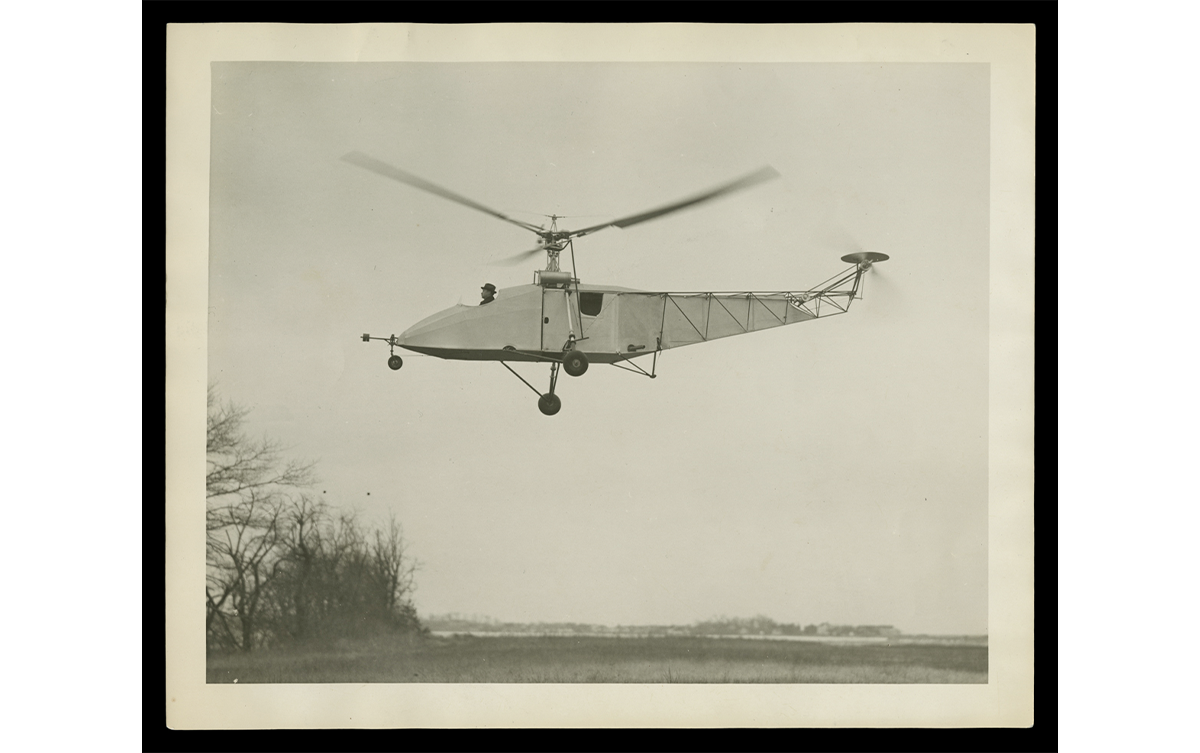 Igor Sikorsky piloting Vought-Sikorsky helicopter, hovering over a field, circa 1942. / THF125616
As mentioned with the aerial screw, da Vinci's theoretical designs were based in observation of nature and his then-current understanding of physics. In Notes on Bird Flight from 1505, da Vinci studied several avian species and noted how they flew and used air currents to resist the forces of gravity—which he understood to be the force that brought objects downward and not the attraction of objects to each other as we now understand it to be. Based on his notes on birds, he theorized and sketched a bird-like human-powered flying machine, which he believed to be his greatest idea yet.
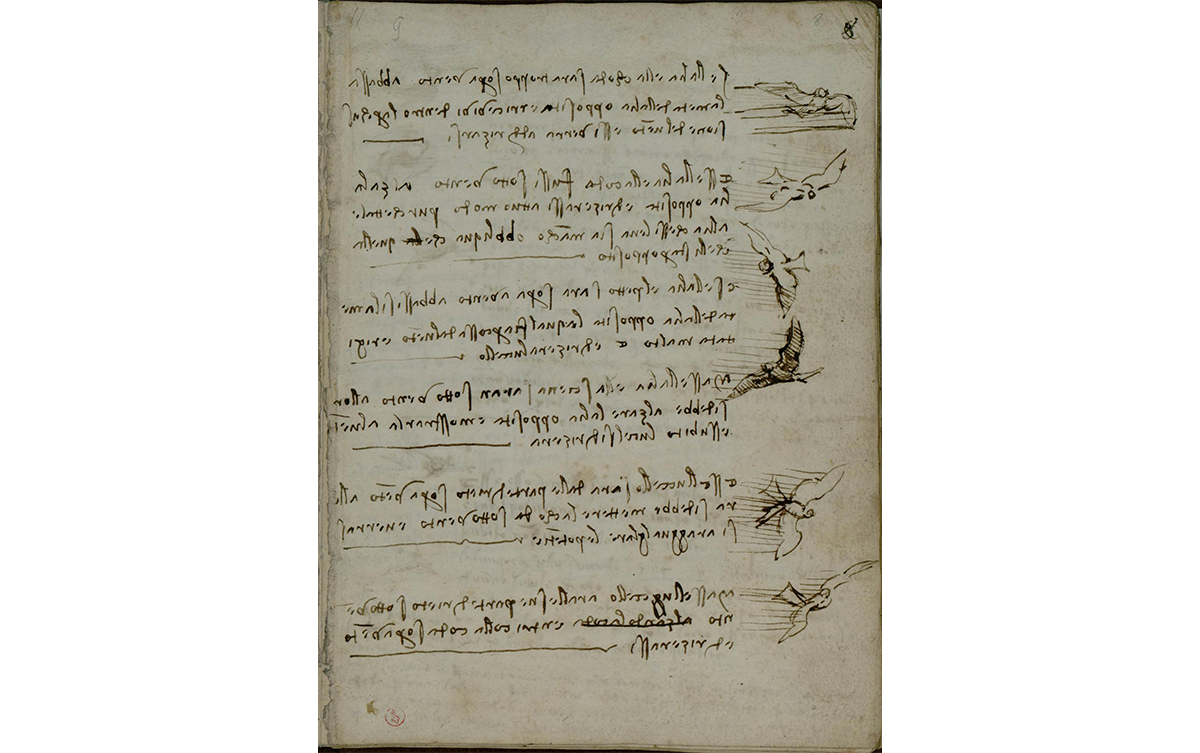 Page from the Codex on the Flight of Birds, 1505-1506. Da Vinci's observations on bird flight were accompanied by drawings of birds in motion. / Via Library of Congress
Early aviation pioneers of the late nineteenth and early twentieth centuries also looked to birds when they began experimenting with man-powered flight. French American engineer and aeronautic pioneer Octave Chanute began his 1894 book Progress in Flying Machines with a description of how birds use their wings, tails, and bodies to fly according to then-contemporary scientific understanding. Chanute concluded that "artificial flying machines will have to conform to these phases of flying" in order to work. Chanute was not the only early aviator who studied the animal world to understand flight. Before they began construction on their flyers, Orville and Wilbur Wright read the book Animal Mechanism by Professor Etienne-Jules Marey to understand how birds and insects get airborne. Both the Wrights and Chanute understood that flying animals used air currents to soar in the air and that human-powered powered flight would do so as well. Wilbur Wright wrote air currents were "as well able to support a flying machine as a bird, if man once learns the art of utilizing it." Da Vinci similarly wrote in his notebook that "with the wings and the tail the bird does the same thing in the air that the swimmer does in water with the arms and legs," and believed that a flying machine could use those same air currents like animals do. The study of birds helped da Vinci and the early aeronauts understand how flight works.
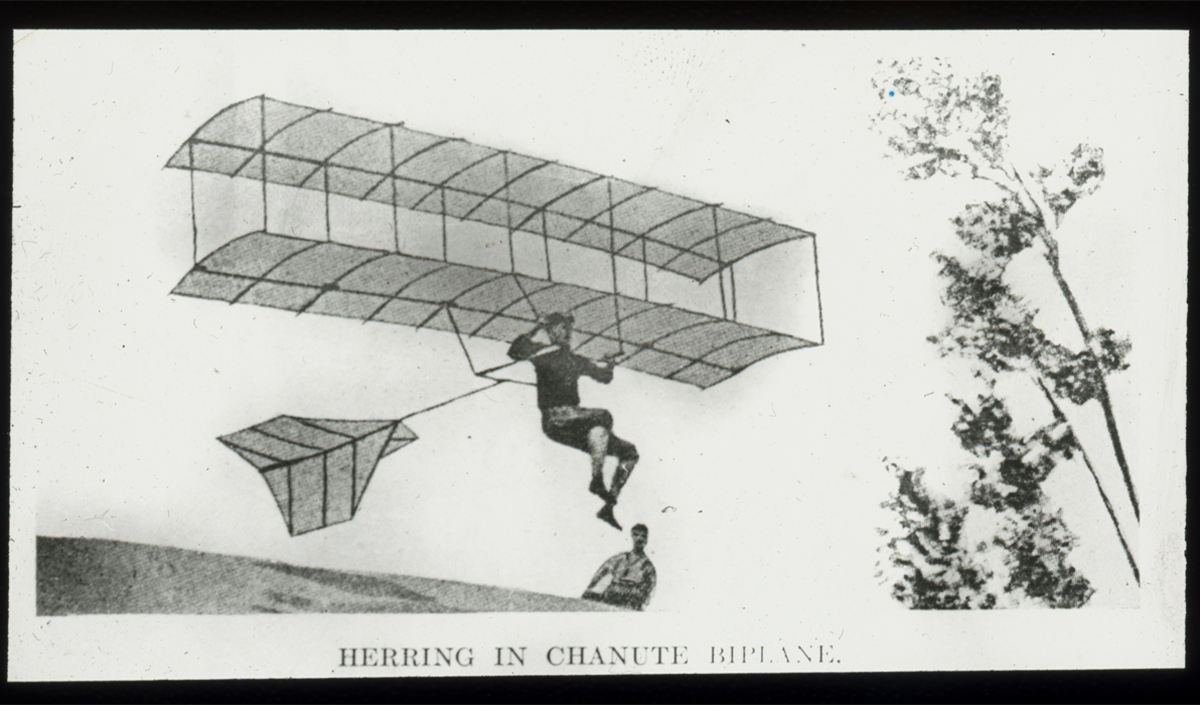 "Herring in Chanute Biplane," 1896. Augustus Herring was an American aviation pioneer who collaborated with Octave Chanute and built his own flyers. Herring piloted Chanute’s glider during an 1896 test on the shores of Lake Michigan. / THF712198
Where innovators like Chanute, the Wrights, and Sikorsky differed from da Vinci was their desire and ability to build and test their inventions. In fact, da Vinci's notes seemingly indicate that he had little interest in building these machines, despite how detailed his descriptions are; he sometimes wrote instructions to hypothetical builders, addressing them as "you." In the twentieth century, testing new ideas allowed inventors to figure out the exact calculations needed to achieve human flight. Along with observations about birds, Chanute also wrote about his experiments with his gliders, including his failures. Those failures allowed Chanute to measure, take notes, and understand how flight practically worked. It was both the theories and experimentation that led to the achievement. As Wilbur Wright said, "If you are looking for perfect safety you will do well to sit on a fence and watch the birds; but if you really wish to learn you must mount a machine and become acquainted with its tricks by actual trial."
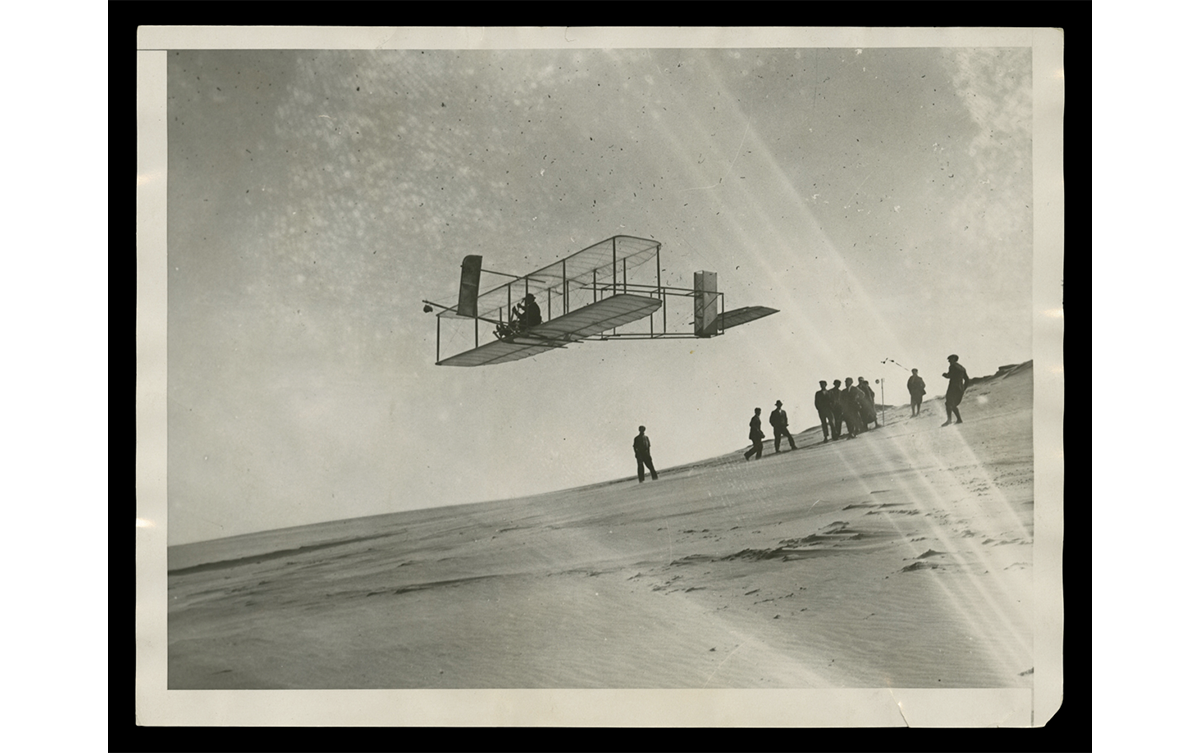 Orville Wright making glider tests at Kill Devil Hills, North Carolina, 1911. / THF111115
In the twenty-first century, engineers and inventors have built devices based on da Vinci's drawings to test his theories and ideas. One such test was in 2022; after three years of research and development, a group of University of Maryland engineers used da Vinci's aerial screw design as the wings for a drone, proving that giving enough power the design could achieve lift as Leonardo da Vinci predicted. Who knows how the past may continue to be reflected in the innovations of the future!
Kayla Chenault is an Associate Curator at The Henry Ford.
Keywords | |
|---|---|
Themes |