
The Declaration of Independence and George Washington: A Chirographic Portrait
| Written by | |
|---|---|
| Published | 7/2/2026 |
The Declaration of Independence and George Washington: A Chirographic Portrait
| Written by | |
|---|---|
| Published | 7/2/2026 |
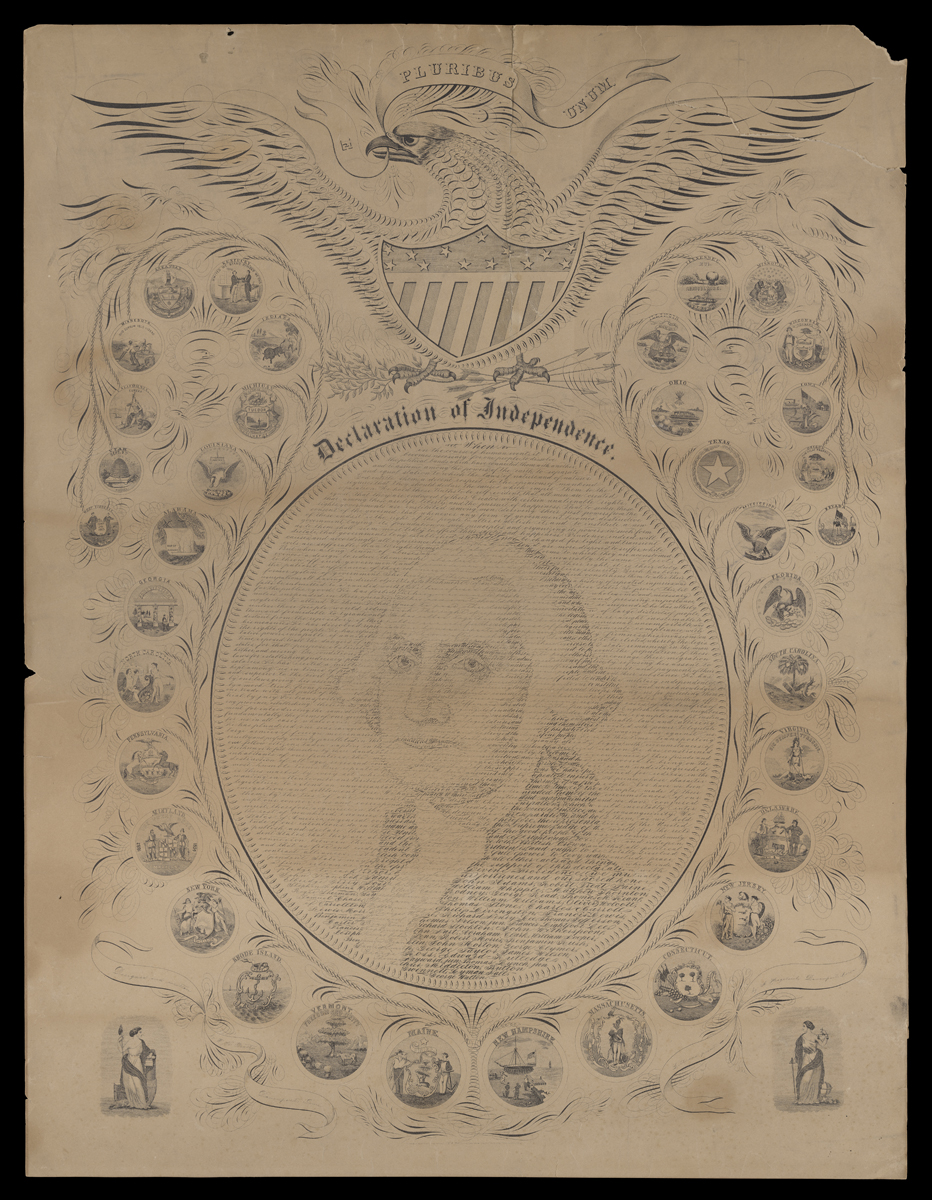 Chirographic Print by William Pratt and Augustus Hageboeck, 1865. / THF735580
In Davenport, Iowa, immediately after the Civil War, William Pratt, a penmanship teacher who ran a local business school, and Augustus Hageboeck, a local printer, teamed up to create a striking image of George Washington. It was a chirographic portrait, which is a type of portrait that renders an image of an individual through handwritten words. Pratt depicted George Washington's likeness -- based on the well-known painting by Gilbert Stuart -- using the words of the Declaration of Independence. Americans had long revered the "Father of our country" and the text of one of the country's founding documents. In the print's unique design, this chirographic interpretation blended commerce, country, and long-simmering ideas of freedom and union
-600x600/thf735582.jpg?sfvrsn=74685d02_1 "THF735582")
The Artist
William H. Pratt (1822-1893) was born in Massachusetts, and while he was still a young boy, his family moved to Illinois. Pratt, a self-taught calligrapher, became a teacher specializing in penmanship and bookkeeping. Penmanship was fundamental for students entering the business world in the nineteenth century. Pratt taught students the requisites of a good "business hand" at a time when orderly handwritten ledger books were the rule. In 1857, he moved to Davenport, Iowa, where he bought a half-interest in a commercial business school. He became the school's sole proprietor a few years later. During these early years in Davenport, Pratt won several premiums at state and local county fairs for his calligraphic ink drawings and artwork, as well as other penmanship specimens. He was even awarded a premium at the United States Fair in Chicago for Ornamental Penmanship. Pratt would sell his business school in 1865, but he remained as an instructor of penmanship and was an active member in the community for many years. He helped organize the Davenport Academy of Natural Sciences in 1867, serving in various capacities throughout the following decades. In 1890, the aging Pratt left Davenport to live with his family in Minneapolis, Minnesota. He died there three years later.
-600x600/thf735583.jpg?sfvrsn=7e95edd9_1 "THF735583") Detail crediting “Lith and print by A. Hageboeck, Davenport, Iowa.” / THF735583
Detail crediting “Lith and print by A. Hageboeck, Davenport, Iowa.” / THF735583
The Printer
Augustus Hageboeck (c. 1836-1907) was born in Germany and emigrated to the United States around 1857. He most likely followed his brothers to America and then to Iowa, where the 1861 Davenport City Directory listed "Hagenboeck [sic] & Bro" (John and Augustus) as lithographers. A year later, however, local newspapers advertised only A. Hageboeck as "Lithographer, Engraver and Printer" with no mention of John.
Like Pratt, Augustus Hageboeck won premiums for his printing and lithography at county fairs in the early 1860s. And for the next several decades, Hageboeck would create prints depicting views of surrounding Iowa and Illinois cities (and later, Minneapolis), as well as supplying city boosters with images of local business establishments to promote regional economic development. Other prints included profiles of Republican US presidents. Hageboeck actively promoted his prints, taking out newspaper advertisements touting his latest endeavors and hiring agents to sell them throughout the region. He would eventually teach lithography, engraving, and printing. Married and later divorced, Hageboeck died in 1907.
The Print
In the years after the War of 1812, some fifty years before Pratt and Hageboeck created their chirographic print of George Washington, Americans witnessed the dwindling number of soldiers, political leaders, and general populace who had experienced America's fight for freedom from Great Britain. By 1820, few of the original signers of the Declaration of Independence still lived. Records had been dispersed or lost. Some Americans feared that their history was disappearing. A renewed interest in the lives of the Revolutionary War generation spurred a desire to preserve and pass on the country's history. Documents were collected and saved, histories written, and prints of the Declaration of Independence —something tangible to display in Americans' homes—became available.
-600x600/thf735593.jpg?sfvrsn=bb8ecf05_1 "THF735593") Pratt and Hageboeck embellished the design with images of thirty-five states seal and one territorial seal. (The Kansas state seal was omitted.) / THF735593
Pratt and Hageboeck embellished the design with images of thirty-five states seal and one territorial seal. (The Kansas state seal was omitted.) / THF735593
During this period, printers crafted ornamental versions of the Declaration. Some embellished the works with facsimile signatures of the original signers, others highlighted text that emphasized key phrases; still others surrounded the text with patriotic symbols, state seals, allegorical images, or historic scenes. Some versions were even printed on silk, linen, or cotton. These prints became a testament to America's founding, echoing and amplifying the fundamental principles that established the nation -- of life, liberty, and the pursuit of happiness, and that all men are created equal -- even as citizens and politicians struggled with the Declaration's meaning and intent before an oncoming Civil War.
-600x600/thf735622.jpg?sfvrsn=438e45fe_1 "THF735622") William Pratt selectively bolded text of the Declaration of Independence to create this chirographic image of George Washington. / THF735622
William Pratt selectively bolded text of the Declaration of Independence to create this chirographic image of George Washington. / THF735622
In the aftermath of the Civil War, William Pratt and Augustus Hageboeck made their chirographic version. A print based on a handwritten version of the Declaration forming the likeness of George Washington seems an unlikely medium, but employing handwriting and ornamental flourishes to design images was popular in the mid-1800s. For Pratt and others who practiced penmanship, it showcased their talent, highlighting their mastery of the pen and their ability to teach others the skill of penmanship. And this print, with Washington emerging from selectively bolded handwritten text and topped by a large ornamental eagle fashioned from flowing strokes of a pen, only confirms the ingenuity of William Pratt, its designer.
The subject and the timing of the print were also no accident. The Civil War had just ended, the Union had been preserved, and freedom had won out. Within months after the end of the war, Pratt had designed a chirographic portrait of Abraham Lincoln using the words of the Emancipation Proclamation. Hageboeck provided a print soon after. Iowa newspapers praised Pratt and Hageboeck's creation. Editors at the Daily Gate City (Keokuk, Iowa) announced that Pratt and Hageboeck had produced a "finely designed and written" lithographed picture of the Emancipation Proclamation, "so written as to make in the center of the plate a very correct portrait of Abraham Lincoln." The artist and lithographer authorized agents to sell the print throughout the state of Iowa. Later, the print was available as far away as Boston, Massachusetts.
A print of George Washington also tapped into a renewed patriotism and a growing nationalism. Washington, the "Father of our country," was revered by Americans. He helped establish and lead the United States in its formative years and became its first president. For many Northerners, Washington was the forerunner of Lincoln. Washington established the Union; Lincoln saved it
-600x600/thf11654.jpg?sfvrsn=673c8546_1 "THF11654")
George Washington was much beloved by Americans in the nineteenth century. Many revered him as the founder of the Union. / THF11654
The print also symbolized the result of a generations-long debate on the interpretation of the Declaration of Independence—interpretations that turned Americans into sectional rivals and that were decided only after years of bloody warfare. No longer was this foundational document a mere justification for the separation of America from Great Britain—a people's right of self-governance against perceived tyranny. The Declaration solidified the statements of individual freedom and equality for all people embodied in principles spelled out in key phrases, "...that all men are created equal, that they are endowed by their Creator with certain unalienable Rights, that among these are Life, Liberty and the pursuit of Happiness." For many, the Union victory in the Civil War and the passage of the Reconstruction amendments to the Constitution ended the debate.
By 1867, Pratt and Hageboeck were selling chirographical portraits of Lincoln rendered from the words of the Emancipation Proclamation (one in English and another in German) and two versions of George Washington, using text from either the Declaration of Independence or the U.S. Constitution. These prints capitalized on the immediate post-Civil War desires of many Americans to memorialize the two great presidents and the foundational documents as symbols of freedom, emancipation, and union that many Northern soldiers had recently fought and died for.
Andy Stupperich is an Associate curator at The Henry Ford
Keywords | |
|---|---|
Themes |