
Mushrooms in Print and Potential
| Written by | |
|---|---|
| Published | 5/14/2026 |
Mushrooms in Print and Potential
| Written by | |
|---|---|
| Published | 5/14/2026 |
Fungi have captured the attention of artists and scientists alike as both collected specimens and discerned traits. The quest to separate the edible from the toxic yielded exemplary identification manuals. Ongoing research applies that visual literacy, builds on it, and digs deeper to identify new uses for American fungi.
Mushroom Manuals
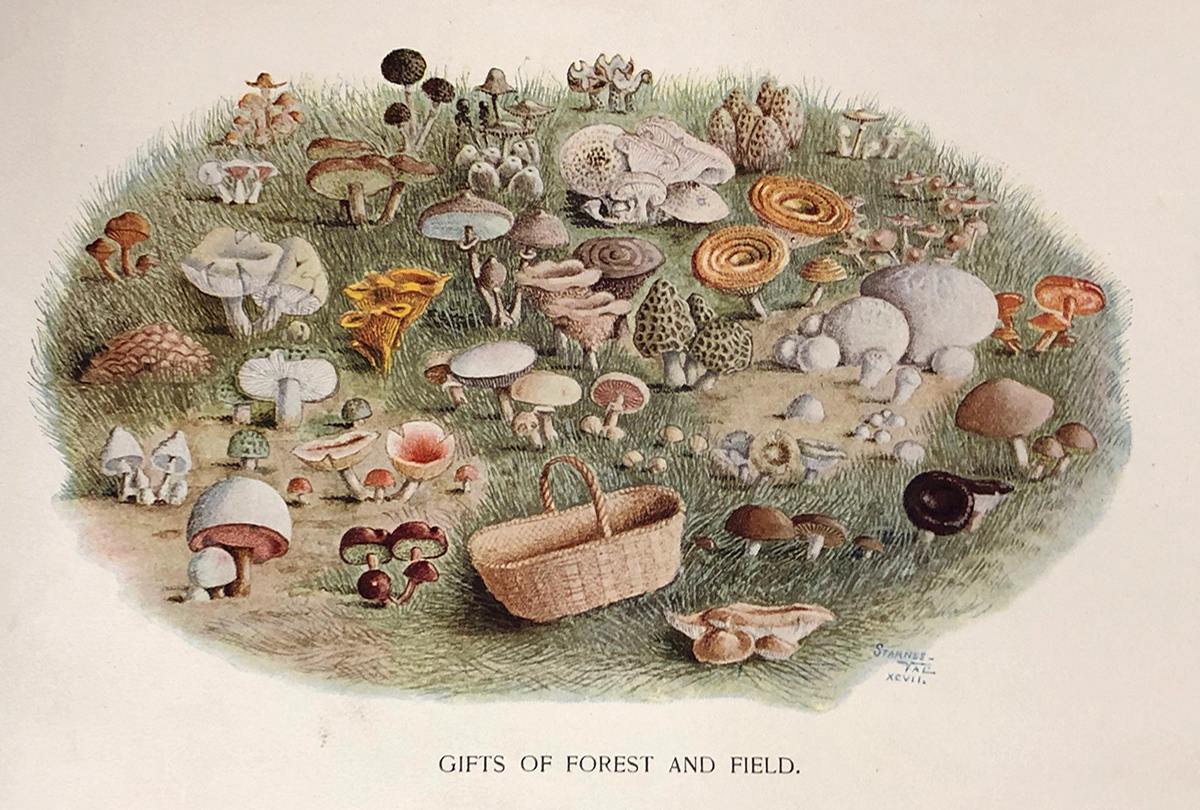
Frontispiece, Charles McIlvaine, Toadstools, Mushrooms, Fungi, Edible and Poisonous: One Thousand American Fungi (1900), in the special collections of Albert R. Mann Library, Cornell University. Public Domain.

Amateur mycologist or student of fungi Charles McIlvaine compiled his notes from twenty years of fieldwork into the first comprehensive overview of fungi found in United States forests and fields. Whimsical illustrations, colorful and complex, enliven the text, all designed to aid readers in identification of more than 700 edible fungi, and several hundred poisonous ones. Published in 1900, McIlvaine’s book, Toadstools, Mushrooms, Fungi, Edible and Poisonous: One Thousand American Fungi, remains a classic.
Digitization makes first and later editions of One Thousand American Fungi readily available—editions that stress the need for accurate identification and careful engagement with these living organisms. The subtitle reinforced this: “How to select and cook the edible; how to distinguish and avoid the poisonous.” Furthermore, Plate VI linked “toxicity” and mortality in the form of a human skull and devil to some of the more poisonous Amanita mushroom specimens.
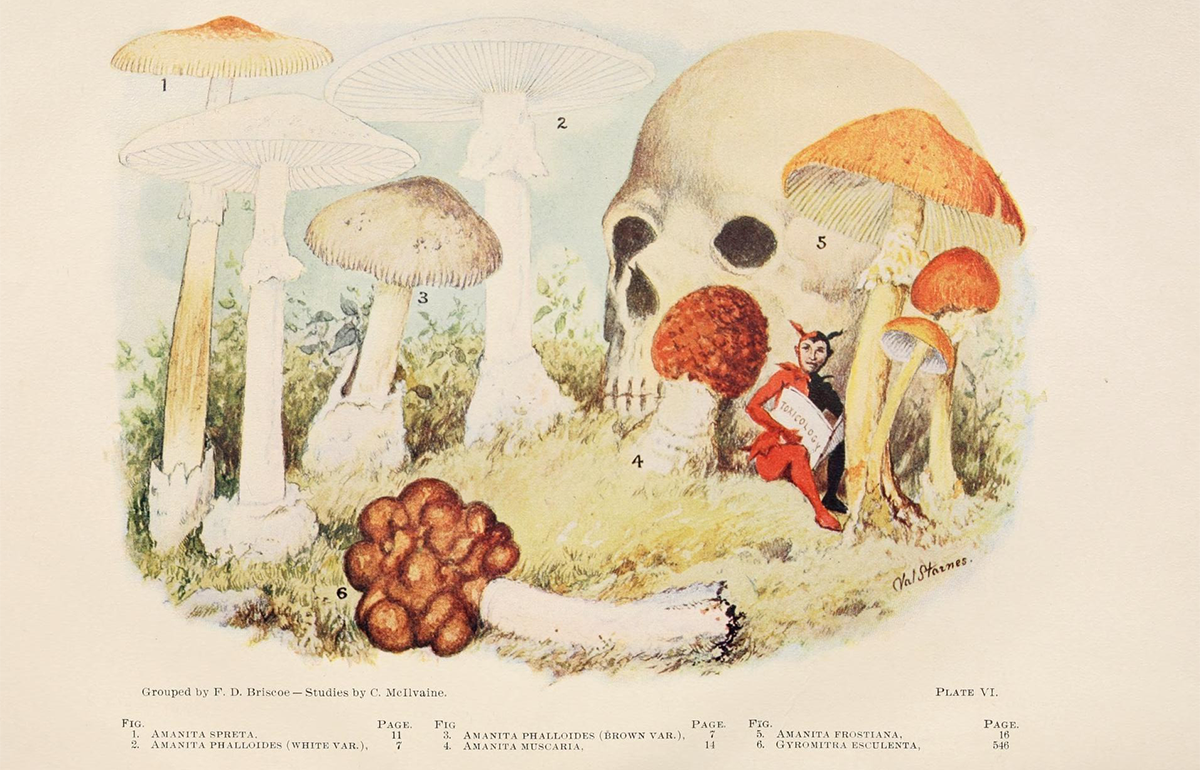
Plate VI, Charles McIlvaine, Toadstools, Mushrooms, Fungi, Edible and Poisonous: One Thousand American Fungi (1900), in the special collections of Albert R. Mann Library, Cornell University. Public Domain.
_(8537059334).jpg)
While artwork engaged readers of One Thousand American Fungi, a trained painter and botanical illustrator, Louis C. C. Krieger, gained a reputation for his aesthetically rich and technically precise watercolor paintings of mushrooms. National Geographic illustrated his May 1920 article, “Common Mushrooms of the United States,” with sixteen full-color plates. These paintings resulted from Krieger’s work with Dr. Howard A. Kelly, a physician, one of the founders of Johns Hopkins Hospital, and a mycologist. Kelly donated his extensive library and Krieger paintings to the University of Michigan in 1928, forming the L.C.C. Krieger Mycological Library. It includes many of the paintings consolidated and published in National Geographic, and more drawings and artwork that were later used to illustrate Krieger’s 1936 publication, The Mushroom Handbook. In the May-June 1941 issue of the Mycologia journal, Krieger’s colleague from the U.S. Department of Agriculture, John A. Stevenson, described the handbook as “one of the most satisfactory of the popular mushroom manuals ever published in this country.”
Common Mushrooms of the United States


Interest in fungi remains consistent, and recent coverage of “fabulous fungi” in an April 2024 issue of National Geographic argues for the addition of funga as a third kingdom alongside flora and fauna. Nick Martin, Senior Editor at National Geographic, emphasized mycologist Giuliana Furci’s belief that “fungi can show you that life begins even when another one ends.” For Furci, this resonates especially with identifying, curating, and conserving mushrooms in locations like Chile, where no field guides or identification manuals like those written by McIlvaine or Krieger exist. For others, it relates to how fungi factors into filtration systems, faux leather, and the mycobiome that holds promise for cancer research and treatment.
The Henry Ford’s Mycoremediation Initiative
The idiom “from soup to nuts” translates as “covering everything from beginning to end,” and Erin Hamilton of The Mushroom Conservatory has helped The Henry Ford realize that research into the potential of mushrooms surpasses the “everything” that we comprehend. Her grant-funded research has increased the number of mushrooms known to exist on The Henry Ford’s grounds, has documented them in situ as they stimulate decay and regenerate soils, and has tested their utility in mycofiltration systems to reduce contamination in the Rouge River.
The Americana Foundation funded a grant submitted by The Henry Ford to further watershed protection and improve water quality in the Rouge River, a major waterway that drains into the Detroit River and on into Lake Erie. The application focused on the creation and implementation of a one-year mycoremediation pilot project in a small channel of the Rouge River, the Oxbow, which runs through The Henry Ford’s property. Mycoremediation, a developing field of environmental restoration, uses the biochemical properties of certain fungi to extract contaminants from water and sediment. This case study will determine if the biofiltration system works, and if scaled up, how biofiltration could benefit the ecological health of the Oxbow-Rouge River ecosystem in the long term.
The Rouge forms the northeastern boundary of The Henry Ford’s property. The Environmental Protection Agency (EPA) designated the river an “Area of Concern” in 1987. The EPA based this on high levels of sediment and water contamination that occurs throughout the Rouge—a consequence of the historical urbanization and industrialization in the area. Heavy metals are among the many contaminants that negatively impact local ecology and recreational opportunities.
Thr mycoremediation project could not happen without support from The Henry Ford’s facilities and grounds division. Alec Jerome, Glenn Gray, Bart Fraley, Jon Bennett and Joe Wolford have each supported Erin in her research. They offered a space for kayak storage and shared the storm sewer systems map so Erin can determine the best locations to collect water samples.
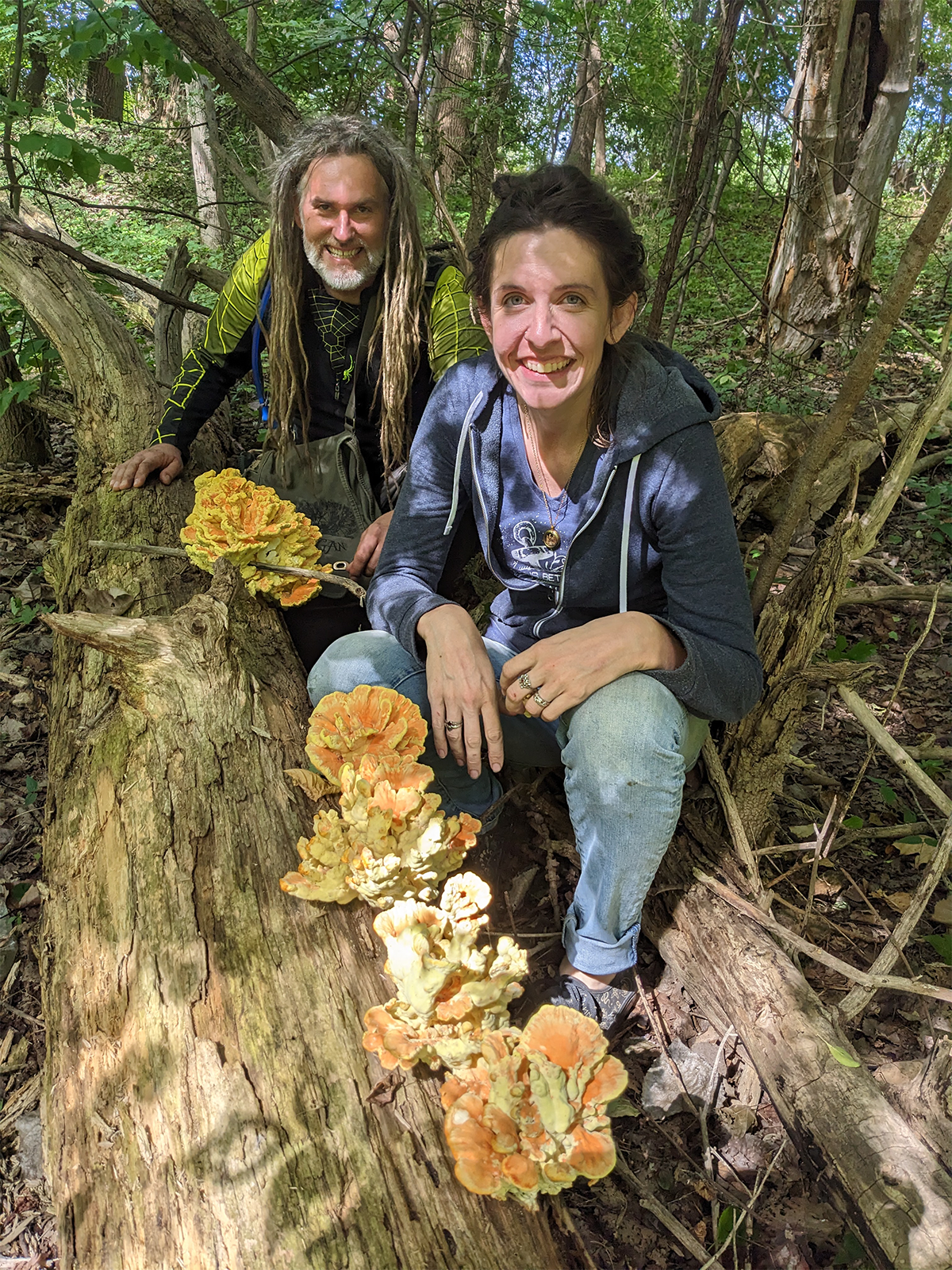
Research team member Nick King (background) and Erin Hamilton with Chicken of the Woods edible mushrooms (Laetiporus sulphureus) on a log in the Oxbow ecosystem, August 2025. / Photograph by staff of The Henry Ford.
During spring and summer 2025, Hamilton and King surveyed native fungi and collected data on Oxbow soil and water quality to serve as a baseline against which to measure change over time. Hamilton then identified native fungi with biochemical properties suitable to filter heavy metals. The research team assumed that oyster mushrooms would be the main mushroom used for the filtration system because they are one of the primary species used in remediation and typically grow throughout Michigan. Yet, the Oxbow supports fewer oyster mushrooms than anticipated, and this necessitated additional exploration.
Extensive fieldwork across the Oxbow and Suwanee Lagoon revealed a critical discovery: Enormous pheasant back or Dryad’s saddle mushrooms (Cerioporus squamosus) grow abundantly throughout the study areas and, remarkably, thrive despite significant environmental contamination including cyanobacteria, E. coli, and multiple pathogens. This finding has fundamentally shaped the project’s direction. The pheasant backs’ robustness in such compromised conditions suggests they are ideally suited for remediation work—capable of colonizing and breaking down pollutants that would inhibit most other species. Further research indicated that other studies have found significant success using a range of Cerioporus mushrooms (a type of white-rot fungus) in remediation, which was ultimately selected as the primary mushroom for the filtration system.
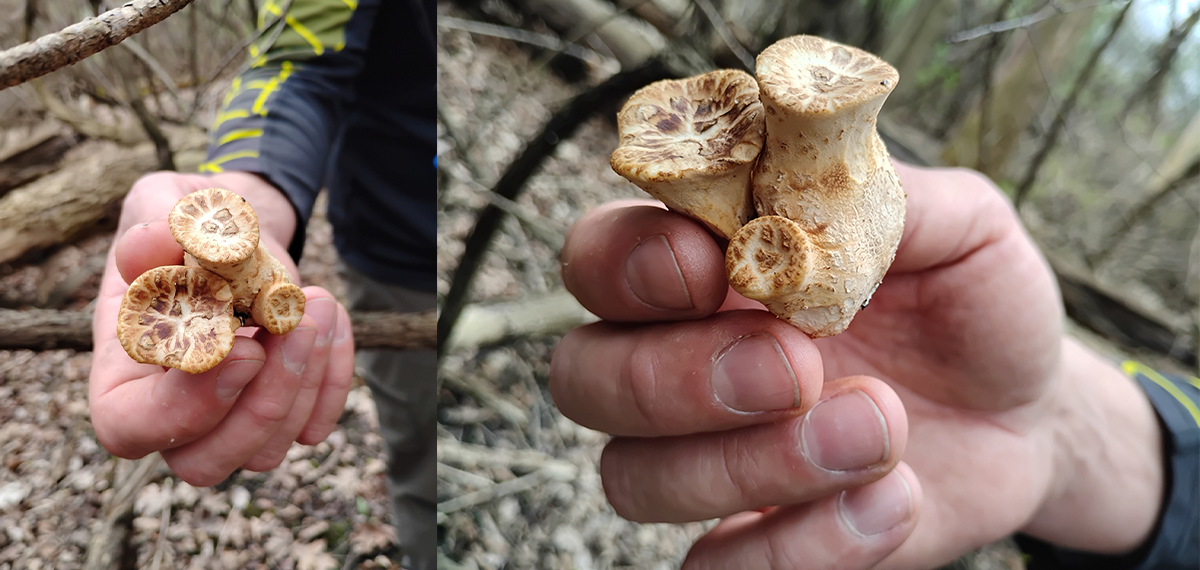
Pheasant back or Dryad’s saddle mushrooms (Cerioporus squamosus). / Photographs by Erin Hamilton.
Over the past year, collaborative sessions between The Mushroom Conservatory and Henry Ford Academy biology faculty and students have provided classroom experiences exploring fungi–ecosystem relationships and environmental stewardship. The location of The Academy is a benefit: The Oxbow channel runs directly along campus. In spring 2026, participating students will begin to test the beta filtration system and participate in broader educational programming including mushroom bucket-making sessions and forager hikes. More significantly, Academy students will help build the full mycofiltration system, transforming this from a research initiative into a genuine collaborative effort that reconnects education to the living ecosystems adjacent to campus.
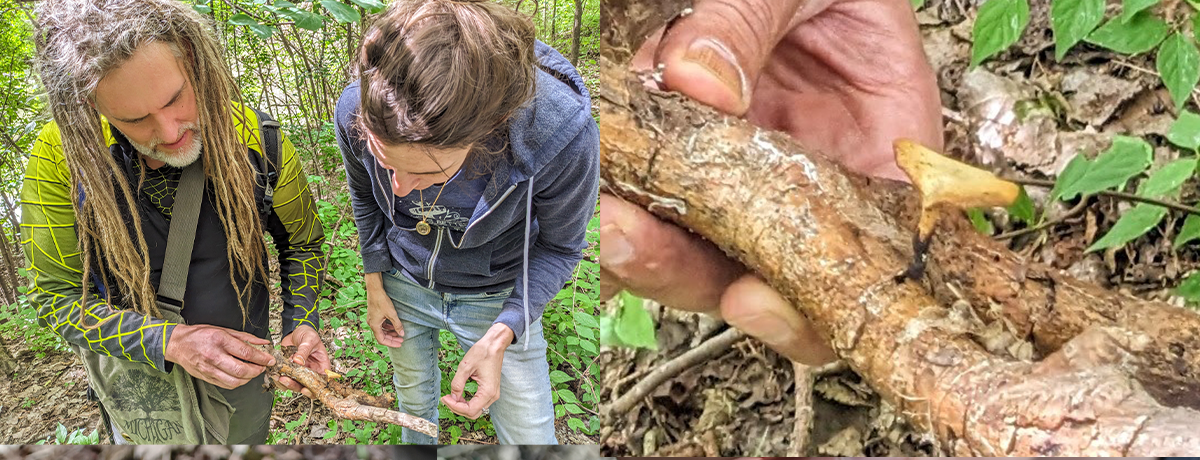 Nick King (left) and Erin Hamilton inspecting fungal growth on a rotting branch in the Oxbow, August 2025. / Photographs by staff of The Henry Ford.
Hamilton cultured the collected specimens during winter 2025-2026 and engineered a prototype mycofilter system. As spring weather permits, these systems are being deployed strategically within the Oxbow for real-world testing under field conditions. This transition from lab to field marks the critical phase where theoretical design meets practical application.
The research team is also preparing third-party lab validation to verify the mycofilter systems’ effectiveness against specific contaminants and PFAS compounds. This is groundbreaking work—the first fungi-remediation system operating at this scale with scientific rigor and economic scalability. The positioning is uniquely suited for demonstrating the realistic potential of fungi-based remediation as a global solution.
The work received significant attention through an article published in agricultural lifestyle magazine, Grit, and the project has garnered tremendous community support throughout the process.
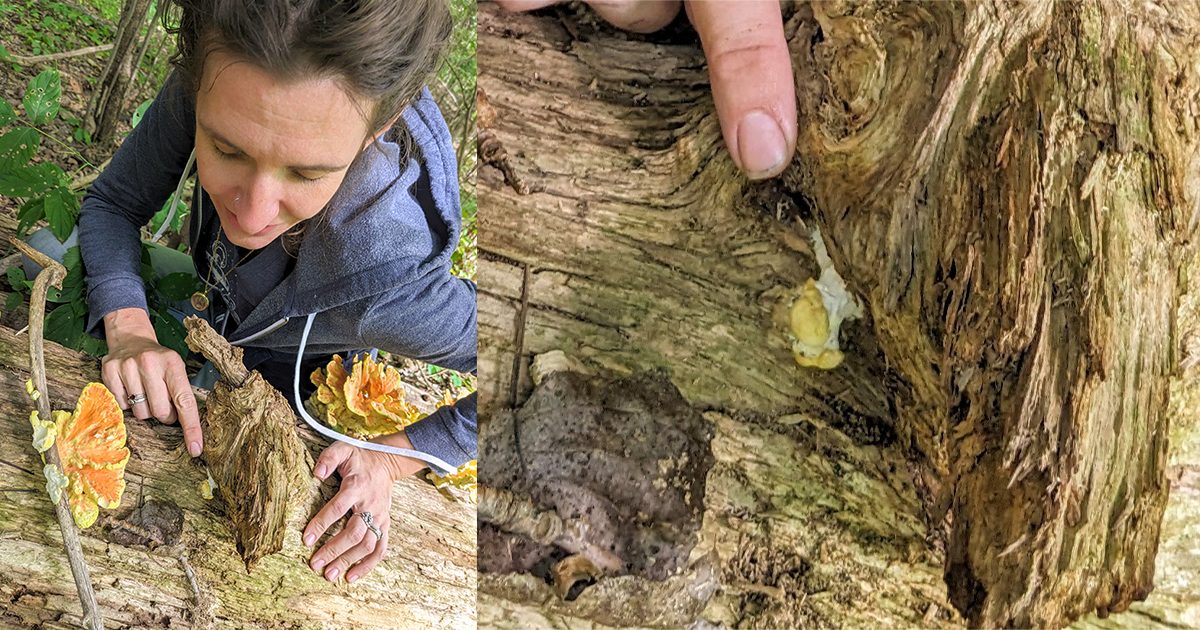
Erin Hamilton inspecting emergent fungi on the same log hosting the Chicken of the Woods in August 2025. / Photographs by staff of The Henry Ford
Debra A. Reid, curator of agriculture and the environment, The Henry Ford, and Erin Hamilton, The Mushroom Conservatory.
Works Cited
“Louis Charles Christopher Krieger, 1873-1940,” Mycologia (May-June 1941)
The Mushroom Handbook, 1936; Dover edition, 1967
Keywords | |
|---|---|
Themes |