
Not Just Sitting Ducks: Diving into the Story of Decoys
| Written by | |
|---|---|
| Published | 9/4/2026 |
Not Just Sitting Ducks: Diving into the Story of Decoys
| Written by | |
|---|---|
| Published | 9/4/2026 |
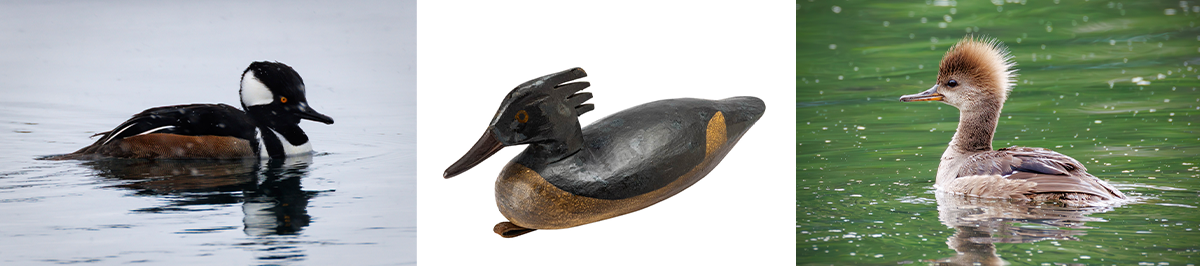
Left: Adult hooded merganser. Center: Hooded merganser decoy, 1900-1925, made by Doug Jester (1876-1961) of Chincoteague, Virginia. Right: Juvenile hooded merganser photographed on The Henry Ford property earlier this year. / Photos by staff of The Henry Ford (left and right), THF810734 (center)
Humans have long transformed available materials into tools to solve problems and accomplish essential tasks. From stone axes and arrowheads to baskets and pottery, these objects helped people hunt, gather, and store food. As hunting skills evolved, so did techniques for attracting prey. Hunters sometimes disguised themselves in animal skins or created lifelike decoys from reeds, sticks, roots, and hides stretched over wooden frames. Waterfowl were among the earliest animals targeted with decoys, and evidence of these hunting aids has been found across the world, including ancient Egypt, the Middle East, Europe, and among many Indigenous peoples of North America.
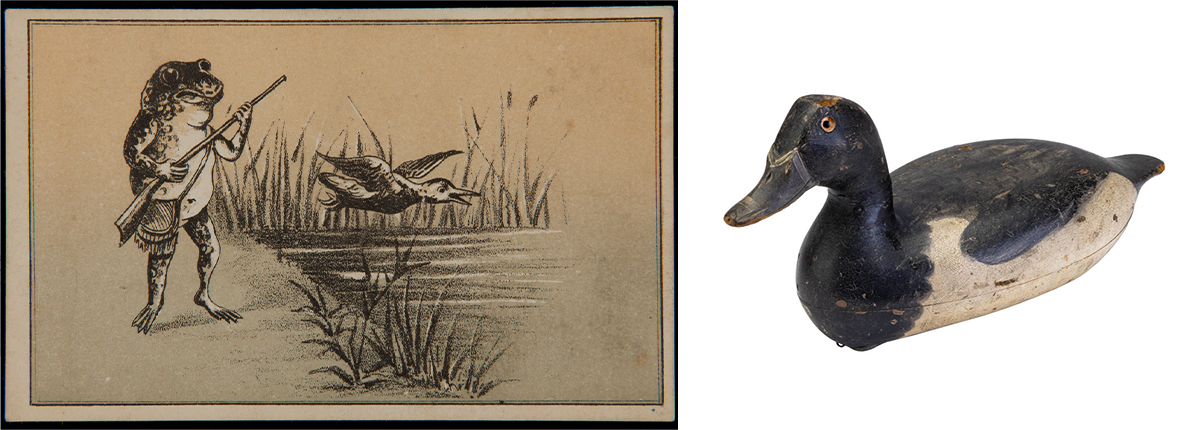
Left: Illustrated postcard with a scene of a frog hunting ducks in a swamp, advertising Fountain City Hotel in Wauseon, Ohio, circa 1880. Right: With his wife Catherine (1858-1953) skillfully painting his carvings, Robert Elliston (1849-1915) set the standard for the Illinois River school of carving. Pictured here is a ring-necked decoy, 1882-1915 (right) / THF215196 (left), THF810990 (right)
Early European settlers observed Native Americans using hunting decoys and soon adopted similar techniques. By the mid-19th century, growing populations and increasing demand for food led American hunters to carve decoys from wood, an abundant and durable material. At the same time, improvements in firearms—accelerated by innovations during the Civil War—gave hunters more efficient repeating rifles and shotguns, increasing hunting success.
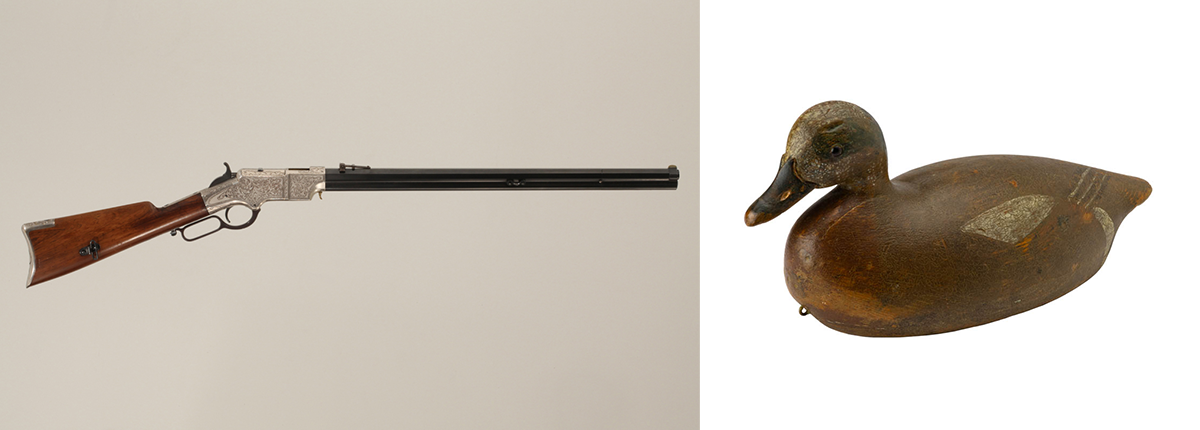
Left: Technological innovations in firearms, like this Henry Repeating Rifle, circa 1865, helped market gunners shoot more waterfowl at one time. Right: Nate Quillen (1839-1908) was a precise craftsman who took his time with his decoys, drying logs for two years before carving. Quillen made this wigeon decoy in 1894 for a member of the Pointe Mouillee Shooting Club in Rockwood, Michigan. / THF151632 (left), THF810921 (right)
The last quarter of the 19th century and the early 20th century marked the golden age of decoy making. Millions of birds were killed across North America, contributing to the extinction of species such as the passenger pigeon and Labrador duck. Public concern over declining bird populations prompted conservation legislation, including the Migratory Bird Treaty Act of 1918 in the United States and Canada. The new laws restricted market hunting, thereby hampering the craft of commercial working decoys.
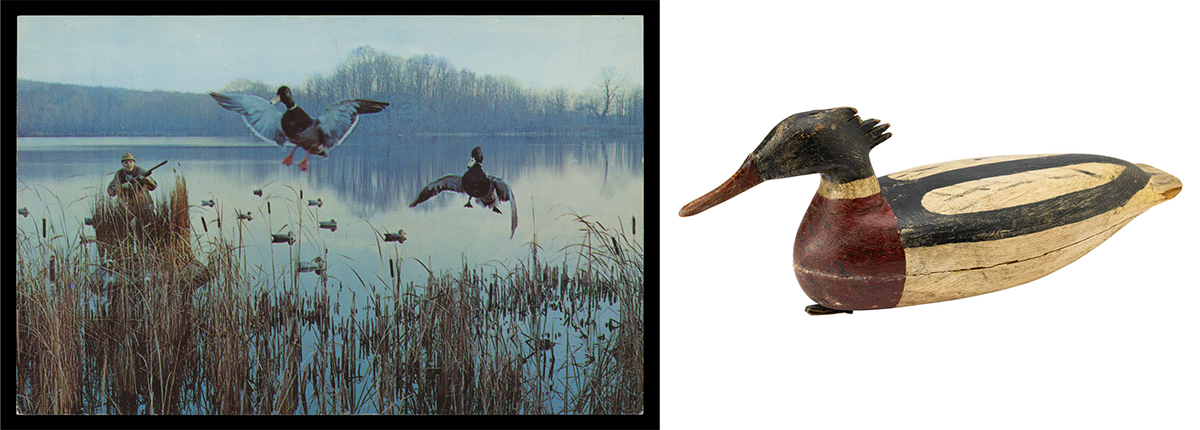
Left: Photographic postcard shows a hunter in a boat surrounded by decoys, shooting at ducks, postmarked 1962. Right: Mark English (1872-1968) was a market hunter in the Northfield, New Jersey, area who made this red-breasted merganser decoy, circa 1900. / THF736673 (left), THF810967 (right)
After World War II, manufacturers increasingly produced decoys using machines and modern materials like plastic. In response, many traditional carvers shifted their focus from functional hunting equipment to decorative and artistic works. Renewed interest in American folk art and craft during the 1960s and 1970s sparked a growing market for decoys, particularly examples associated with well-known regional carving traditions. The collecting of decoys expanded rapidly, and driving up auction prices. Today, contemporary carvers continue to produce both working decoys and sculptural birds for collectors for sale online, or in person at shows and festivals.
ANATOMY OF A DECOY
Decoys represent a wide variety of bird species, including ducks, geese, shorebirds, owls, and crows. Most consist of a solid or hollow body with a carved head and neck attached. Bottoms may be flat, rounded, or V-shaped, often with a keel for stability, while lead or weighted metal provides ballast. Loops near the waterline allow hunters to attach lines and anchors.
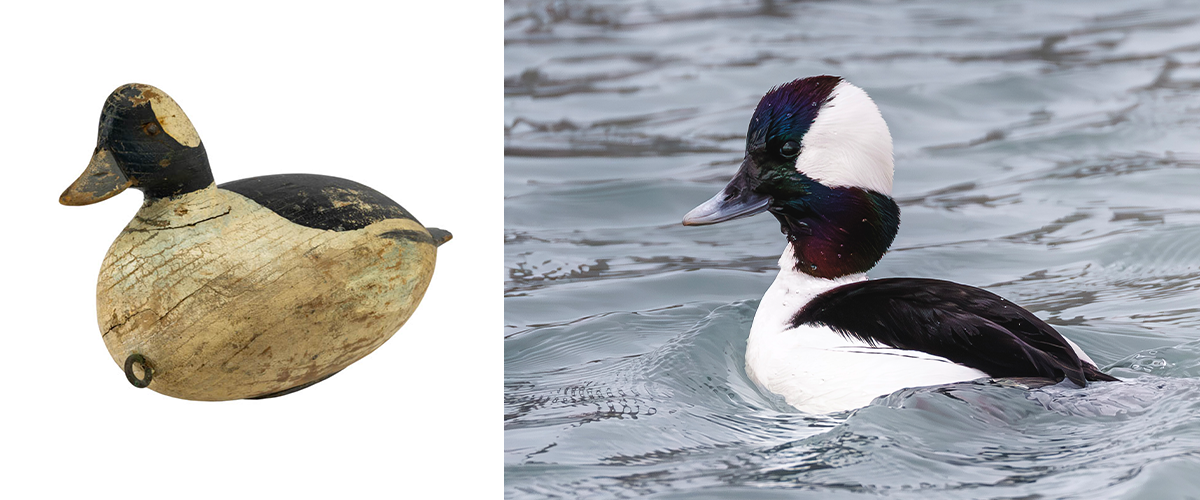
Left: Ira Hudson (1873-1949) was a prolific decoy carver in Chincoteague, Virginia, who used available materials such as ship parts to make decoys like this bufflehead decoy, circa 1910, in well-known style of full “fat” body decoys. Right: a bufflehead in water. / THF810955 (left), photo by staff of The Henry Ford (right)
Construction and decoration varied widely. Some decoys feature intricately carved bills, wings, tails, and feather details, while others rely on simple, streamlined forms. Paint ranges from broad blocks of color suggesting plumage to highly detailed feather patterns created by combing wet paint to produce textured patterns.
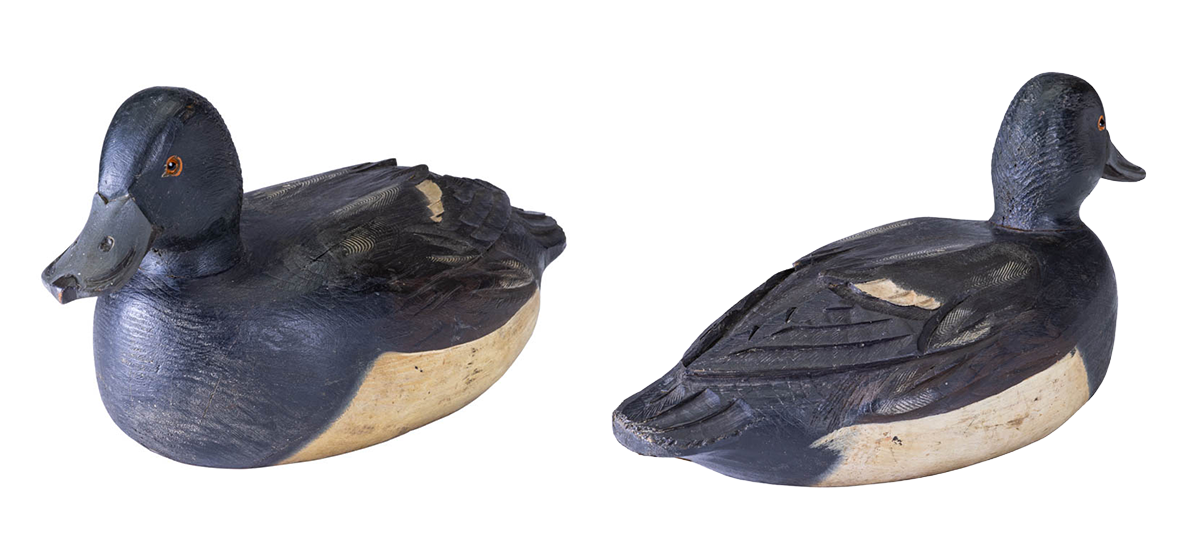
Two views of a scaup decoy, circa 1925, by Orel LeBoeuf (1886-1968) of Saint-Anicet, Quebec, Canada. LeBoeuf’s style evolved from heavy and plain to birds with intricately carved feathers created by using a draw knife and penknife. His paint colors were created by mixing colors to match recently harvested birds. / THF811085 (left), THF811086 (right)
Regional differences became especially pronounced during the golden age of carving. Local waterfowl species, hunting and water conditions, available materials, and nearby carving traditions all influenced design. As a result, distinct regional "schools" of carving are recognized across Canada and the United States. Decoys from the Maritime provinces and northern New England, for example, differ from those produced around the Long Island Sound, while the forms developed along Michigan's Detroit River and Lake St. Clair are distinct from those of Crisfield, Maryland, or Virginia’s Eastern Shore.
Regional Decoys


Exceptional Carvers: Crowell, Holmes, and Perdew


As demand grew during the late 19th and early 20th centuries, commercial production expanded from small family workshops to larger factories. The Stevens Decoy Factory in Weedsport, New York, started in the 1860s when brothers Harvey and George Stevens produced handmade decoys for sale. After advertising in national magazines in 1880, the business expanded to employ several workers before closing following Harvey’s death in 1894.
Larger factories popped up in cities like Detroit. Woodworker and machinist George Peterson established one of the earliest commercial decoy factories in 1873. Jasper N. Dodge (1829-1909) bought Peterson’s business assets around 1884 and expanded the operation, producing several grades of decoys ranging from premium models to inexpensive working birds.
Factory Decoys


The best-known manufacturer was the Mason Decoy Factory, founded by William Mason, who was making decoys out of a shed behind his home. Mason purchased Dodge Decoy Factory’s assets and hired some of their workers. Mason produced five grades of decoys, from the high-quality Premier line to economical painted-eye models, shipping products throughout the United States. With the conservation laws reducing demand, the company closed in 1924. The William E. Pratt Manufacturing Company of Joliet, Illinois, purchased Mason’s production lines and assets, manufacturing decoys until the late 1930s
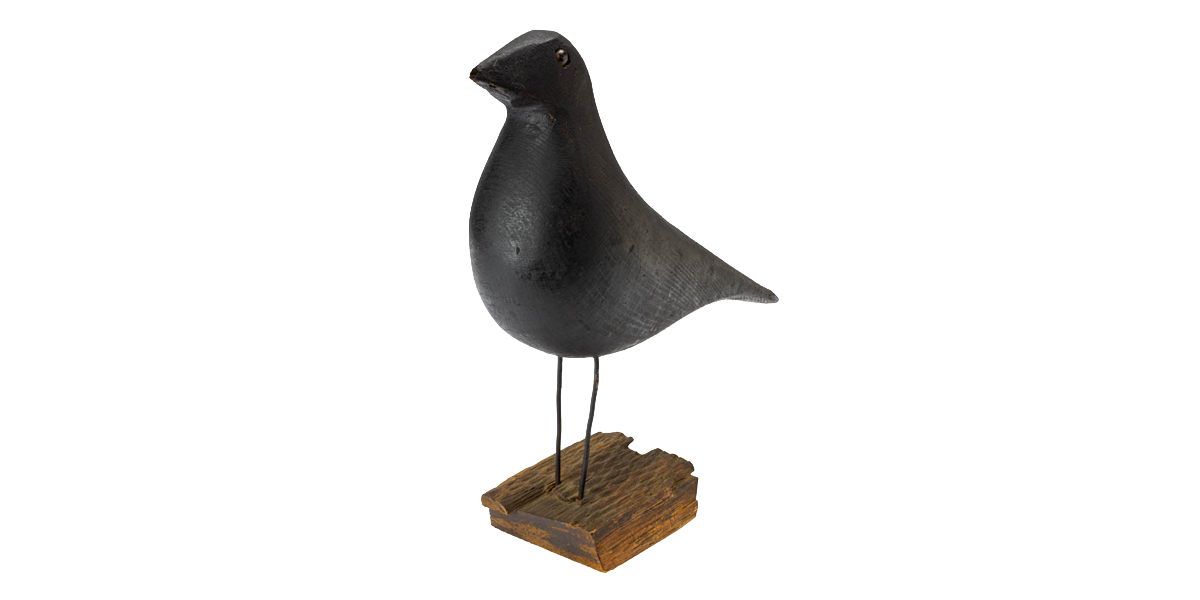
Besides hunting, decoys such as crows, owls, and other birds of prey are used for pest deterrence to protect gardens, crops, and animal feed. The William E. Pratt Manufacturing Company, which started as a hardware business in Chicago in 1893 before expanding into an iron foundry in Joliet, Illinois, made this crow decoy, 1936-1938. / THF810746
DECOY COLLECTIONS AT THE HENRY FORD
The Henry Ford’s collections hold approximately 420 waterfowl decoys. Although a few trickled into the collection earlier, more than 80 percent were acquired during the 1960s and 1970s as the museum expanded its holdings in American folk art.
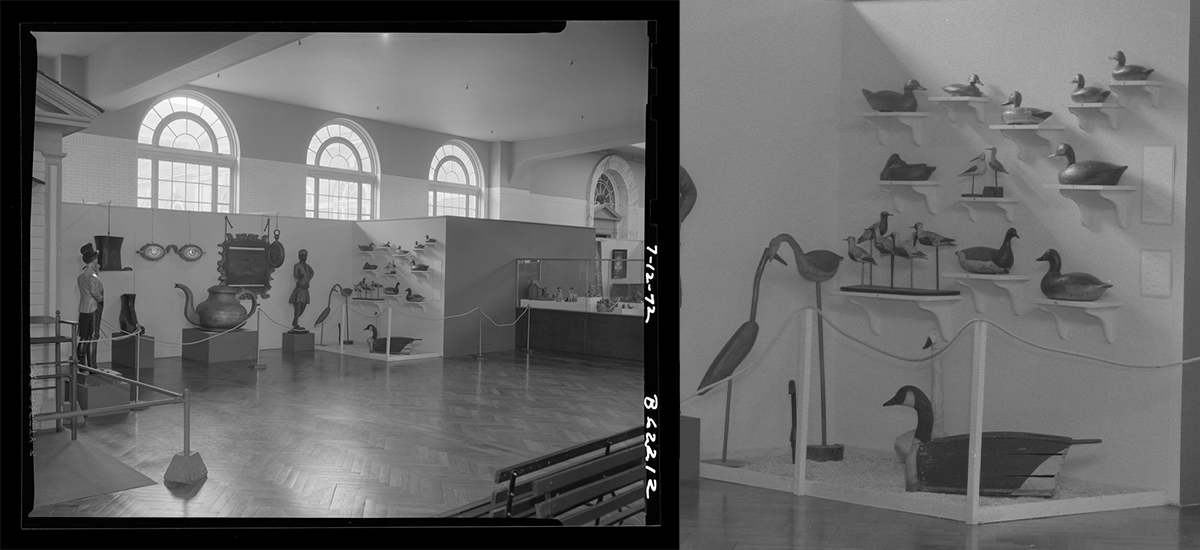
Image of the exhibit “American Folk Art and Decoration” showing the shop sign and duck decoys displays, 1972 (left). Detail of the image, cropped to the duck decoy display (right). / THF734077
Several major acquisitions came from prominent collectors. In 1965, William J. Mackey Jr., whose book American Bird Decoys helped establish the field of decoy scholarship, sold fifty examples from his sizable collection to the museum. In 1972, the museum acquired 103 decoys, a decoy shop sign, and a duck boat from Maze Pottinger Antiques in Bloomfield Hills, Michigan. Recent research has shown that these objects came from the renowned collection of Michigan collector Phyllis Ellison, who also donated extensively to the Michigan State University Museum.
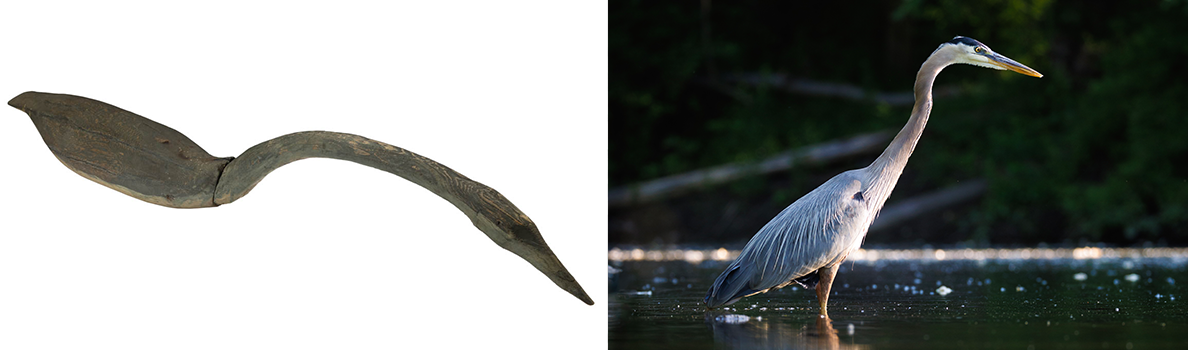
Former Henry Ford Museum editor and curator Robert Bishop (1938-1991) included this simple but effective decoy of a heron, 1885-1900, in his book American Folk Sculpture (1974). / THF374402 (left), photo by staff of The Henry Ford
Later that year, the museum purchased ninety decoys from Dr. Joseph Bard French, whose collection notes documented carvers, places of origin, acquisition histories, and published references. Purchase of another 105 decoys in 1966 and 1970 from Mary Thornton Antiques in Norwalk, Ohio, further strengthened the collection.
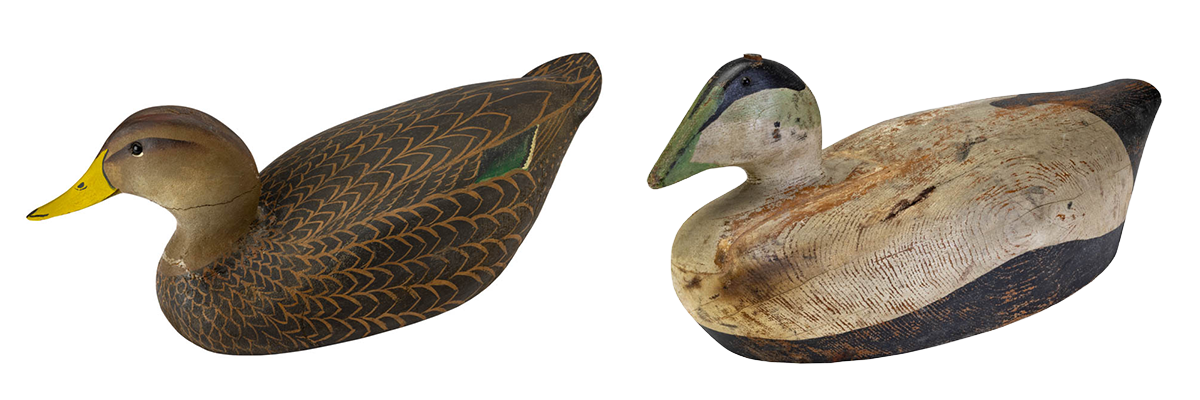
Left: The Ward brothers — Lemuel (1896-1984) and Stephen (1895-1976) — made decoys that transcended functional tools into art. Their focus on “extreme realism” can be seen in this black duck, 1948-1955. Right: Captain Merritt P. Pinkham (1861-1947) was a lighthouse keeper on Seguin Island, Maine, who carved this large eider decoy, 1890-1900, from the salvage of a shipwreck. / THF810958 (left), THF810981 (right)
From simple hunting tools to celebrated works of folk art, North American waterfowl decoys reflect changing relationships between people, wildlife, craftsmanship, and conservation. Their regional styles, innovative construction, and artistic qualities preserve the traditions of generations of hunters and carvers while offering insight into the cultural and environmental history of North America.
Aimee Burpee is an associate curator at The Henry Ford.
For more photographs of birds in and around southeast Michigan, check out @smithtelephoto, who kindly shared his photography and expertise for this article.