
“Raw Courage”: Farm Families from Marion to Montgomery, 1965
| Written by | |
|---|---|
| Published | 3/23/2026 |
“Raw Courage”: Farm Families from Marion to Montgomery, 1965
| Written by | |
|---|---|
| Published | 3/23/2026 |
What would you do if, in the tenth year after Emmett Till’s murder in Mississippi, the sheriff of your town — in this case, Jim Clark in Selma, Alabama — sent your high schooler off on a two-and-a-half-mile run into the countryside? Clark subjected high school students who had been demonstrating in front of the Selma County Courthouse to this treatment. The Black students perceived assembling at the courthouse as an exercise of their constitutional rights. The actions of the white sheriff, pushing the students out of town and away from family, demonstrated white supremacy.
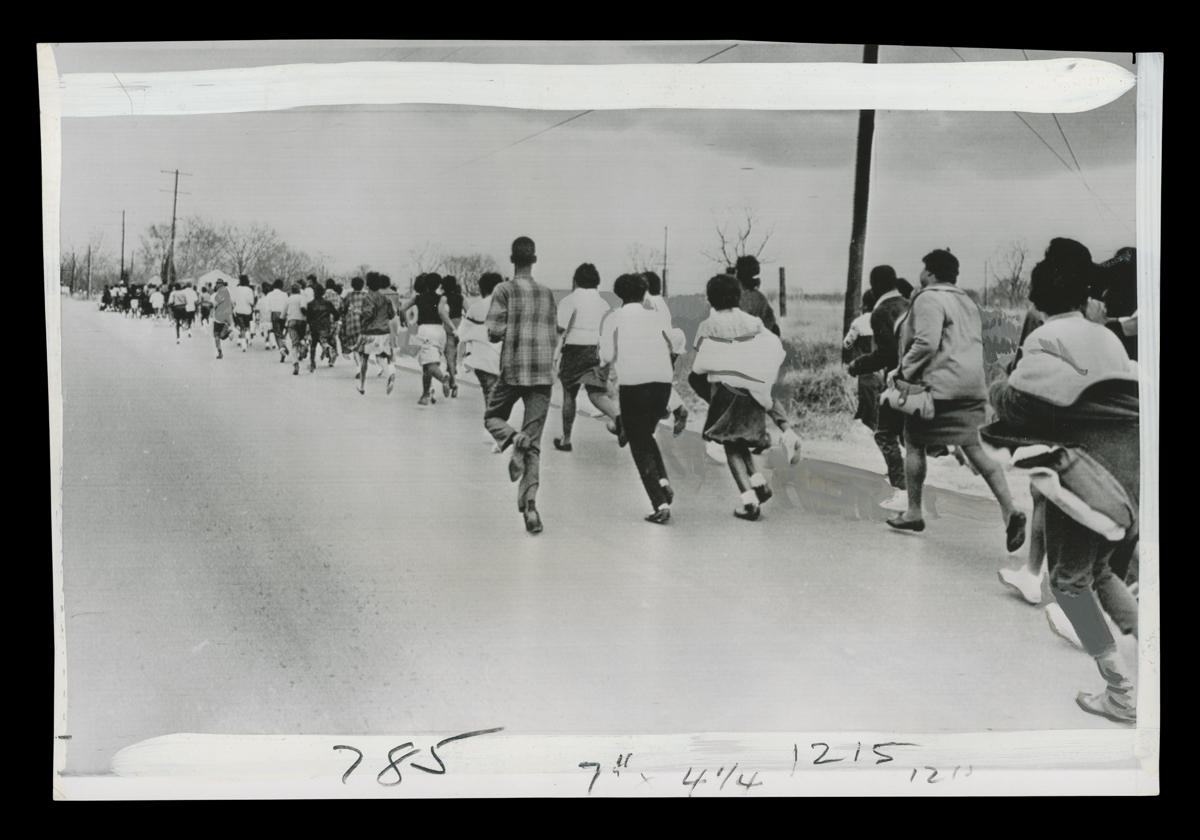
Students running to keep up with Sheriff Jim Clark during a forced march out of Selma, Alabama, February 10, 1965. / THF730294
Farm families in Alabama knew well the association between the countryside and lawlessness. Some of those most involved with organizing the Selma marches grew up and lived within this milieu. Their actions during February and March 1965 confirmed the courage required within and beyond the countryside to effect change. This applied especially to the three farm families who provided land for marchers to camp overnight. A correspondent with the weekly magazine Jet described their fortitude as “raw courage” (April 8, 1965, page 46).
Two activists, one well known locally and one well known globally, shared memories of childhood on the family farm. Jimmie Lee Jackson grew up near Sprott and Coretta Scott King grew up near Heiberger, both in Perry County. Both valued education and community engagement. Coretta Scott met Juanita Lee, Jimmie Lee Jackson’s aunt, during high school in Marion, Alabama, and Scott described Lee as one of her best friends. Jackson also graduated from Lincoln High School in Marion, and he tried to register to vote five times after turning 21 years of age. His pursuit led to his murder in Marion when a peaceful voting rights gathering turned deadly. At Jackson’s funeral, one minister eulogized him as “a man. . . picking cotton, plowing corn or following a mule.” Black rural and farm families knew the risk, and it did not stop them from seeking the vote and pursuing justice.
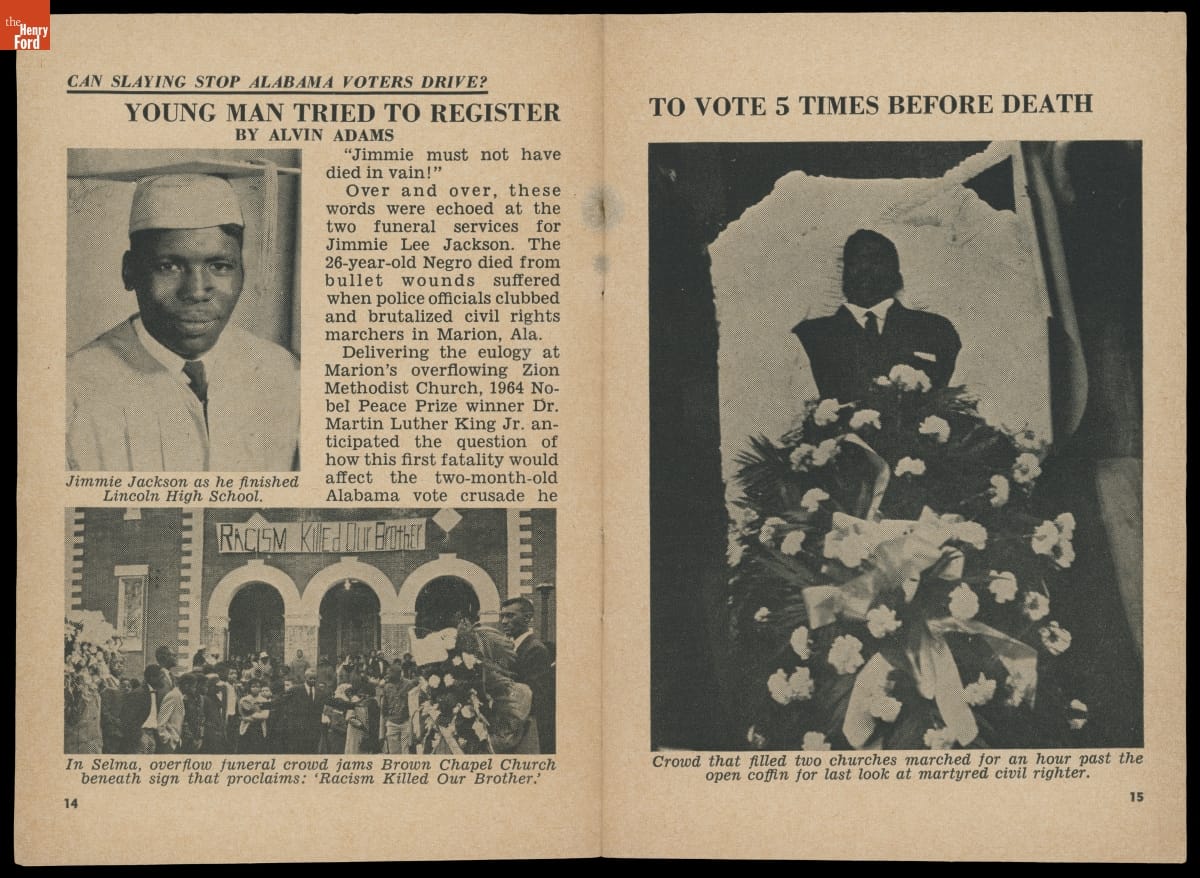
Jimmie Lee Jackson, shot in Marion, Alabama, February 18, died February 26, 1965, as reported in Jet, March 18, 1965. / THF726612
The Southern Christian Leadership Conference (SCLC), founded in 1957 in Atlanta, engaged directly with rural and farm families in Alabama as did the Student Nonviolent Coordinating Committee (SNCC), founded in 1960 in Raleigh, North Carolina. John Lewis, the chair of SNCC between 1963 and 1966, could speak directly to the majority experience as he had grown up in a sharecropping family in Pike County, Alabama.
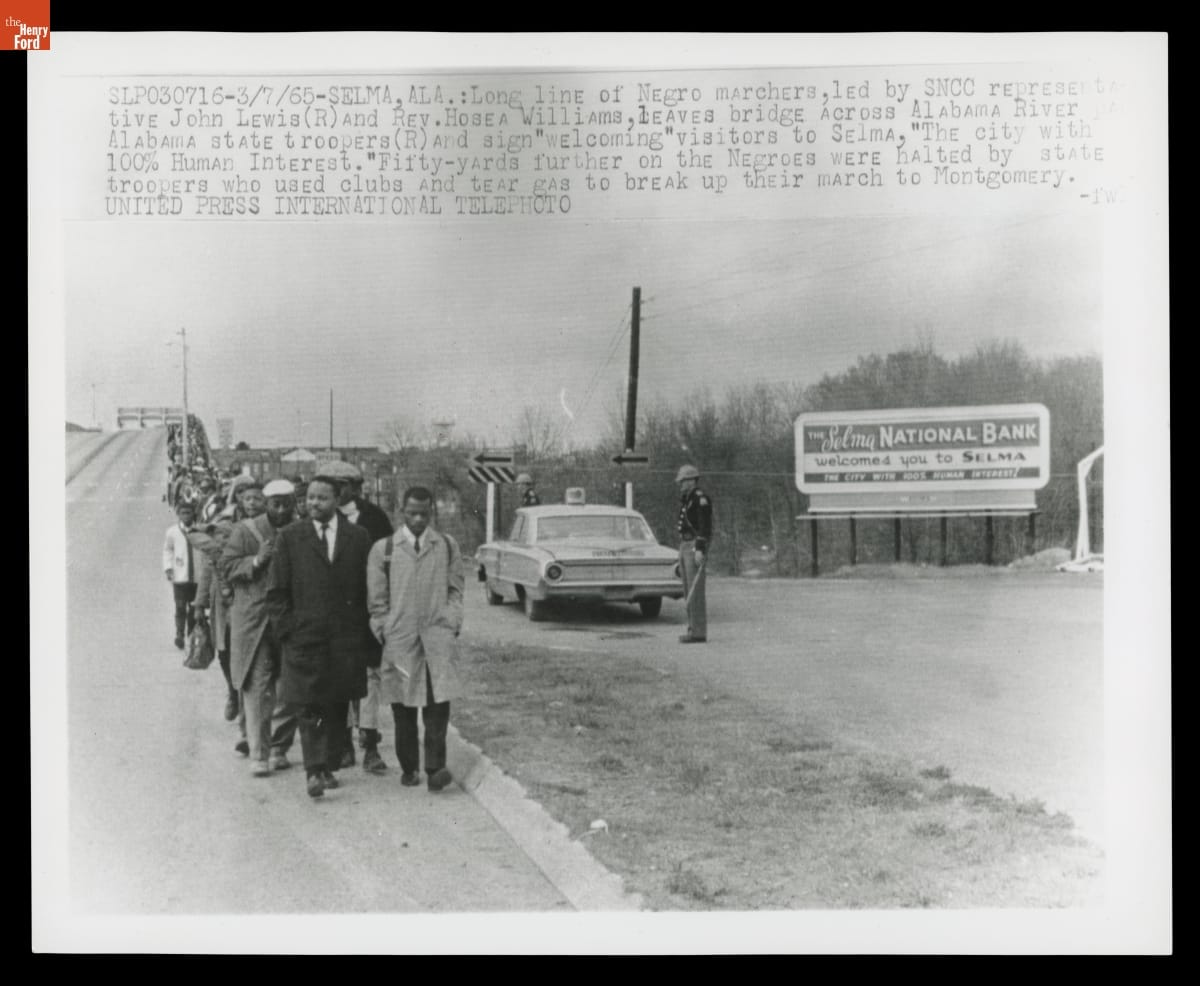
John Lewis (right), son of sharecroppers, and Rev. Hosea Williams, leading marchers over the Edmund Pettus Bridge, March 7, 1965. / THF730308
A support system existed within rural Alabama that allied with the SCLC and SNCC officials. Agents employed by the Agricultural Extension Service operated out of Tuskegee Normal and Industrial Institute, but state leaders of the work reported to white administrators at Auburn University. The Black agricultural agents and home demonstration agents often worked with landowning families who had more authority over their time and economic decisions. The agents tended to emphasize soil care, livestock management, human nutrition, and home improvement. But agents also organized clubs through which members, young and old, male and female, could learn parliamentary procedure, practice debate and decision-making, and encourage lifelong learning. These agents became conduits for information between organizations like the SCLC and SNCC. The first Black agricultural agent in Perry County, Lawrence C. Johnson, started in 1938 and retired in 1962. He served as a contact in Marion for the SCLC and he was listed among registered voters in 1962, according to Valerie Pope Burnes’s 2012 dissertation on African Americans in Perry County (page 154).
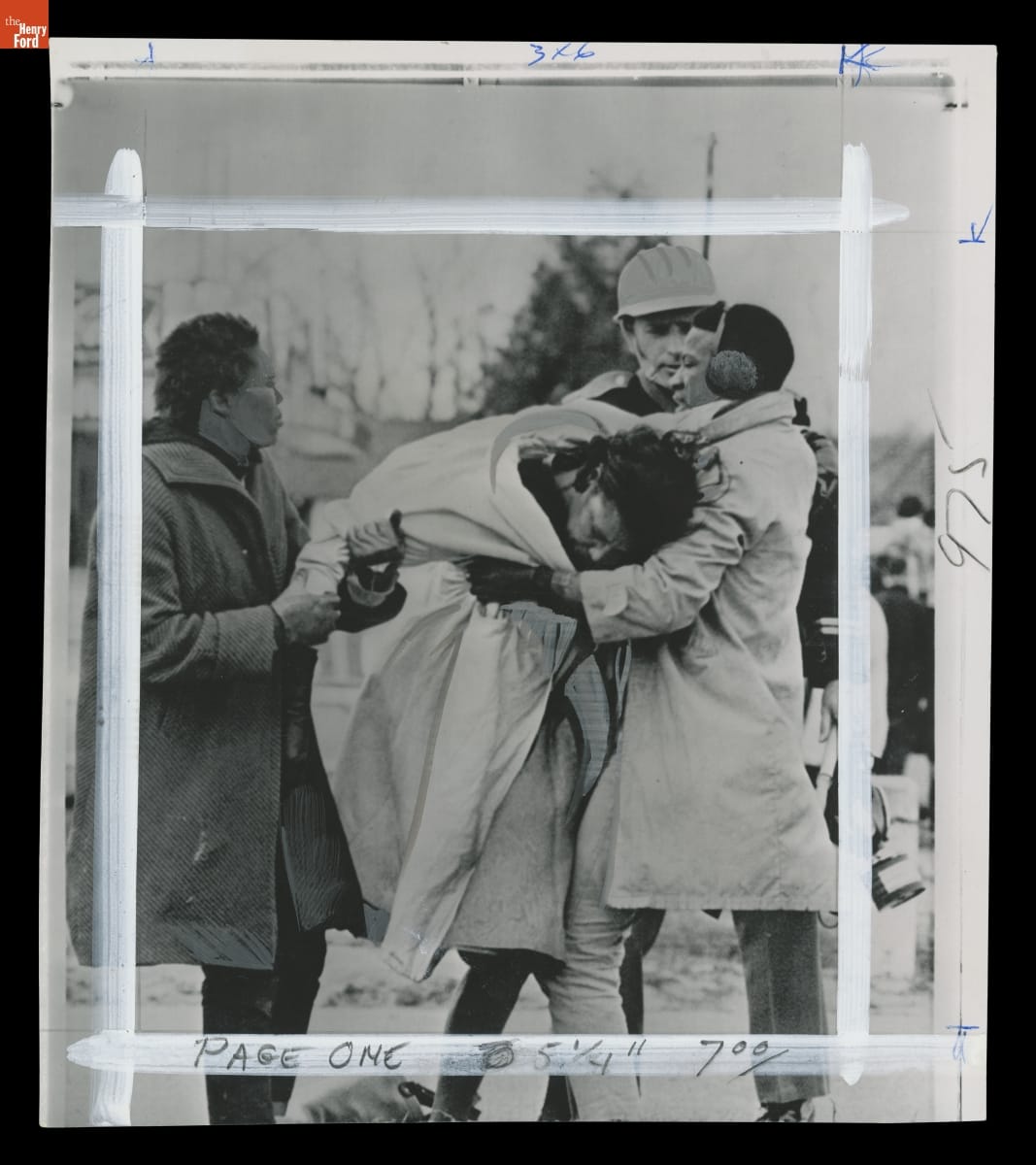
Amelia Boynton, widow of Samuel W. Boynton, reeling from blows struck during “Bloody Sunday,” Selma, Alabama, March 7, 1965. / THF730274
Some agricultural and home demonstration agents became more centrally involved with the voting rights movement than others. Amelia I. Platts became Dallas County’s Black home demonstration agent in 1930. She worked with Black county agent Samuel W. Boynton, and the two married in 1936. In addition to their jobs with rural and farm families, they registered people to vote. The Alabama Elks Lodge in Selma described them as “Mr. and Mrs. Civil Liberties” in 1945. After Samuel Boynton's retirement from the extension service in 1951, the activism shifted to Amelia Boynton's home business, the Boynton Real Estate and Insurance Office. Amelia Boynton’s raw courage sustained her after Samuel died in May 1963, and her work with the SCLC and the Dallas County Voters League earned her a spot among the Courageous Eight in Selma (Amelia Platts Boynton Robinson, Bridge Across Jordan, rev. ed., 1991).
Activist and organizer persistence culminated in a successful march from Selma to Alabama’s capital between March 21-25, 1965. The Selma to Montgomery National Historic Trail marks the fifty-four-mile route. Participants walked along the Dixie Overland Highway (also designated as U.S. 80 and the Jefferson Davis Memorial Highway).
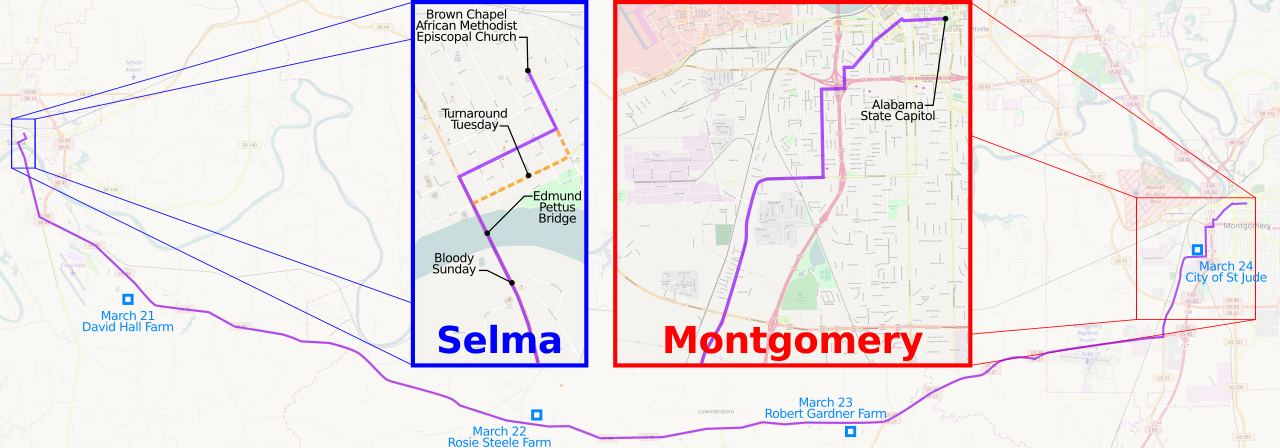
Map showing route of Selma to Montgomery marches in March 1965. Includes campsites. Vector overlay on OpenStreetMap raster, derived from National Park Service brochures and information for Selma To Montgomery National Historic Trail (Creative Commons, 2017).

Marchers passed through the Alabama Black Belt, an agricultural region notable for fertile soil, exploitative labor practices, and personalized violence. Editors of Jet described the landscape as “swampy marshland” and the fifty-four miles as a “pitch black roadway with dangerous curves” (April 8, 1965, page 3). Organizers relied on Black farm families to volunteer their properties as rest stops along the route. The three who did so, David Hall, Rosie Steele, and Robert and Mary Gardner, “became major civil rights heroes” as a result. Jet briefly reported on each (April 8, 1965, pages 46-48). The work of preservationists and the film 54 Miles to Home (2021), directed by Claire Haughey and presented by Southern Exposure Films, draw attention to their experiences.
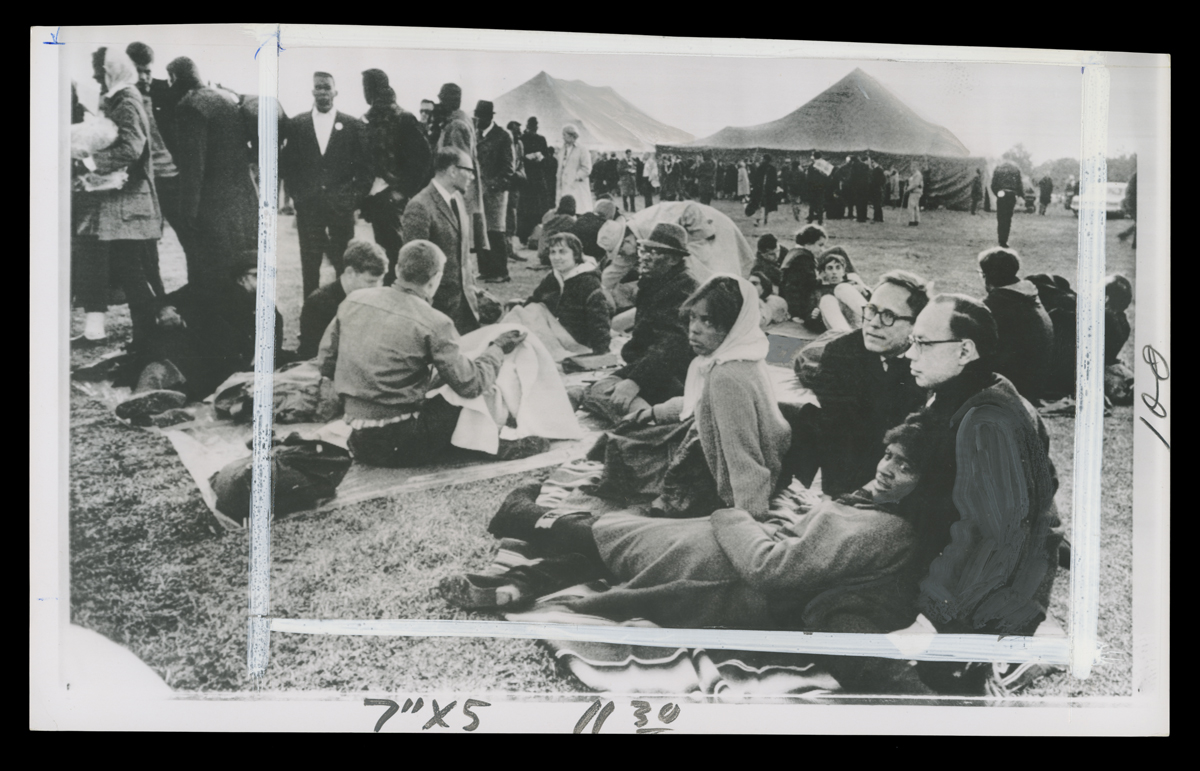
First encampment for marchers, David Hall Farm, March 21, 1965. / THF730286
Each farm family represented a different approach to farming in 1960s Alabama. Some owned land. Some served as anchors of unincorporated rural communities. Some worked off the farm to ensure economic solvency. One worked as a tenant to a Black landowner. Each had to navigate challenges imposed by decades of racial segregation and oppression. Each experience confirmed that a combination of personal decisions, familial connections, church and civic group support, agricultural networks, and activist organizations supported their cause.
David Hall, a 60-year-old father of eight, offered his farm as a stop along the way because “it is the thing to do” (Jet, April 8, 1965, page 46). Family members recalled that he paid $1,800 for 80 acres of farmland about nine miles from Selma, in Dallas County, in 1935. The U.S. agricultural census for that year reported that only 8 percent of Black farmers in Dallas County owned their farmland, compared to 92 percent of Black farm operators (tenants and croppers) who labored on someone else’s land.
During the second day, marchers passed through unincorporated Black communities like Trickem Fork. In the May 22, 1965, article, “The Meaning of the Selma March: Great Day at Trickem Fork,” Saturday Evening Post reporters focused on it as an example of impoverishment caused by racial discrimination. The farm stop on the evening of the second day reinforced this message. Rosie Steele, 75 years old in 1965, and her family operated a store that anchored a small rural community in Lowndes County. Steele’s grandchildren described her as a property owner, businesswoman, widow raising six children, and fearless (54 Miles to Home). Steele told Jet reporters that “I’m not afraid because I’ve lived my three score and ten” (April 8, 1965, page 47).
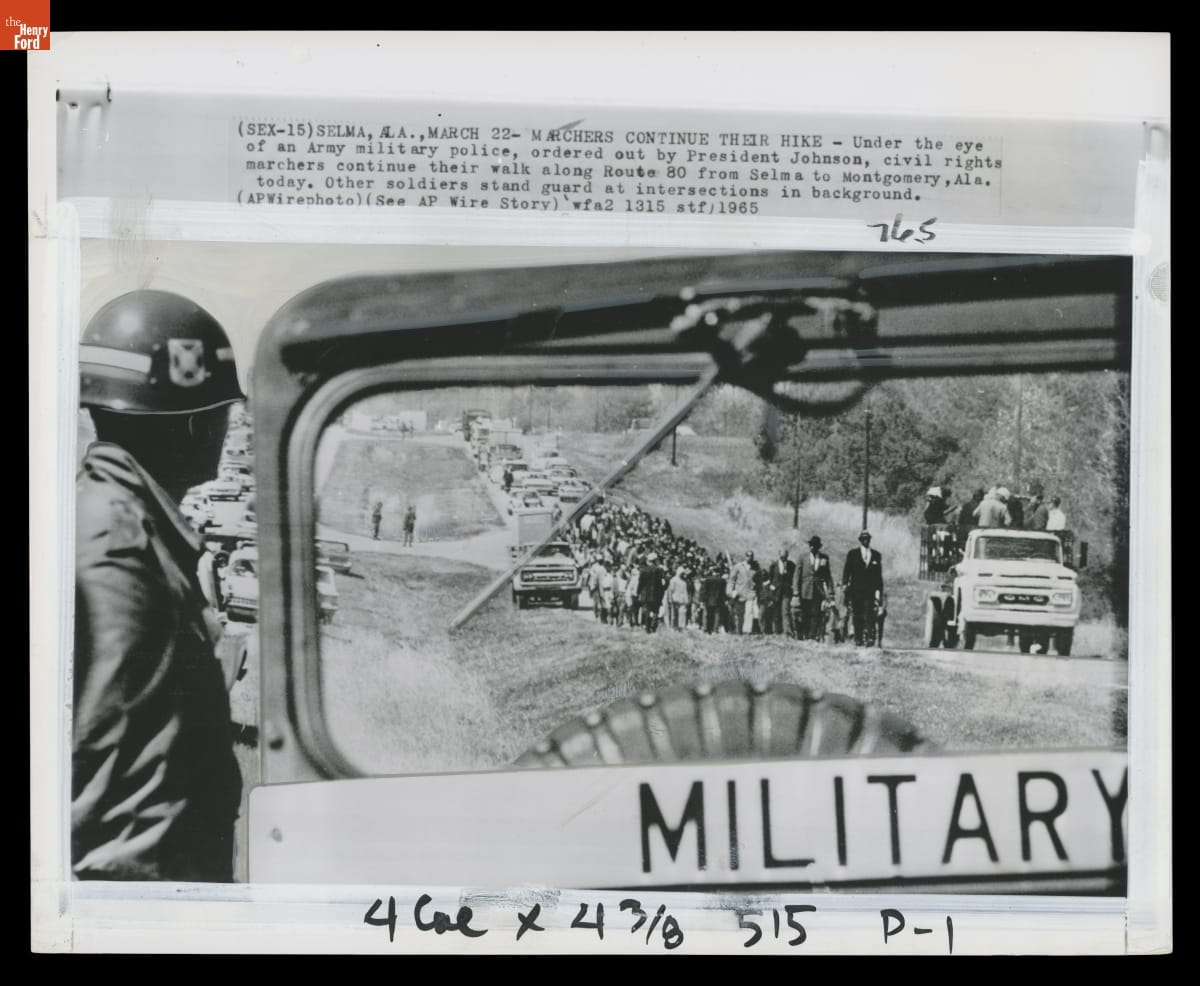
A military policeman watches from beside his Jeep as civil rights activists march from Selma to Montgomery, March 22, 1965. / THF730291
The third stop on the evening of March 23 occurred because Black entrepreneur and landowner Arthur G. Gaston volunteered land farmed by Robert Gardner and family to march organizers. Robert, 40 years old in 1965, grew up in the farmhouse that he, his wife Mary, and their four children called home. Family members interviewed for 54 Miles to Home recalled that the land equaled food security. Yet, supporting the march made the Gardner family a target, destroying the security that the land afforded. Bullies cut phone and electric wires and trained shotguns on the family.
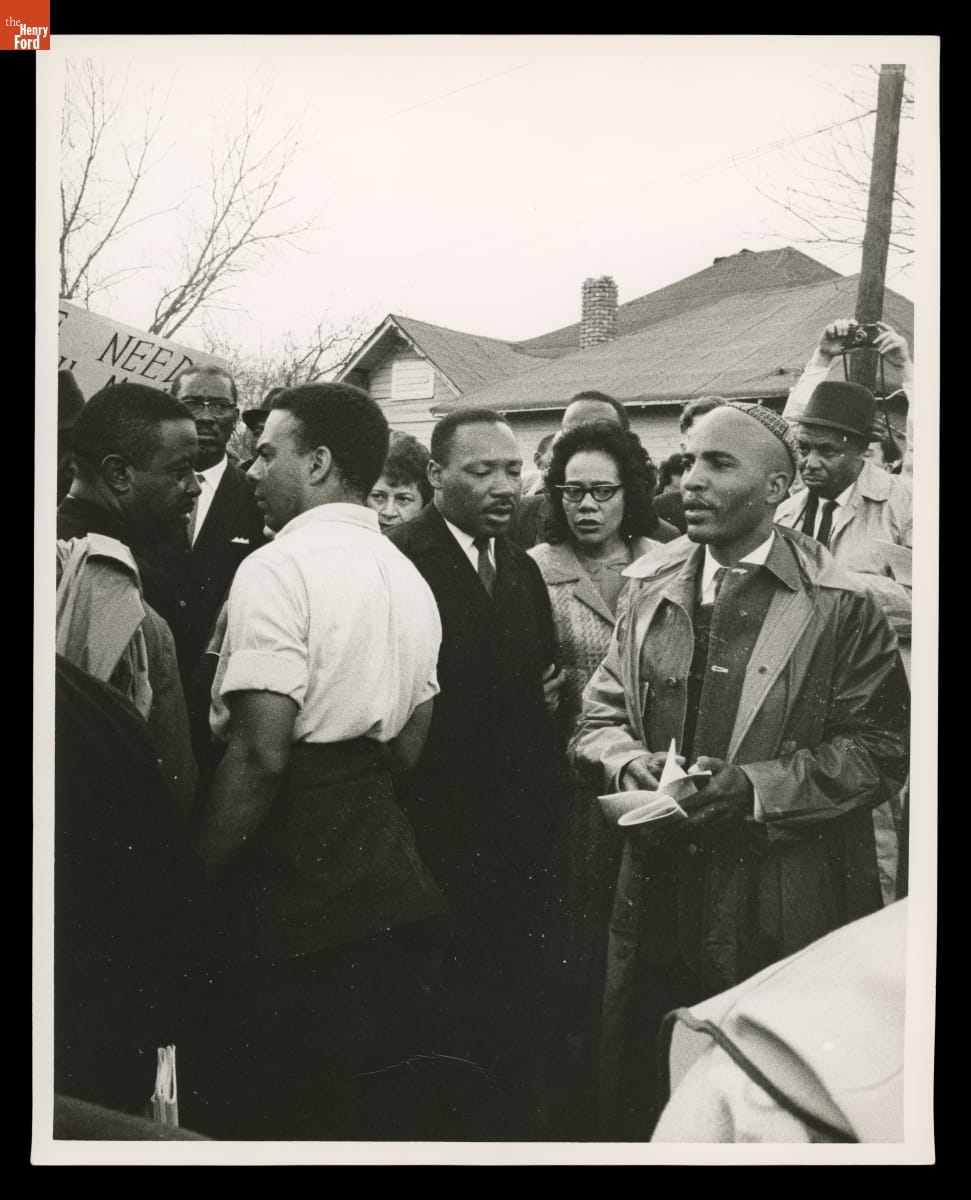
Martin Luther King Jr. and Coretta Scott King with marchers in Montgomery, Alabama, March 25, 1965. / THF731429
Between overnight stops, the military police watched marchers move along the Dixie Overland Highway, inching closer to their destination — the office of Alabama Governor George Wallace. More than 25,000 strong on March 25, 1965, marchers stopped to listen to Martin Luther King Jr. deliver his “How Long, Not Long” speech. In it, he described the march as “a pilgrimage of clergymen and laymen of every race and faith pouring into Selma to face danger.” Supporters included an inestimable number of farm families, children raised on farms, like Coretta Scott King and John Lewis, Jimmie Lee Jackson, and Robert Gardner. All drew on raw courage to overcome.
Debra A. Reid, curator of agriculture and the environment, The Henry Ford.
Keywords | |
|---|---|
Series | |
Themes |