
Engraving, "The First Reading of the Emancipation Proclamation Before the Cabinet" 1866
THF6763 / Engraving, "The First Reading of the Emancipation Proclamation Before the Cabinet" 1866
01
Artifact Overview
Following the American Civil War, this engraving commemorated a crucial event and became popular for classroom display across the country. On July 22, 1862, President Abraham Lincoln first read the Emancipation Proclamation to his cabinet officers. Publicly announced by Lincoln in September 1862 to become law on January 1, 1863, it was the essential first legal step in eliminating slavery.
Following the American Civil War, this engraving commemorated a crucial event and became popular for classroom display across the country. It illustrates President Abraham Lincoln's first reading of the Emancipation Proclamation to his cabinet officers on July 22, 1862. Seated with papers in his lap, he is surrounded by the members of his cabinet. Text printed below the image identifies the men, left to right, as Edwin M. Stanton (Secretary of War), Salmon P. Chase (Secretary of the Treasury), President Lincoln, Gideon Welles (Secretary of the Navy), Caleb Smith (Secretary of the Interior), William H. Seward (profile, Secretary of State), Montgomery Blair (Postmaster General), and Edward Bates (Attorney General). Alexander Hay Ritchie engraved this large black-and-white print in 1866 based on the painting that Francis Bicknell Carpenter made in 1864 for display in the White House. For the many American abolitionists, the Emancipation Proclamation publicly announced by Lincoln in September 1862 to become law on January 1, 1863, was the essential first legal step in eliminating slavery throughout the United States. For the almost four million enslaved Americans, it gave them the hope of freedom and becoming equal citizens in the country they labored for so long to build and maintain.
Artifact Details
Artifact
Print (Visual work)
Date Made
1866
Subject Date
1862
Creator Notes
Engraved by Alexander Hay Ritchie, based on painting by Francis Bicknell Carpenter.
Collection Title
Location
at Henry Ford Museum in With Liberty & Justice for All
Object ID
89.0.332.368
Credit
From the Collections of The Henry Ford.
Material
Paper (Fiber product)
Technique
Engraving (Printing process)
Color
Black-and-white (Colors)
Dimensions
Height: 23.75 in
Width: 36 in
Inscriptions
Printed below image:
PAINTED BY F.B. CARPENTER ENGRAVED BY A.H. RITCHIE. EDWIN M. STANTON SALMON P. CHASE PRESIDENT LINCOLN GIDEON WELLES CALEB SMITH WILLIAM H. SEWARD MONTGOMERY BLAIR EDWARD BATES THE FIRST READING OF THE EMANCIPATION PROCLAMATION BEFORE THE CABINET.
Keywords |
|---|
02
Related Content
 Set
SetAbraham Lincoln: Preserving the Union
- 10 Artifacts
Following the American Civil War, this engraving commemorated a crucial event and became popular for classroom display across the country. On July 22, 1862, President Abraham Lincoln first read the Emancipation Proclamation to his cabinet officers. Publicly announced by Lincoln in September 1862 to become law on January 1, 1863, it was the essential first legal step in eliminating slavery.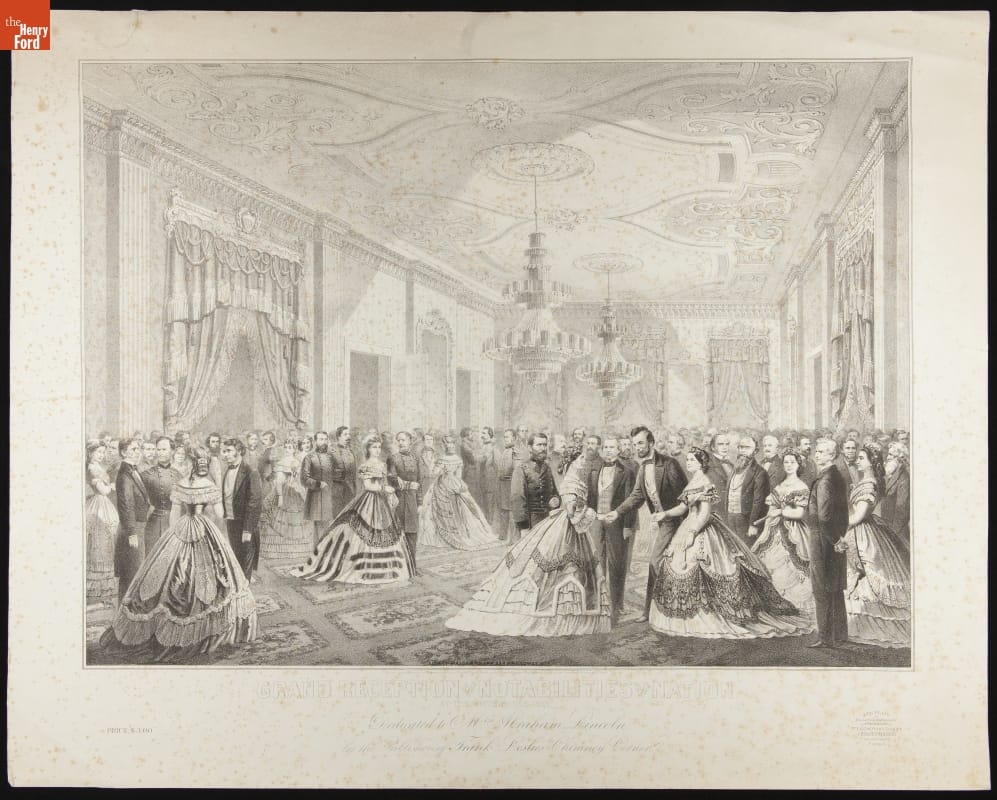 Set
SetThe Lincolns in the White House
- 7 Artifacts
This reception was held in the East Room of the White House just after President Lincoln's second inauguration on March 4, 1865. The President and the first lady are prominently placed in the foreground receiving General and Mrs. Grant in a room filled with notable figures in the U. S. Government and Army. The scene is one of the last major public events before the President's Assassination on April 14, 1865. article
Emancipation Day Celebrations
Parades through the city streets of Richmond, Virginia, in celebration of the emancipation of slavery began on April 3, 1866, and continued through the post-Civil War era and into the 20th century. article
Reflecting on the Emancipation Proclamation's Visit to Henry Ford Museum
Earlier this week, we had the wonderful opportunity to host a most historic document: the Emancipation Proclamation.