
Patent Model of Sholes & Glidden Typewriter, 1874-1878
THF152550 / Patent Model of Sholes & Glidden Typewriter, 1874-1878
01
Artifact Overview
From 1790 to 1880, the U.S. Patent Office required applicants to submit a miniature model along with diagrams and written descriptions detailing the operation of their invention. Patent models could be no larger than 12" by 12" by 12". Though they were usually not operational, these models helped explain an inventor's idea and protect it from competitors.
Artifact Details
Artifact
Model (Patent)
Date Made
1874-1878
Place of Creation
Creator Notes
Invented by Christopher Latham Sholes and Carlos Glidden in Milwaukee, Wisconsin
Location
Not on exhibit to the public.
Object ID
29.1524.2
Credit
From the Collections of The Henry Ford. Gift of Remington Rand Business Service.
Material
Wood (Plant material)
Iron (Metal)
Brass (Alloy)
Ceramic (Material)
Dimensions
Height: 11.75 in
Width: 11.75 in
Length: 12 in
Weight: 10 lbs
Keywords |
|---|
02
Related Artifacts
 Artifact
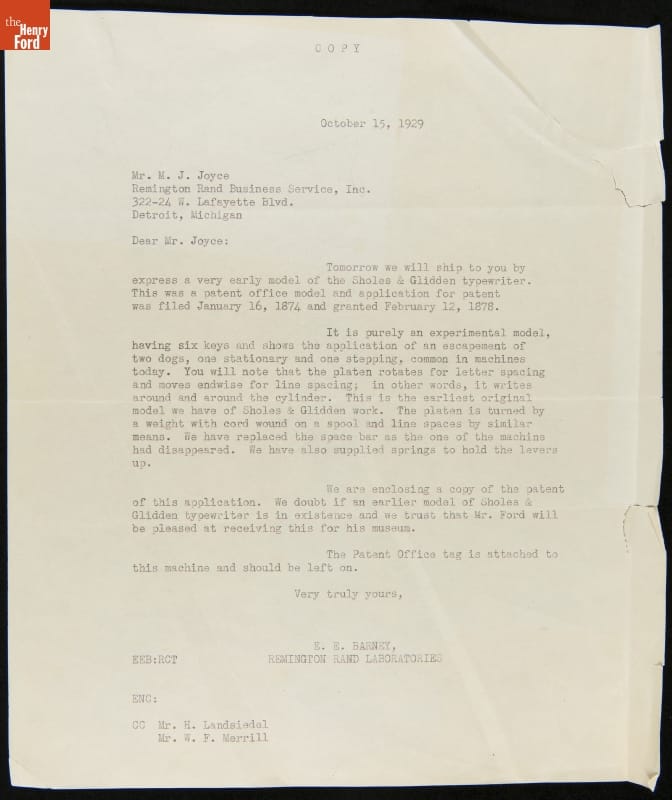
Correspondence regarding Donation of Sholes & Glidden Typewriter Patent Model, 1929
03
Related Content
 Set
SetThe Patent Process
- 20 Artifacts
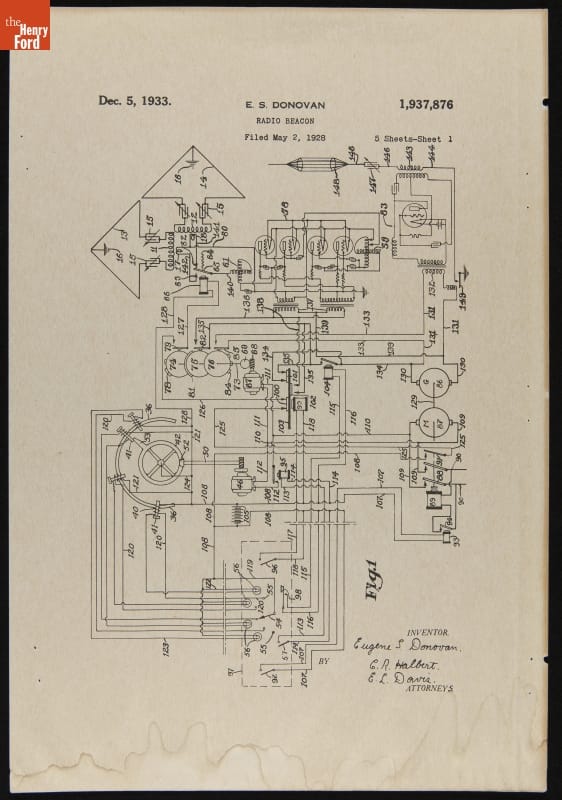
The radio beacon may be Henry Ford's most important contribution to aviation. Early pilots depended on landmarks, preventing reliable navigation in bad weather. Ford's engineers developed a radio beacon that simultaneously transmitted the Morse code letter "A" (dot-dash) in one direction and the letter "N" (dash-dot) in another. The pilot steered until the separate signals merged into a steady hum.