
Casket, 1830-1840
THF95297 / Casket, 1830-1840
01
Artifact Overview
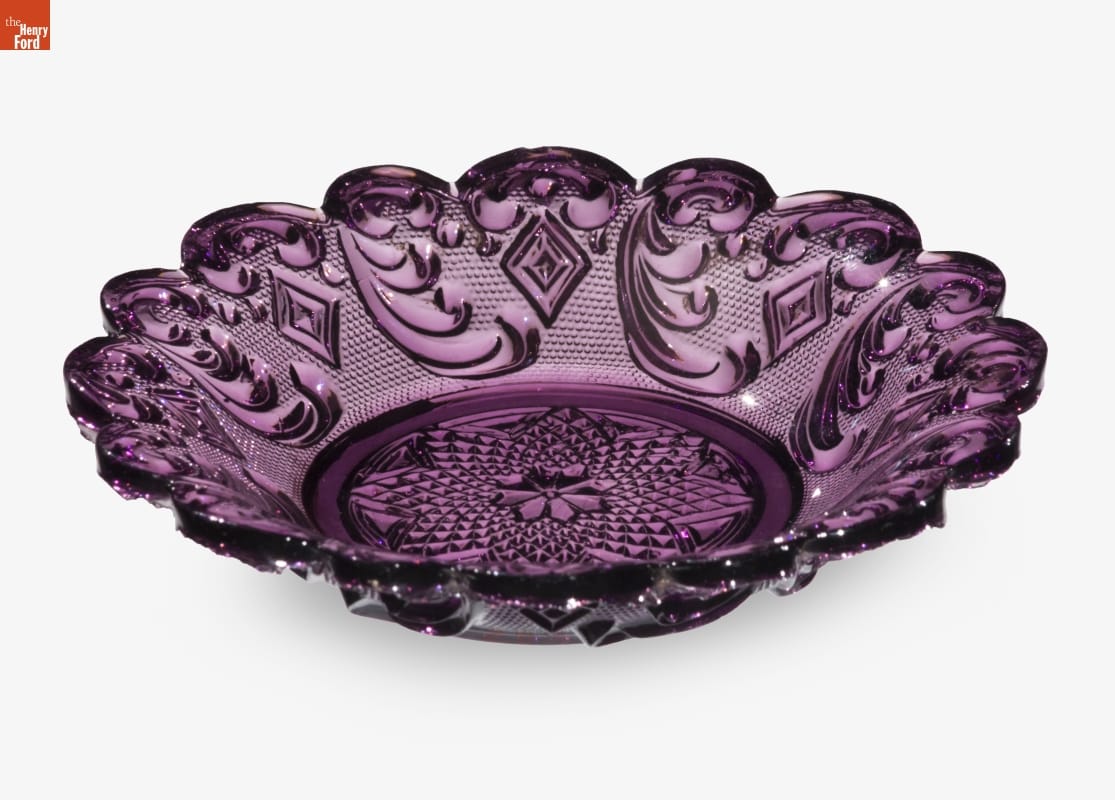
This mold-made, pressed glass box was intended to hold a middle class lady's jewelry. It was made in the lacy glass technique, in which decoration covers the entire surface of the mold, and is raised against a background of small dots, to create a stippled appearance on the surface. The dots catch any ambient light, making the surface shimmer.
Artifact Details
Artifact
Casket (Personal gear)
Date Made
1830-1840
Place of Creation
Creator Notes
Attributed to Boston and Sandwich Glass Company, Sandwich, Massachusetts.
Location
at Greenfield Village in Davidson-Gerson Gallery of Glass
Object ID
00.3.580
Credit
From the Collections of The Henry Ford.
Material
Glass (Material)
Pressed glass
Dimensions
Height: 6 in
Width: 4.5 in
Length: 7 in
Weight: 3.25 lb
Keywords |
|---|
02
Related Content
 Set
SetPressed Glass
- 15 Artifacts
Mechanically pressed glass was an innovation in glass history, making decorative, "patterned" glass available to a broad audience. One of the earliest types of pressed glass, dating to the 1830s is known as "Lacy Glass". Complex stippled patterns were developed to help hide technical defects caused by early presses, when the glass gather was cut off and dropped into a mold. Set
SetCurators' Choice: Home & Community Life
- 24 Artifacts
This mold-made, pressed glass box was intended to hold a middle class lady's jewelry. It was made in the lacy glass technique, in which decoration covers the entire surface of the mold, and is raised against a background of small dots, to create a stippled appearance on the surface. The dots catch any ambient light, making the surface shimmer. Set
SetDesign and Making
- 50 Artifacts
This 1937 Sparton radio was designed by Walter Dorwin Teague, a designer renowned for his use of streamlined forms. A study in contrasts -- the blue mirrored finish and curved sled-like base suggest speed while the five jutting parallel panels appear almost architectural -- this expensive and glamorous radio had a limited market during the Great Depression. article
Gothic Revival: An “Alternative” Trend for Victorian Americans
What began as deliciously gloomy in 18th-century England took hold in Victorian America as romantic and picturesque. Learn more about Gothic Revival.