
Landau, Made for Abram and Sarah Hewitt of New York, 1890
THF87336 / Landau, Made for Abram and Sarah Hewitt of New York, 1890
01
Artifact Overview
Popular with wealthy Americans, the landau carriage featured a falling top that divided in the middle to convert it from a closed coach to an open vehicle. Sarah Cooper Hewitt, wife of industrialist and politician Abram Hewitt, ordered this landau from prominent coachbuilder Brewster and Company in May 1890. The Hewitt family crest is painted on its doors.
Artifact Details
Artifact
Landau (Four-wheeled carriage)
Date Made
1890
Creators
Place of Creation
Location
Not on exhibit to the public.
Object ID
30.1542.113
Credit
From the Collections of The Henry Ford. Gift of Sarah Cooper Hewitt.
Material
Brass (Alloy)
Cloth
Leather
Paint (Coating)
Wood (Plant material)
Color
Black (Color)
Green
Yellow (Color)
Dimensions
Height: 87.5 in
Width: 73.125 in
Length: 151.5 in
Wheelbase: 102 in
Diameter: 51 in (Wheel Diameter)
Diameter: 37.25 in (Wheel Diameter)
Inscriptions
Painted below the shield: TAM NOCTE QUAM DIE SAPIRE
Candle lamps marked: BREWSTER & CO. / OF BROOME ST. N.Y. / PAT. APPLIED FOR
Keywords |
|---|
02
Related Content
 Set
SetOnline Horse-Drawn Vehicles Collection
- 29 Artifacts
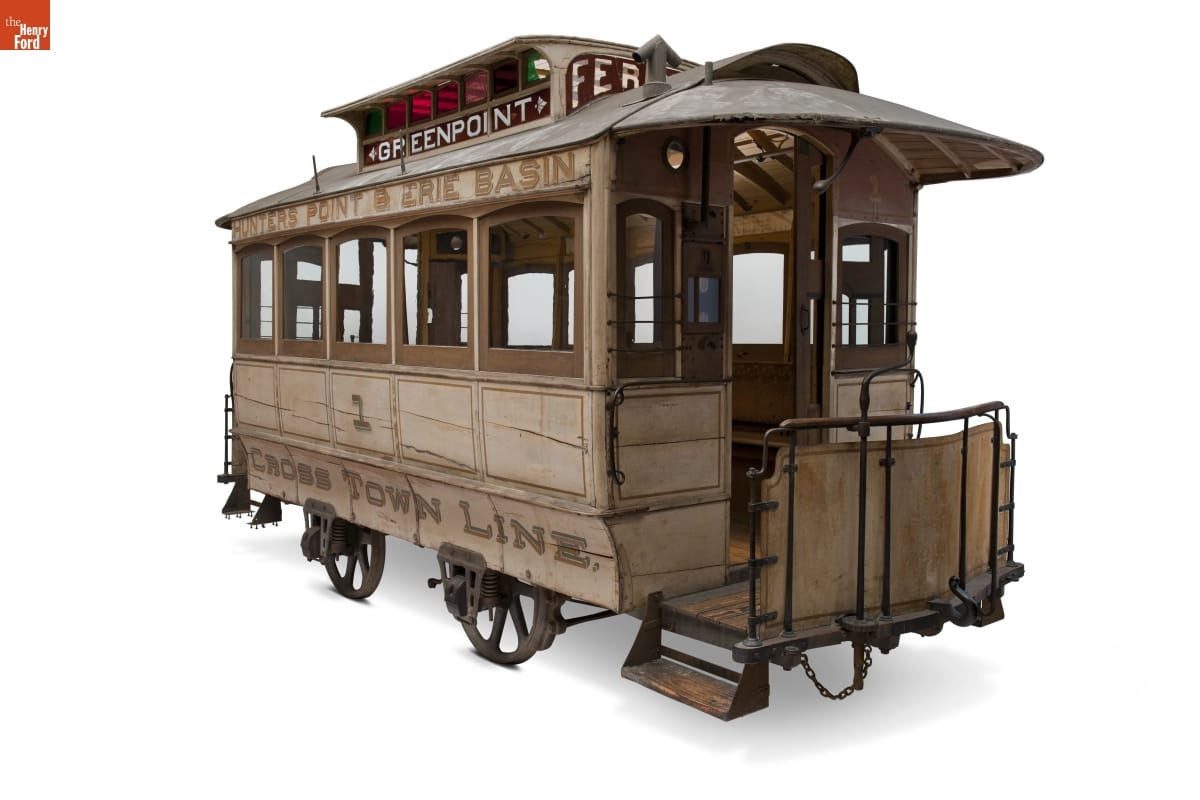
The horse-drawn streetcar was an important means of public transportation in 19th-century American cities. New York's Brooklyn City Railroad ran this car on its line between Hunters Point in Long Island City, and Erie Basin in South Brooklyn. But horses were expensive to stable and feed -- and messy too. Operators embraced electric streetcars starting in the late 1880s. article
1915 Brewster Town Landaulet: 20th-Century Technology, 19th-Century Comfort
Get a quick overview on how Brewster automobiles stopped looking like carriages and began to look like cars.