
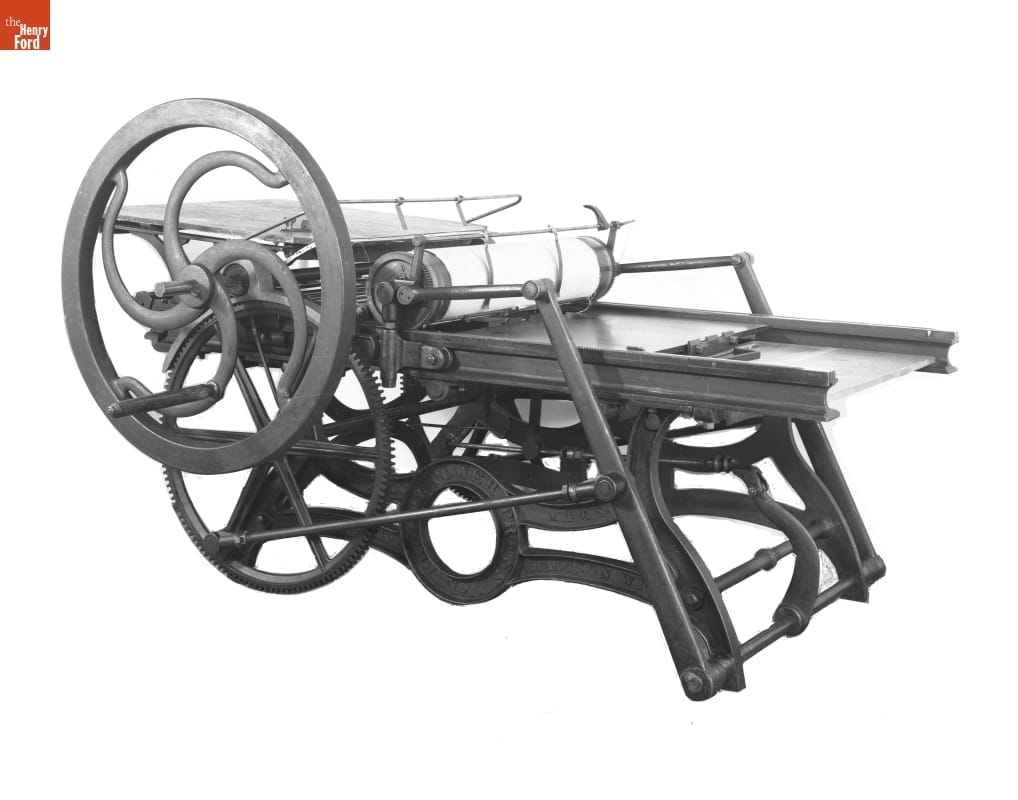
Copy Press, 1890-1910
THF132530 / Copy Press, 1890-1910
01
Artifact Overview
The copy press, while visually similar to certain printing presses, serves a different function. These devices were used to make copies of handwritten correspondence or drawings. A document written in water-soluble ink was moistened and placed in the press to make a duplicate. James Watt--who improved upon and invented important steam engines--patented the perfected copy press in 1780.
Artifact Details
Artifact
Copy press
Date Made
1890-1910
Place of Creation
Creator Notes
Made by Racine Malleable and Wrought Iron Co. in Racine, Wisconsin.
Location
Not on exhibit to the public.
Object ID
31.767.19
Credit
From the Collections of The Henry Ford. Gift of A. H. Haas.
Material
Cast Iron
Dimensions
Height: 15.0 in
Width: 16.0 in
Depth: 10.0 in
Keywords |
|---|
02
Related Content
 Set
SetInformation Machines: Printing Presses at The Henry Ford
- 18 Artifacts
Enoch Prouty was a Baptist minister who wanted to print a temperance newspaper. He could not afford a press--so he invented one. The long arms and rods on this "grasshopper" press move when operated. In 1892 and 1893, it received merit awards at Chicago's Columbian Exposition. This particular press printed an agricultural journal in Ohio in the 1920s. article
Light and Static: The Origins of the Xerox Copy
Discover how the modern photocopier came to be, through the story of Chester Carlson and what would become the Xerox Corporation.