
Folding Portable Spinning Wheel Used by Mahatma M. K. Gandhi
Artifact Overview
In the early decades of the 20th century, Mahatma M. K. Gandhi (1869-1948) used the spinning wheel, or charkha, as a unifying call-to-action in the nonviolent struggle against British colonial rule in India. The charkha was used in one form or another in nearly all parts of India to spin thread for making cloth before British imports had overwhelmed local production. The charkha, in the hands of Gandhi and other Indian nationalists, became a symbol for national unity; and the simple act of spinning an act of protest. The charkha proved a highly visible symbol for India's political independence and economic self-sufficiency.
Henry Ford was a great admirer of Gandhi's selfless life, self-reliant ideals and nonviolent principles. In July 1941, Henry Ford wrote a short note to Gandhi praising the "lofty work" of the Indian leader. Gandhi returned the compliment and sent a spinning wheel that he had used to the famed industrialist. Gandhi signed the gift in both English and Hindi. Mr. T. A. Raman, London editor of the United Press of India, couriered the portable spinning wheel to America and presented it to Henry Ford in December 1942.
Artifact Details
Artifact
Subject Date
Place of Creation
Location
Object ID
42.142.1
Credit
Material
Wood (Plant material)
Dimensions
Height: 4 in (closed)
Width: 10 in (closed)
Length: 17 in (closed)
Height: 4.625 in (open)
Width: 10.813 in (open)
Length: 33.75 in (open)
Inscriptions
Keywords |
|---|
Related Content
 Set
SetSpinning Highlights from the Collections of The Henry Ford
- 16 Artifacts
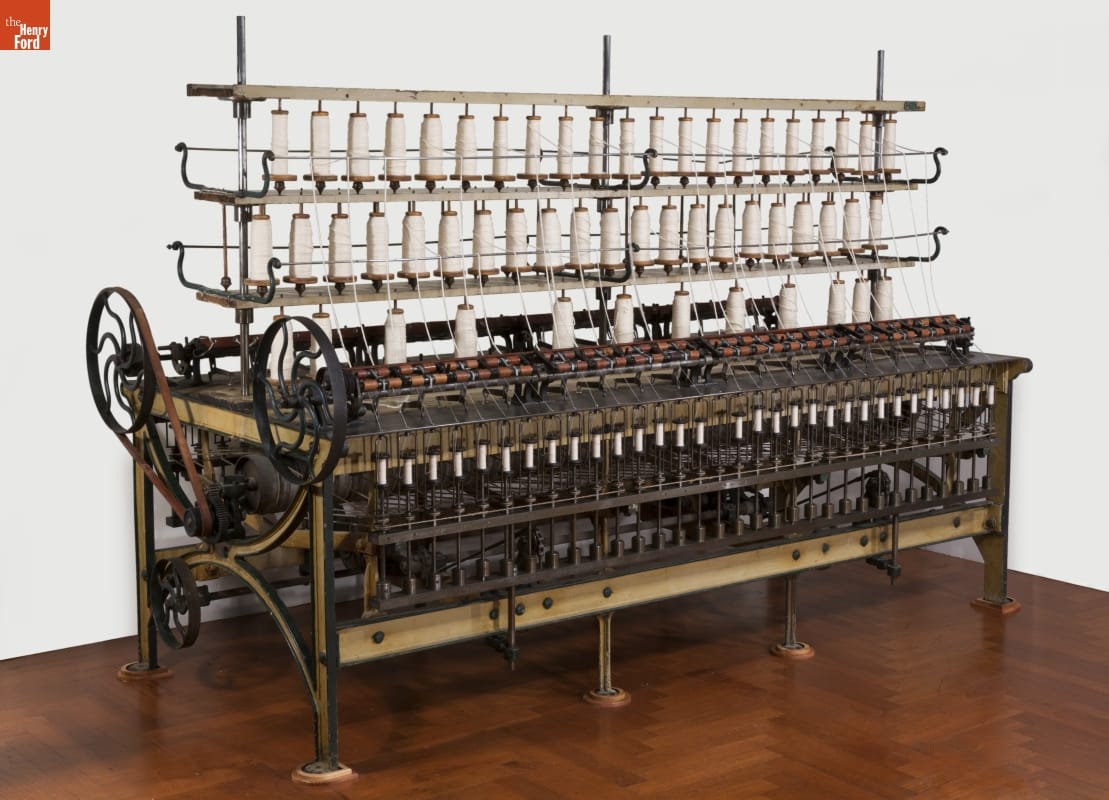
Spinning frames spin cotton fiber into yarn and then wind it onto a bobbin. This throstle spinning frame could simultaneously spin 64 strands of yarn. (Throstle -- an old name for a song thrush -- refers to the bird-like sounds the machine made.) Machines like this helped produce the large quantities of yarn that growing industrial weaving operations needed in the early and mid-1800s. Set
SetCelebrating 90 — Collecting through the Decades: 1940s
- 8 Artifacts
The Henry Ford marks its 90th anniversary in 2019. In celebration, The Henry Ford's curators have taken a decade-by-decade look at how our collections have grown — through significant additions and evolving philosophies. This set looks at some of the objects and archives collected during the 1940s.
 Set
SetHenry Ford
- 49 Artifacts
The Quadricycle was Henry Ford's first attempt to build a gasoline-powered automobile. It utilized commonly available materials: angle iron for the frame, a leather belt and chain drive for the transmission, and a buggy seat. Ford had to devise his own ignition system. He sold his Quadricycle for $200, then used the money to build his second car. article
Celebrating Ninety: Collecting in the 1940s
We're celebrating our 90th birthday by looking, decade by decade, at significant additions to our collection. During the 1940s, we acquired the first functional helicopter, a spinning wheel used by Gandhi, and built a replica of a cabin.