
Patent Model of Edison's Universal Stock Printer, circa 1872
THF151800 / Patent Model of Edison's Universal Stock Printer, circa 1872
01
Artifact Overview
Thomas Edison's reputation was initially established through his work in telegraphy, particularly on stock tickers -- telegraphs that printed real-time financial information. While he did not invent the stock ticker, his improvements -- particularly those related to synchronizing multiple units -- were a great commercial success. Edison's experience with telegraphy infrastructure, and his approach to continually refining his designs, was foundational for his later successes.
Artifact Details
Artifact
Model (Patent)
Subject Date
circa 1872
Place of Creation
Creator Notes
Designed by Thomas A. Edison in Newark, New Jersey.
Location
at Greenfield Village in Menlo Park Laboratory
Object ID
29.1980.293
Credit
From the Collections of The Henry Ford. Gift of the Edison Pioneers.
Material
Brass (Alloy)
Copper (Metal)
Iron (Metal)
Dimensions
Height: 8 in
Diameter: 8.75 in
Inscriptions
Painted on base; EDISON'S PATENT GOLD & STOCK TELEGRAPH CO.; NO.510
Keywords |
|---|
02
Related Content
 Set
SetThe Patent Process
- 20 Artifacts
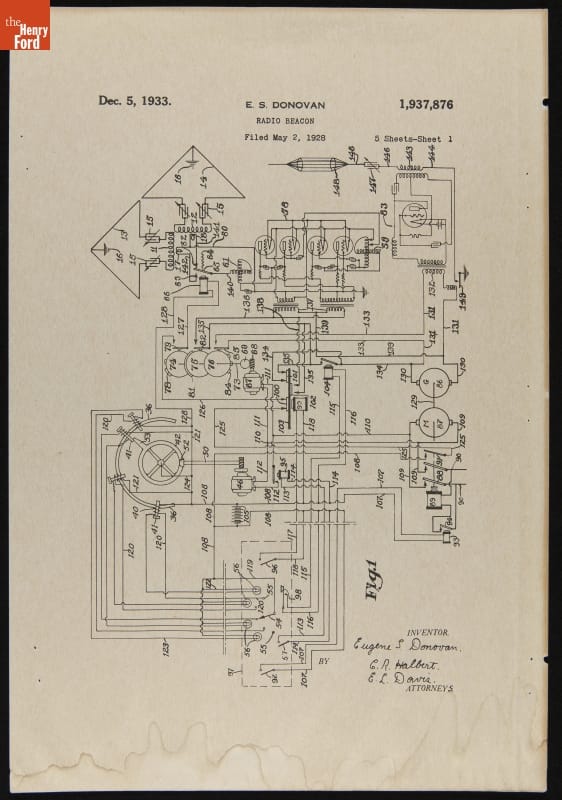
The radio beacon may be Henry Ford's most important contribution to aviation. Early pilots depended on landmarks, preventing reliable navigation in bad weather. Ford's engineers developed a radio beacon that simultaneously transmitted the Morse code letter "A" (dot-dash) in one direction and the letter "N" (dash-dot) in another. The pilot steered until the separate signals merged into a steady hum. Set
SetThomas Edison Patent Models
- 49 Artifacts