
Mullen Paper Tester, circa 1901
THF170141 / Mullen Paper Tester, circa 1901
01
Artifact Overview
In the late 1880s, John Mullen developed a test -- and a testing device -- to assess the strength and quality of paper goods. The Mullen test involves placing a paper sample over a rubber diaphragm, then inflating the diaphragm until the sample bursts. The device's pressure gauge records the measurement. Though testers have evolved, Mullen's eponymous test remains an industry standard.
Artifact Details
Artifact
Paper tester
Date Made
circa 1901
Creator Notes
Patented by John William Mullen and manufactured by B. F. Perkins & Sons, Inc., Holyoke, Massachusetts and the Ashton Valve Company, Boston, Massachusetts.
Location
Not on exhibit to the public.
Object ID
37.720.1
Credit
From the Collections of The Henry Ford.
Material
Metal
Wood (Plant material)
Color
Gold (Color)
Red
Brown
Dimensions
Height: 8.5 in
Width: 6.5 in
Length: 16 in
Inscriptions
on wheel:
PATENTED/ FEB 22 1887/ BY/ J W MULLEN
on dial of gauge:
THE MULLEN/ PAPER TESTER/ MANF'D BY/ B.F. PERKINS & SON, INC./ HOLYOKE, MASS./ U.S.A.
on dial of gauge:
The Ashton Valve Co./ BOSTON, MASS./ 434701
Keywords |
|---|
02
Related Content
 Set
SetExposed Collections—2017-2020 IMLS Grant Project
- 20 Artifacts
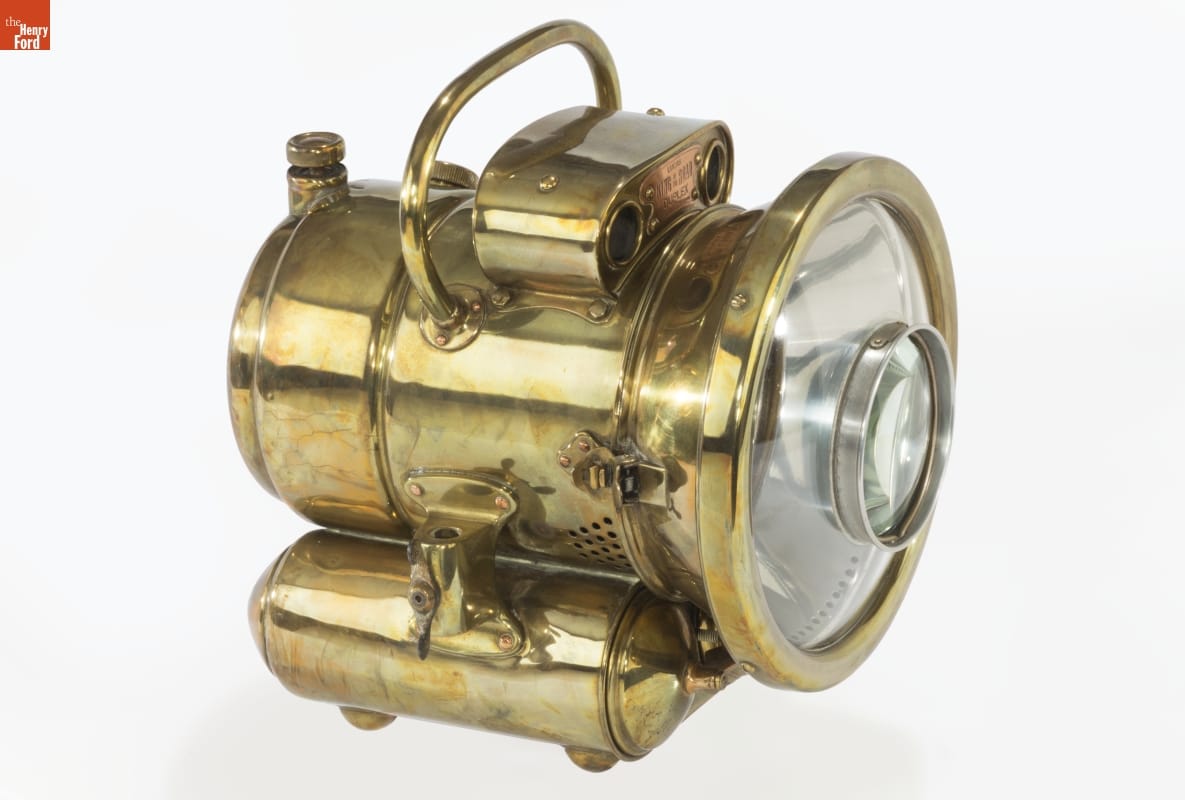
Drivers in the early 1900s attached headlights to their automobiles to help light their way at night. To use this "King of the Road" model, automobilists filled the chambers with calcium carbide and then added water creating acetylene gas. Igniting the gas burner produced a strong white light. The lamp's lens and parabolic reflector cast a broad beam lighting the road ahead.