
1928 Junkers W33 "Bremen" Airplane
THF108198 / 1928 Junkers W33 "Bremen" Airplane
01
Artifact Overview
The Bremen was the first aircraft to fly nonstop from Europe to North America. Hermann Kohl, Ehrenfried Guenther von Huenefeld, and James Fitzmaurice took off from Baldonnel, Ireland, on April 12, 1928, and touched down on Greenly Island, Canada, the next day. The east-to-west crossing, made against prevailing winds, was more difficult than a flight from North America to Europe.
Artifact Details
Artifact
Airplane
Date Made
1928
Place of Creation
Location
Not on exhibit to the public.
Object ID
36.676.1
Credit
From the Collections of The Henry Ford. Gift of the Museum of the City of New York
Material
Metal
Dimensions
Height: 9.5 ft
Width: 60.333 ft
Length: 58.5 ft
Inscriptions
Sides marked: D 1167 BREMEN.
Tail marked: JUNKERS / 2 33b / 2504
Each side of front: JUNKERS
Keywords |
|---|
02
Related Content
 Set
SetFord Tri-Motor
- 14 Artifacts
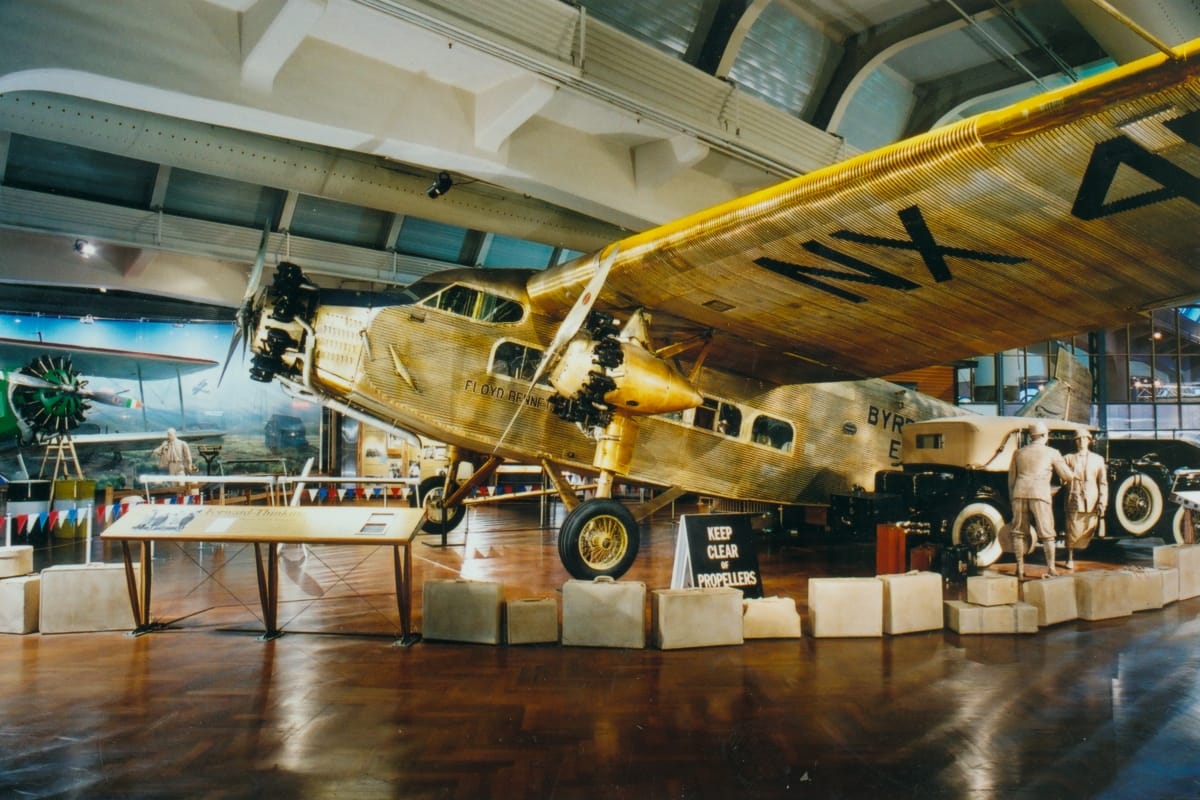
The Ford Tri-Motor was the most popular airliner of the late 1920s and early 1930s. Its rugged dependability led Richard Byrd to choose a Tri-Motor for his attempt to be the first person to fly over the South Pole. On November 28-29, 1929, Byrd and a crew of three achieved that goal in this plane. Set
SetOn the Road with The Henry Ford
- 16 Artifacts
Despite the vast acreage of exhibit space that comprises the campuses of The Henry Ford, most of our assets reside in storage. The Henry Ford's loan program allows audiences from around the world who may never be able to visit Dearborn to connect with our collections. We collaborate with local, national, and international institutions to provide artifacts that tell America's innovation story to inspire learners and doers everywhere.