
Columbian Press, 1857
THF95405 / Columbian Press, 1857
01
Artifact Overview
This ornate cast iron hand press paid homage to America, but sold best in England. George Clymer developed the press and its ingenious system of levers in Philadelphia in 1813. He named it "Columbian" and decorated it with an eagle (which also served as counterweight), a horn of plenty, and other symbols of American prosperity. Our Columbian was made in England in 1857, after Clymer's death.
Artifact Details
Artifact
Printing press
Date Made
1857
Place of Creation
Creator Notes
Made by Edward Bevan in London, England. Patented by George Clymer.
Location
Not on exhibit to the public.
Object ID
28.772.1
Credit
From the Collections of The Henry Ford.
Material
Cast iron
Steel (Alloy)
Brass (Alloy)
Wood (Plant material)
Dimensions
Height: 6 ft
Width: 3.583 ft
Depth: 4.75 ft
Inscriptions
COLUMBIAN PRESS / NO.1713 / EDWARD BEVAN / LATE / CLYMER DIXON & CO. / ORIGINAL PATENTEES / MANUFACTURERS / 10 FINSBURY ST. 1857 LONDON
Keywords |
|---|
02
Related Content
 Set
SetCurators' Choice: Info Technology & Communications
- 25 Artifacts
Thomas Edison's electric pen, an ancestor of both the mimeograph and the tattoo needle, was a successful product in the mid-1870s. Users would write normally with the pen, which, instead of a nib, had a needle powered by an electric motor. The needle poked holes into a stencil, which was then used to copy the document. Many businesses found document duplication an attractive possibility.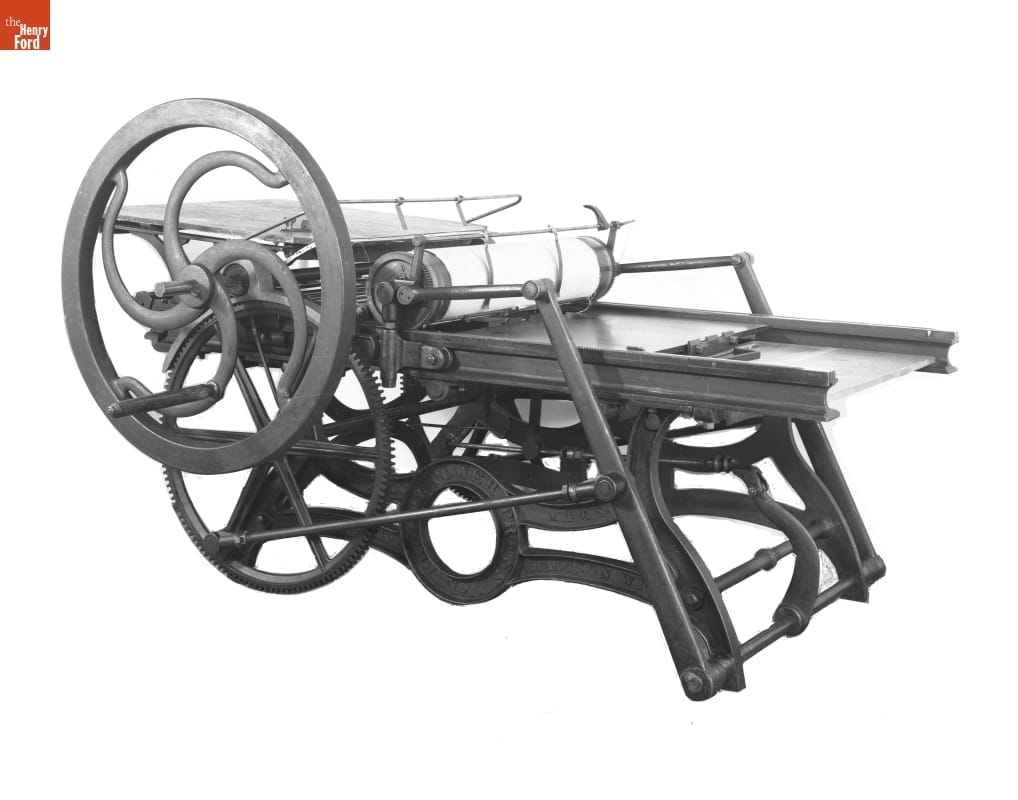 Set
SetInformation Machines: Printing Presses at The Henry Ford
- 18 Artifacts
Enoch Prouty was a Baptist minister who wanted to print a temperance newspaper. He could not afford a press--so he invented one. The long arms and rods on this "grasshopper" press move when operated. In 1892 and 1893, it received merit awards at Chicago's Columbian Exposition. This particular press printed an agricultural journal in Ohio in the 1920s.