
Patent Model of Argand Lamp Burner, 1855
THF152225 / Patent Model of Argand Lamp Burner, 1855
01
Artifact Overview
Nineteenth century inventors constantly sought to create more efficient lighting technology, leading to improved patents such as this Argand burner. This principle forced air through the center of a hollow wick tube, allowing for a more complete combustion and a longer burning period. This burner would fit into a lamp hung from a ceiling.
Artifact Details
Artifact
Model (Patent)
Date Made
1855
Subject Date
09 October 1855
Creators
Place of Creation
Location
Not on exhibit to the public.
Object ID
26.160.16
Credit
From the Collections of The Henry Ford. Gift of the Smithsonian Institution
Material
Brass (Alloy)
Dimensions
Height: 6.5 in
Diameter: 5.5 in
Inscriptions
Plaque on side of font: J. G. WEBB. N.Y.
Patent office tag reads: NO. 13674 1855 / J.G. WEBB. / ARGAND LAMPS. / PATENTED OCT. 9 / 1855 / REC. JUNE. / 6-55.
Keywords |
|---|
02
Related Content
 Set
SetThe Patent Process
- 20 Artifacts
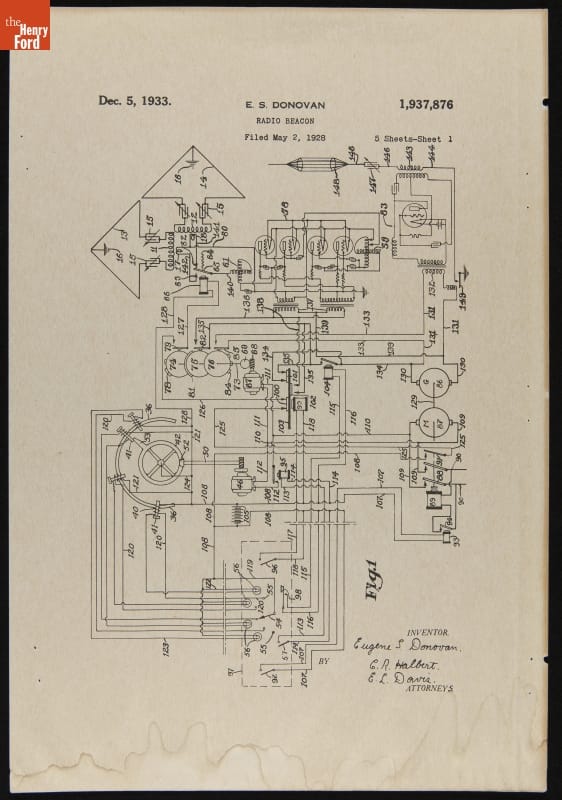
The radio beacon may be Henry Ford's most important contribution to aviation. Early pilots depended on landmarks, preventing reliable navigation in bad weather. Ford's engineers developed a radio beacon that simultaneously transmitted the Morse code letter "A" (dot-dash) in one direction and the letter "N" (dash-dot) in another. The pilot steered until the separate signals merged into a steady hum.