
1970 Meyers Manx Dune Buggy
THF131127 / 1970 Meyers Manx Dune Buggy
01
Artifact Overview
The Meyers Manx was a famous model of the dune buggies first built for use on the beaches of California. Less than $1,000 bought a fiberglass body, a windshield and a hood. Buyers supplied the rest from a used Volkswagen Beetle, plus the labor to assemble the parts. A teenager from Birmingham, Michigan, built this one with his grandfather.
Artifact Details
Artifact
Dune buggy
Date Made
1970
Place of Creation
Creator Notes
Made from a Meyers Manx, Inc., kit using a Volkswagen chassis, assembled by David Van de Grift in Birmingham, Michigan.
Location
Not on exhibit to the public.
Object ID
90.120.1
Credit
From the Collections of The Henry Ford. Gift of David Van de Grift.
Material
Metal
Fiberglass
Glass (Material)
Rubber (Material)
Chromium
Technique
Homemade
Color
Black (Color)
White (Color)
Dimensions
Height: 53 in
Width: 54 in
Length: 128 in
Specifications
Make & Model: 1970 Meyers Manx Dune Buggy
Maker: B.F. Meyers & Company, Fountain Valley, California
Engine: horizontally opposed 4, overhead valves, 73 cubic inches
Transmission: 4-speed manual
Height: 53 inches
Wheelbase: 80.5 inches
Width: 54 inches
Overall length: 128 inches
Weight: 1200 pounds
Horsepower: 65
Pounds per horsepower: 18.5
Price: $875 for an unassembled kit
Average 1970 wage: $10,817
Time you'd work to buy this car: about 1 month
Keywords |
|---|
02
Related Content
 Set
SetFeatured on The Henry Ford’s Innovation Nation: Season 10
- 18 Artifacts
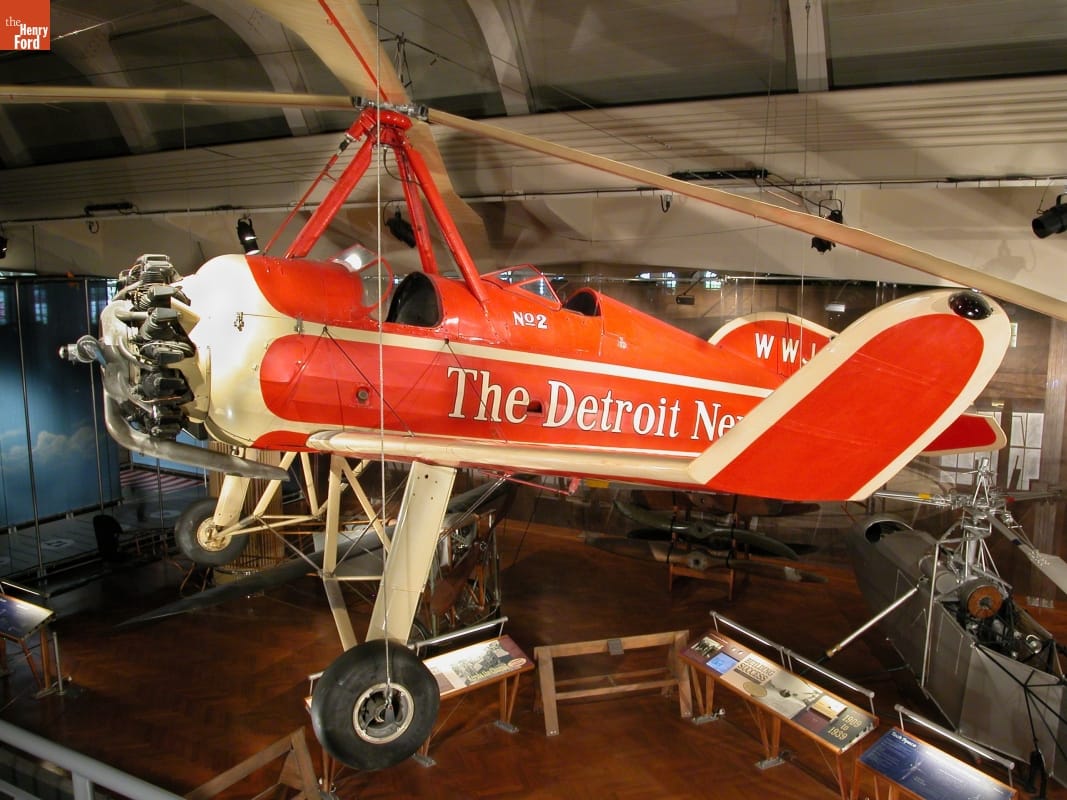
Like an airplane, the autogiro is moved by an engine-powered propeller, but like a helicopter, lift is provided by a rotor. The rotor is not powered, and while the aircraft can land vertically, it cannot take off vertically. The Detroit News purchased this autogiro to gather news. The novel aircraft probably was better at making news!