
Portable Steam Engine, circa 1857
THF92184 / Portable Steam Engine, circa 1857
01
Artifact Overview
Portable agricultural steam engines, such as this very early example, introduced American farmers to mechanical power. These engines were pulled out to the field by horses, and then used to power threshers and separators for the grain harvest. This 10-horsepower Owens, Lane & Dyer engine consists of a side-crank engine mounted on the side of a locomotive-type boiler.
Artifact Details
Artifact
Steam engine (Engine)
Date Made
circa 1857
Creators
Place of Creation
Location
at Greenfield Village in Soybean Lab Agricultural Gallery
Object ID
00.3.5205
Credit
From the Collections of The Henry Ford.
Material
Iron (Metal)
Brass (Alloy)
Copper (Metal)
Wood (Plant material)
Dimensions
Diameter: 6.5 in (Bore)
Horsepower: 10 hp (7.47 kW)
Length: 10 in (Stroke)
Diameter: 39.25 in
Diameter: 46 in
Wheelbase: 63 in
Width: 78.25 in
Height: 120 in
Length: 129 in
Inscriptions
Builder's plate on right side towards rear marked: OWENS, LANE & DYER / MANUFACTURERS / HAMILTON O.
Boiler marked in front: OWENS. LANE & DYER / HAMILTON O.
Steam gauge marked: POST & CO. CIN. O. / MAKERS / POST & COMPANY/ IMPROVED GAUGE / PAT. JULY 2, 1872.
Keywords |
|---|
02
Related Content
 Set
SetHenry Ford’s Steam Engines
- 9 Artifacts
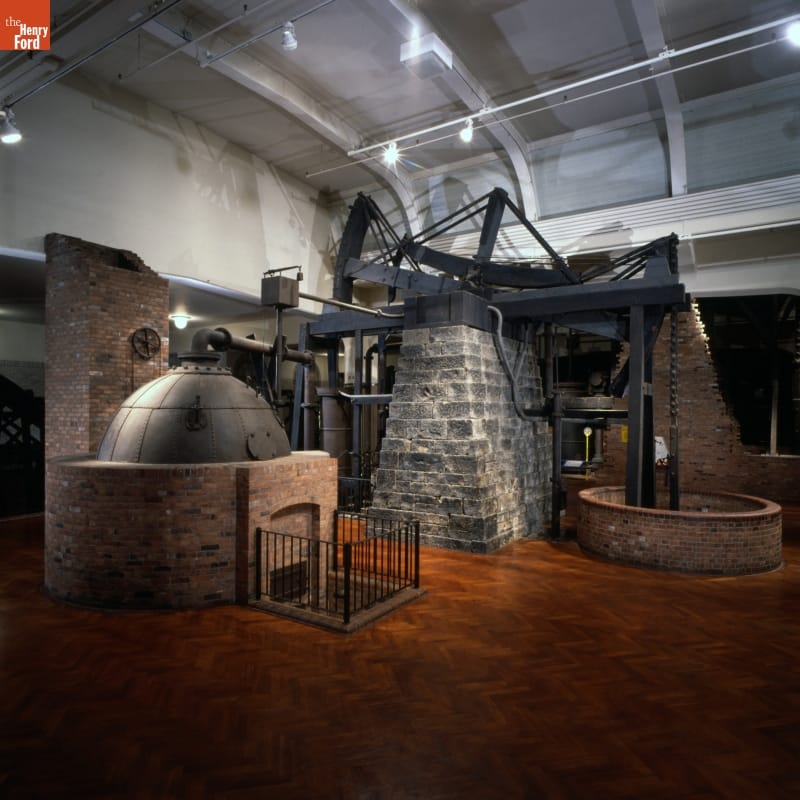
This is the oldest known surviving steam engine in the world. Named for its inventor Thomas Newcomen, the engine converted chemical energy in the fuel into useful mechanical work. Its early history is not known, but it was used to pump water out of the Cannel mine in the Lancashire coalfields of England in about 1765. The engine was presented to Henry Ford in 1929.