
Ford V-8 Automobile Engine, 1937
THF171583 / Ford V-8 Automobile Engine, 1937
01
Artifact Overview
Ford's affordable V-8 engine, introduced in 1932, proved so popular that the company stopped selling four-cylinder cars beginning with the 1935 model year. For 1937, Ford attracted economy-minded customers with a smaller 60-horsepower version of its V-8. The "60" engine had a displacement of 136 cubic inches compared with the larger 85-horsepower V-8's 221 cubic inches.
Artifact Details
Artifact
Automobile engine
Date Made
1937
Creators
Place of Creation
Location
Not on exhibit to the public.
Object ID
55.22.3
Credit
From the Collections of The Henry Ford. Gift of Ford Motor Company.
Material
Metal
Dimensions
Height: 33 in
Width: 19.75 in
Length: 42.5 in
Specifications
Make & Model: Ford "60" V-8 Engine, 1937
Maker: Ford Motor Company, Dearborn, Michigan
Configuration: 90-degree V-8, L-head valves
Displacement: 136 cubic inches
Bore: 2.6 inches
Stroke: 3.2 inches
Compression: 6.6 to 1
Torque: 94 pound-feet
Horsepower: 60 at 3500 revolutions per minute
Keywords |
|---|
02
Related Content
 Set
SetExposed Collections—2017-2020 IMLS Grant Project
- 20 Artifacts
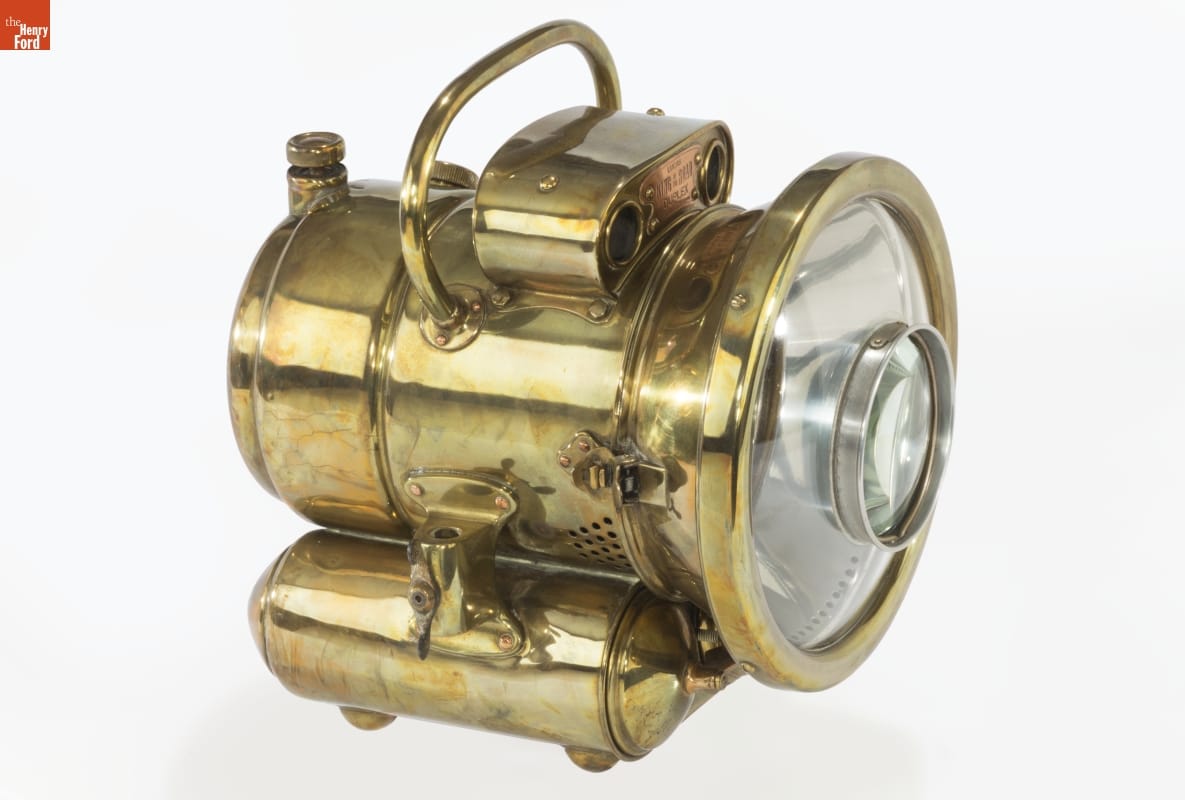
Drivers in the early 1900s attached headlights to their automobiles to help light their way at night. To use this "King of the Road" model, automobilists filled the chambers with calcium carbide and then added water creating acetylene gas. Igniting the gas burner produced a strong white light. The lamp's lens and parabolic reflector cast a broad beam lighting the road ahead.