
Portrait of Joseph-Marie Jacquard, 1839
THF150179 / Portrait of Joseph-Marie Jacquard, 1839
01
Artifact Overview
This portrait of French inventor Joseph-Marie Jacquard (1752 - 1834) was woven of fine silk using the mechanism that he developed and patented in 1804. Jacquard's device employs punched cards to store the intricate pattern design and to control the loom. These loom cards eventually led to the data cards used in early digital computers.
Artifact Details
Artifact
Portrait
Date Made
1839
Subject Date
1831
Place of Creation
Creator Notes
Produced by Didier Petit et Cie, Lyon, executed on a Jacquard loom by Michel-Marie Carquillat, based on the portrait of Jacquard by Claude Bonnefond
Location
Not on exhibit to the public.
Object ID
39.173.1
Credit
From the Collections of The Henry Ford. Gift of Gabrielle Dannenfeld.
Material
Silk (Textile)
Dimensions
Height: 45 in
Width: 34 in
Inscriptions
Imprinted below portrait: À la Mémoire de J.M. Jacquard, Né à Lyon le 7 Juillet 1752, Mort le 7 Août 1834. Lyon: Didier Petit et Cie, 1839.
Obverse: A LA MEMOIRE DE J. M. JACQUARD
Keywords |
|---|
02
Related Content
 Set
SetPunch Card Technology
- 10 Artifacts
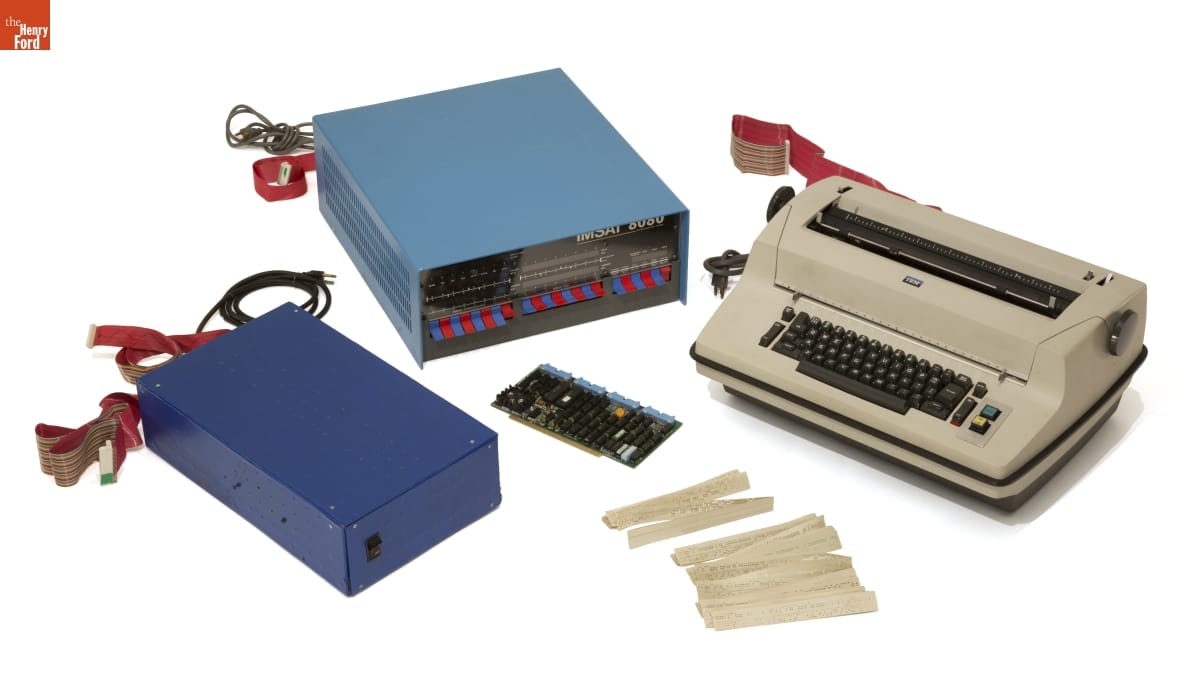
The IMSAI 8080 was a clone of the Altair 8800, the first mass marketed personal computer. It was a popular "kit computer," requiring assembly and programming. With no keyboard, toggle switches allowed input and LED lights signaled output. This could be modified using an IBM I/O typewriter. The donor, O.S. Narayanaswami, was a mechanical engineer interested in the educative power of computers.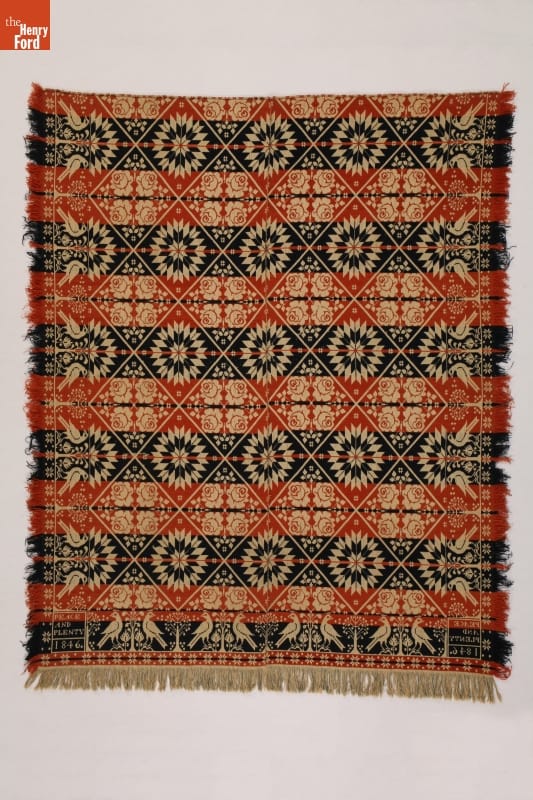 Set
SetFrom the Jacquard Loom
- 18 Artifacts
A coverlet is a decorative bedcovering--usually made of cotton and wool--woven on a loom. This "Peace and Plenty" coverlet expresses the optimism of a young America. This popular sentiment and the bird-and-bush Pennsylvania German border motif were used by a number of coverlet weavers, but were combined with different centerfield designs.