
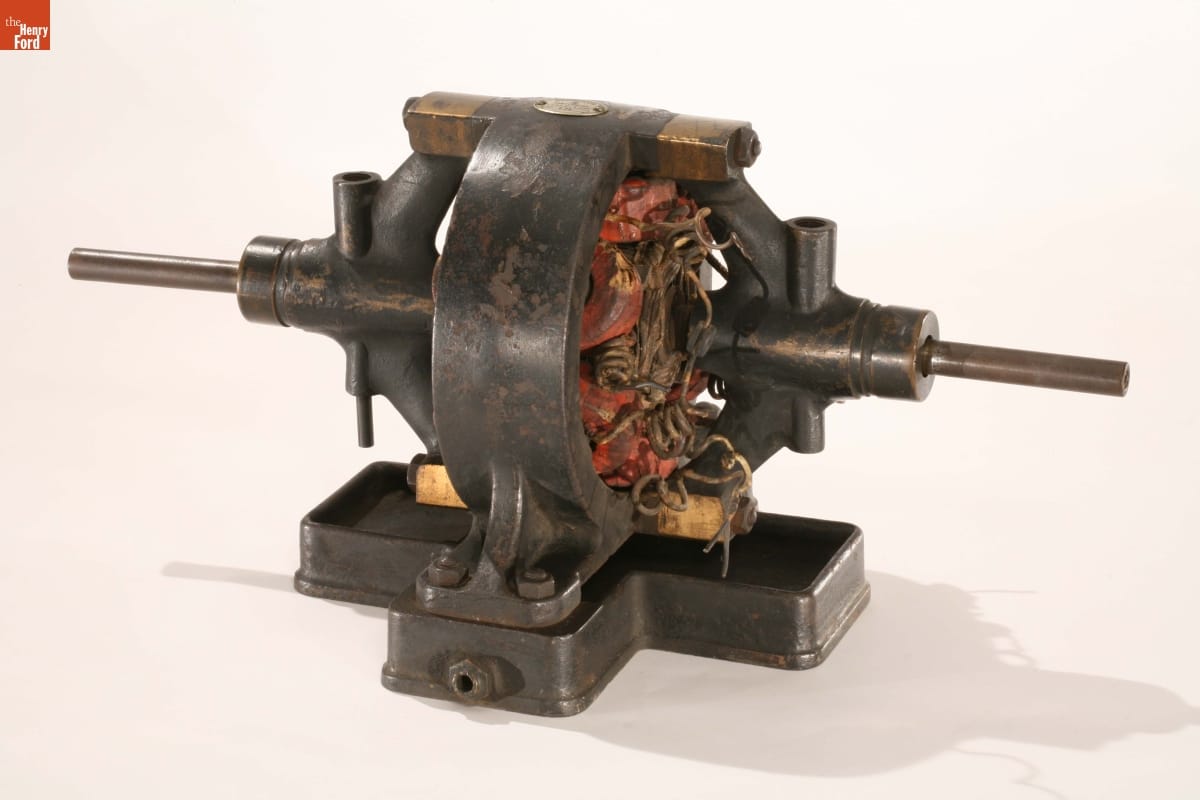
Westinghouse Type A Polyphase Wattmeter, 1903-1906
THF109865 / Westinghouse Type A Polyphase Wattmeter, 1903-1906
01
Artifact Overview
In the late 1800s, companies that supplied electricity to consumers needed a way to measure how much customers used -- and then charge them accordingly. Paul McGahan, a Westinghouse electrical engineer created a practical polyphase wattmeter in 1899 to measure electric power usage. This design was adopted by other companies and remained a standard well into the mid-1900s.
Artifact Details
Artifact
Wattmeter
Date Made
1903-1906
Place of Creation
Collection Title
Location
at Henry Ford Museum in Made in America
Object ID
29.1333.16
Credit
From the Collections of The Henry Ford. Gift of Westinghouse Electric and Manufacturing Company.
Material
Metal
Color
Black (Color)
Dimensions
Height: 12 in
Width: 7 in
Length: 4.5 in
Inscriptions
on front:
WESTINGHOUSE, ELEC & MFG. CO. / PITTSBURG, PA., U.S.A.
POLYPHASE / WATTMETER
Keywords |
|---|
02
Related Content
 Set
SetNikola Tesla
- 12 Artifacts
Nikola Tesla's name is inseparable from the development of alternating current electricity--particularly with regard to polyphase transmission, but especially with regard to the induction motor. His motor, patented in 1888, was the first practical AC motor. George Westinghouse licensed Tesla's motor patents that same year--enabling the Westinghouse AC lighting system to become a real competitor with direct current systems.