
1901 Riker Torpedo Race Car
THF195852 / 1901 Riker Torpedo Race Car
01
Artifact Overview
Andrew Riker, an early believer in the electric car, designed this battery-powered racer in 1901. He ran it at Coney Island, New York, that November and, at 57.1 miles per hour, set a world speed record for electric cars. It was a triumph for electricity, but Riker soon lost faith. He joined Locomobile the next year and started designing gasoline-powered automobiles.
Artifact Details
Artifact
Racing car
Date Made
1901
Creators
Place of Creation
Location
Not on exhibit to the public.
Object ID
30.328.2
Credit
From the Collections of The Henry Ford. Gift of Andrew L. Riker.
Material
Metal
Steel (Alloy)
Rubber (Material)
Wood (Plant material)
Color
Black (Color)
Dimensions
Height: 35 in
Width: 55.5 in
Length: 127 in
Inscriptions
Rear hubs marked: RIKER ELECTRIC VEHICLE CO.
Front hubs marked: RIKER MOTOR VEHICLE CO. U.S.A. ELIZABETHPORT, N.J.
Plates on each motor marked: RIKER MOTOR VEHICLE CO. / ELIZABETHPORT, N.J. U.S.A. / (Patents from June 5, 1888 to Oct. 28, 1898 / OTHER PATENTS PENDING
Keywords |
|---|
02
Related Content
 Set
SetElectrics and Hybrids at The Henry Ford
- 26 Artifacts
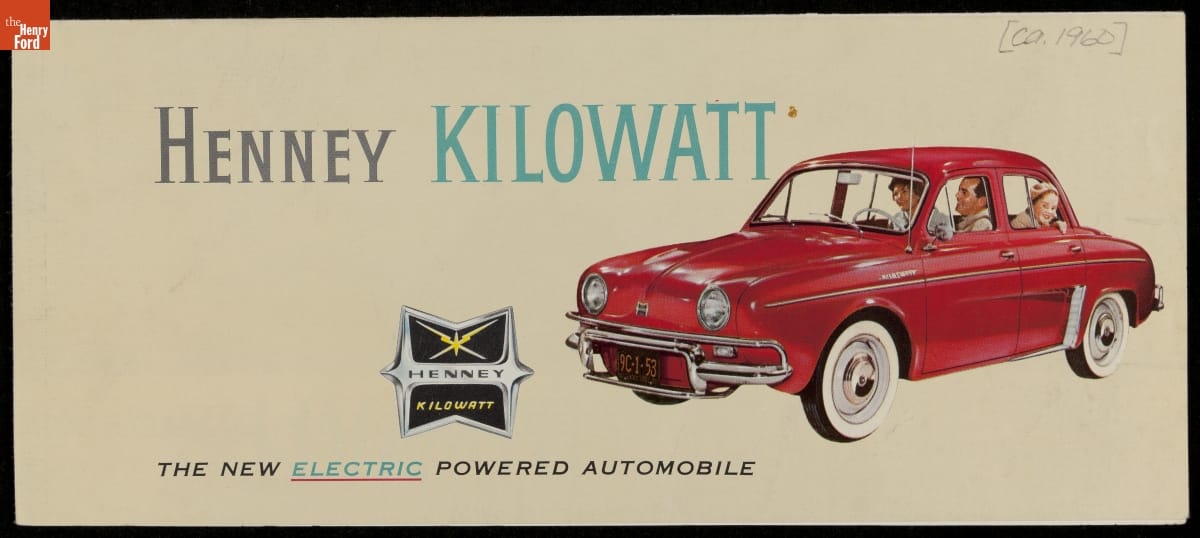
The Henney Motor Company produced an electric vehicle, based on the French-made Renault Dauphine, in 1959 and 1960. The cruising speed was around 30 miles per hour, with a range of about 40 miles between charges. This sales catalog for the Henney Kilowatt provided answers to questions buyers had about the vehicle. Set
SetAndrew Riker: An Electric Car Pioneer Turns to Gas
- 11 Artifacts
Andrew Riker, an early believer in the electric car, designed this battery-powered racer in 1901. He ran it at Coney Island, New York, that November and, at 57.1 miles per hour, set a world speed record for electric cars. It was a triumph for electricity, but Riker soon lost faith. He joined Locomobile the next year and started designing gasoline-powered automobiles.