
Patent Model of Edison's Automatic Telegraph, 1879
THF110893 / Patent Model of Edison's Automatic Telegraph, 1879
01
Artifact Overview
This patent demonstrated the recording and transmitting of Morse code messages. A cardboard disc was placed on top of a rotating plate with spiral grooves. Indentations were embossed onto the cardboard by a needle powered by an electromagnet. These indents formed a recorded message, which could then be transmitted—without needing an operator—to several stations, saving labor.
Artifact Details
Artifact
Model (Patent)
Date Made
circa 1877
Subject Date
1879
Place of Creation
Location
Not on exhibit to the public.
Object ID
29.1980.1372.1
Credit
From the Collections of The Henry Ford. Gift of the Edison Pioneers.
Material
Wood (Plant material)
Brass (Alloy)
Steel (Alloy)
Dimensions
Height: 7 in
Width: 9.5 in
Length: 5.5 in
Keywords |
|---|
02
Related Content
 Set
SetThe Patent Process
- 20 Artifacts
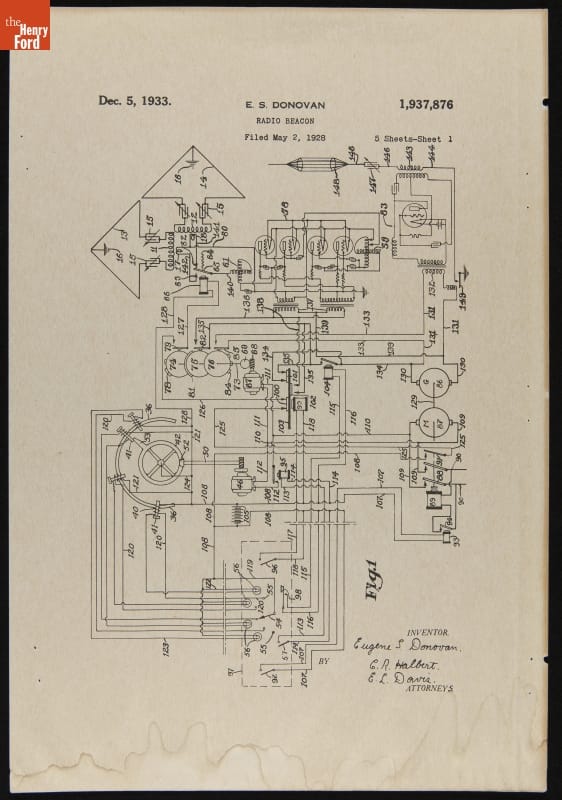
The radio beacon may be Henry Ford's most important contribution to aviation. Early pilots depended on landmarks, preventing reliable navigation in bad weather. Ford's engineers developed a radio beacon that simultaneously transmitted the Morse code letter "A" (dot-dash) in one direction and the letter "N" (dash-dot) in another. The pilot steered until the separate signals merged into a steady hum. Set
SetThomas Edison Patent Models
- 49 Artifacts