
Hoover "Model 150" Vacuum Cleaner, 1936-1939
THF711733 / Hoover "Model 150" Vacuum Cleaner, 1936-1939
01
Artifact Overview
Industrial design pioneer Henry Dreyfuss created Hoover's 1936 Model 150 upright vacuum cleaner. It had a magnesium chassis and a Bakelite plastic hood, making it more lightweight. Henry Dreyfuss was a leading proponent of streamlined design--a modern, rounded, aerodynamic form which increasingly shaped 1930s household appliance design. Dreyfuss stressed "designing for people"--developing products that not only looked good, but also worked well.
Artifact Details
Artifact
Vacuum cleaner
Date Made
1936-1939
Place of Creation
Creator Notes
Designed by Henry Dreyfuss and made by Hoover Company.
Location
Not on exhibit to the public.
Object ID
00.4.1725
Credit
From the Collections of The Henry Ford.
Material
Cloth
Rubber (Material)
Magnesium
Dimensions
Height: 47.25 in
Width: 13 in
Depth: 16 in
Inscriptions
THE HOOVER CLEANER
Keywords |
|---|
02
Related Content
 Set
SetSocial Transformation
- 50 Artifacts
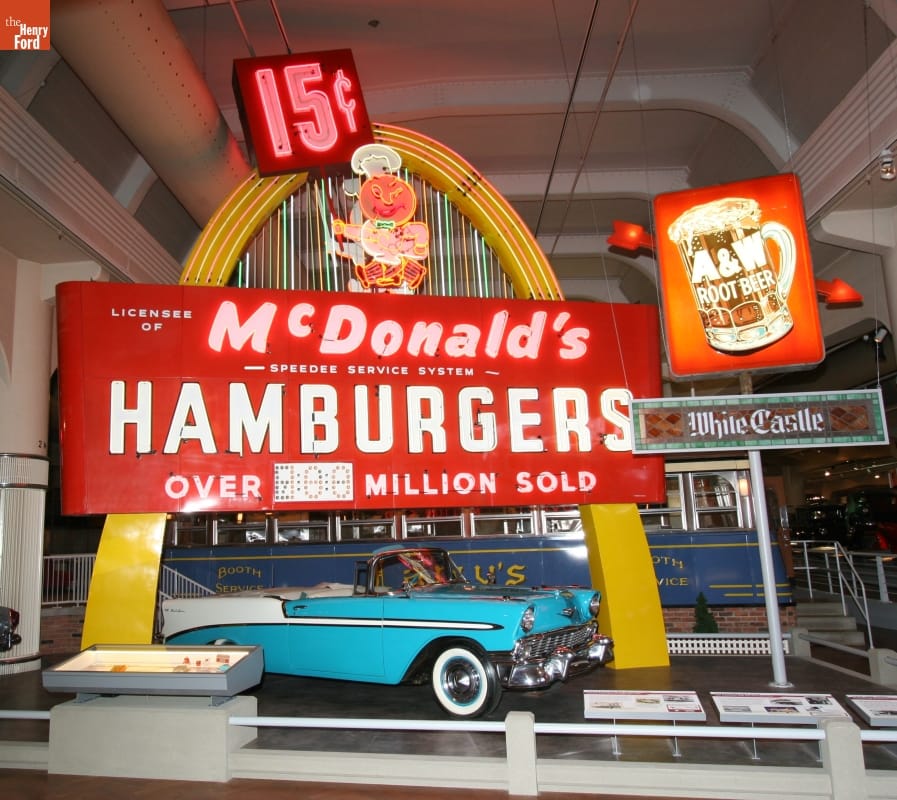
In 1948, the McDonald brothers transformed their Southern California drive-in restaurant with their radical new "Speedee Service System"--assembly-line production of a limited menu at drastically reduced prices. Richard McDonald created this sign design in 1952. In 1955, milkshake machine salesman Ray Kroc franchised the McDonald's concept--prompting numerous imitators and ultimately turning America into a "fast food nation." Set
SetDesign and Making
- 50 Artifacts
This 1937 Sparton radio was designed by Walter Dorwin Teague, a designer renowned for his use of streamlined forms. A study in contrasts -- the blue mirrored finish and curved sled-like base suggest speed while the five jutting parallel panels appear almost architectural -- this expensive and glamorous radio had a limited market during the Great Depression.