
Birth and Baptismal Certificate for Maria Heimbach, 1784
THF237517 / Birth and Baptismal Certificate for Maria Heimbach, 1784
01
Artifact Overview
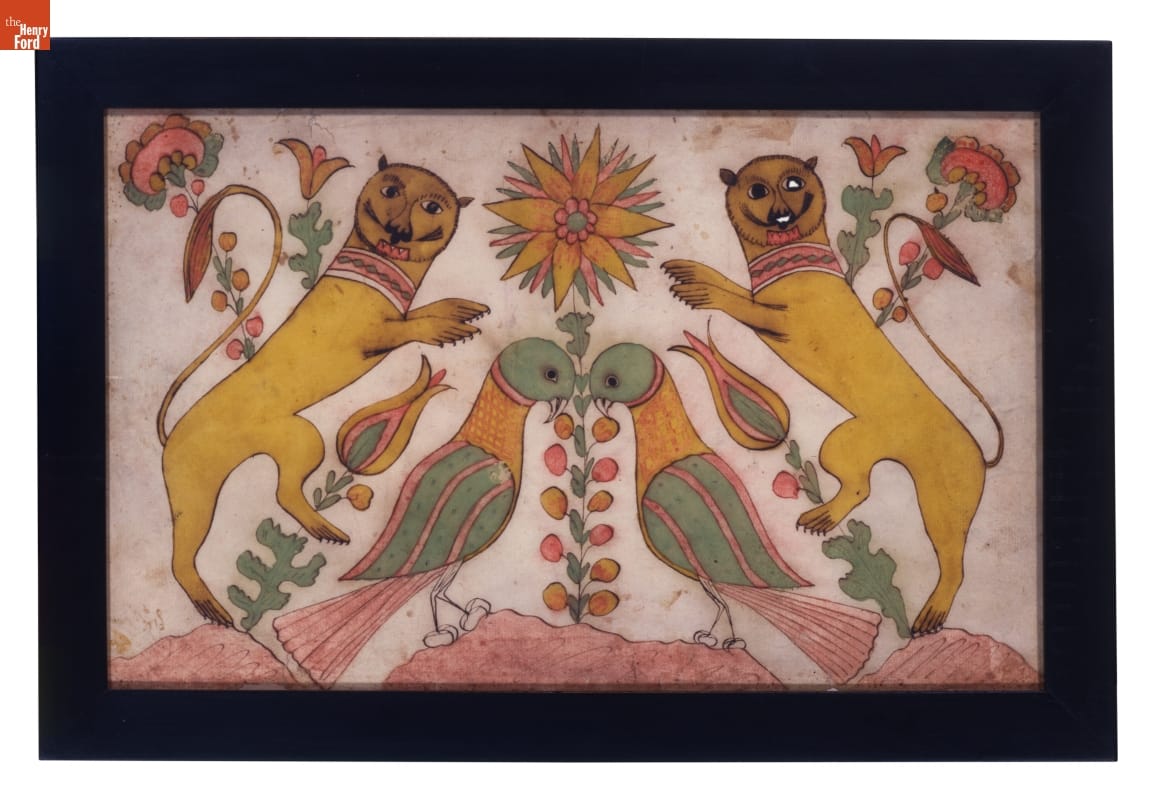
Early German immigrants created decorative keepsakes to commemorate important family events. These documents, known as Fraktur, usually incorporated intricate lettering, elaborate borders and colorful drawings of birds, flowers, hearts or other stylized figures. Inside the heart-shaped center of this Fraktur is information about the birth and baptism of Maria Heimbach. The artist decorated the remaining areas with colorful, hand-painted flowers and other foliage.
Artifact Details
Artifact
Fraktur (Document)
Date Made
1784
Subject Date
12 August 1784
Place of Creation
Creator Notes
Probably made in Berks County, Pennsylvania.
Location
Not on exhibit to the public.
Object ID
55.86.7
Credit
From the Collections of The Henry Ford.
Material
Paper (Fiber product)
Ink
Watercolor (Paint)
Technique
Watercolor painting (Technique)
Color
Red
Yellow (Color)
Black (Color)
Dimensions
Height: 13.375 in
Width: 16.375 in
Inscriptions
Maria gerteraut[?] Heimbachm | ist von Christlichen Eltern geboren worden den 12ten Tag August im Jahr | Christi 1784 in Winser Taunschip in Bercks Caunty geTauft worden von | P. Seman Die Taufzeugen waren Bastian Gref und seine Frau | Maria gerteraut[?] Die Eltern sind die Ehrsame Peter Heimbach und | Seyne Ehrsame Haussfrau Names Anna Barbara Eine geborne | Becherin [...]
Keywords |
|---|
02
Related Content
 Set
SetPennsylvania German Aesthetics
- 12 Artifacts
The Pennsylvania Germans, popularly known as the Pennsylvania "Dutch," were a vibrant immigrant community active in southeastern Pennsylvania in the late 18th and early 19th centuries. The Henry Ford has a rich collection of objects that show the Pennsylvania Germans' flamboyant, whimsical, playful, and highly imaginative artistic style. These pieces are a few of the highlights. Set
SetCelebrating 90 — Collecting through the Decades: 1950s
- 10 Artifacts
The Henry Ford marks its 90th anniversary in 2019. In celebration, The Henry Ford's curators have taken a decade-by-decade look at how our collections have grown — through significant additions and evolving philosophies. This set looks at some of the objects and archives collected during the 1950s.