
"Breaking Prairie Sod With 'Case' 32 Horse Plow Engine," 1915
THF284044 / "Breaking Prairie Sod With 'Case' 32 Horse Plow Engine," 1915
01
Artifact Overview
Treeless grasslands covered 1.4 million square miles of North America, but crews with plowing engines like this created crop fields in short order. Work crews traveled from farm to farm pulling their equipment, a cook wagon, and fuel supplies. Others invested in "bonanza farms," intensely cultivating thousands of acres season after season. This system of agriculture destroyed the semi-arid plains ecosystem.
Artifact Details
Artifact
Postcard
Date Made
1915
Subject Date
1915
Place of Creation
Collection Title
Location
By Request in the Benson Ford Research Center
Object ID
91.315.1355
Credit
From the Collections of The Henry Ford. Gift of Christine Dillon.
Material
Paper (Fiber product)
Technique
Printing (Process)
Handwriting
Color
Multicolored
Dimensions
Height: 3.438 in
Width: 5.375 in
Keywords |
|---|
02
Related Content
 Set
SetAgriculture and the Environment
- 50 Artifacts
"Combines" combine the major tasks of grain harvest: cutting and gathering the crop, threshing and separating the kernels from the chaff, and disposing of the straw. The Massey-Harris Model 20, introduced in 1938, culminated over 100 years of mechanical improvements. One driver operated the self-propelled machine, which reduced the need for hired help during the labor shortages of World War II.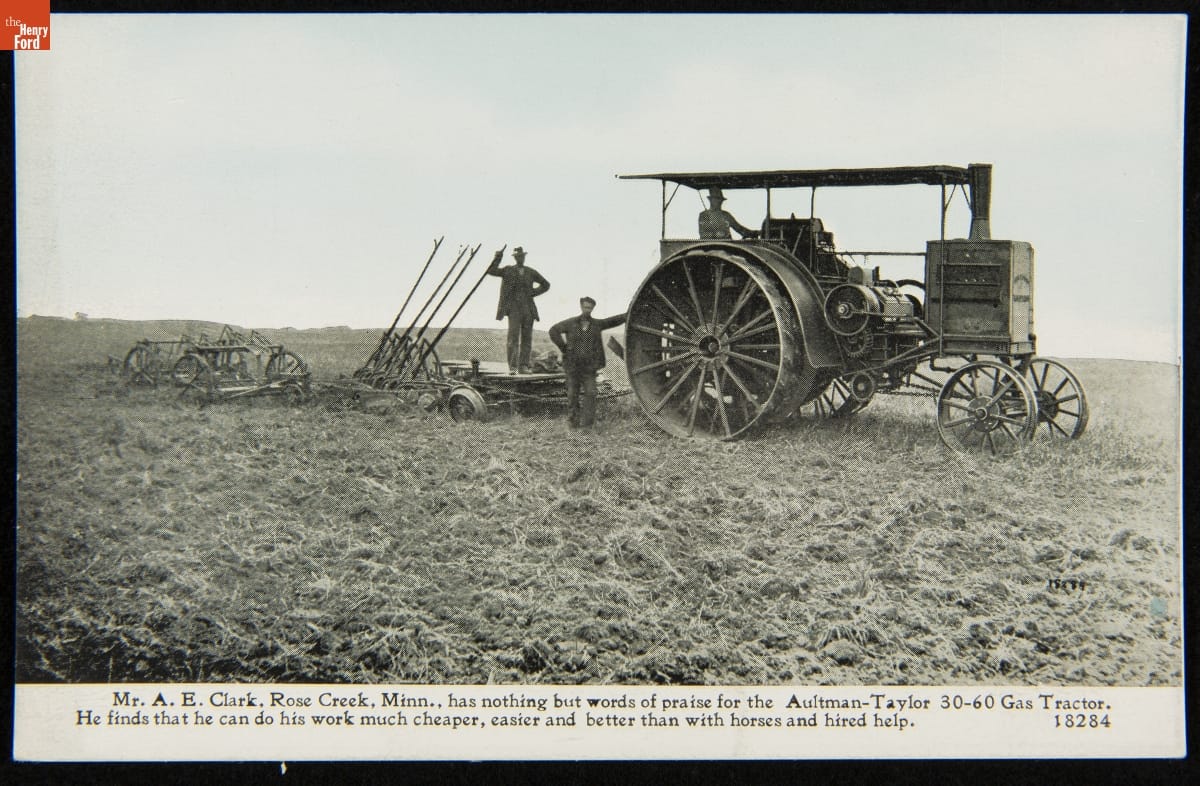 Set
SetEmergence of the Tractor
- 15 Artifacts
American agriculture entered a "golden age" during the late nineteenth century. High market prices for wheat drove farmers to the Plains and Western states where they carved out large -- and profitable -- "bonanza" farms. Innovative machinery reduced labor costs and a competitive traction engine industry emerged. In the 1910s, to meet the needs of farmers with less acreage, these steam-powered traction engines evolved into today's iconic tractor.