
Airship "Norge," Designed and Piloted by Umberto Nobile, before Departure to the North Pole, May 1926
THF621183 / Airship "Norge," Designed and Piloted by Umberto Nobile, before Departure to the North Pole, May 1926
01
Artifact Overview
The semi-rigid airship Norge flew over the North Pole on May 12, 1926. It was the first confirmed visit of any kind to the pole. Norwegian explorer Roald Amundsen headed the expedition. He was joined by American adventurer Lincoln Ellsworth, who helped fund the mission, Italian aviator Umberto Nobile, who designed the Norge, and a crew of 13 others.
Artifact Details
Artifact
Photographic print
Date Made
1926
Subject Date
May 1926
Collection Title
Location
By Request in the Benson Ford Research Center
Object ID
88.15.23
Credit
From the Collections of The Henry Ford. Gift of Dr. Gertrude Nobile.
Material
Paper (Fiber product)
Technique
Gelatin silver process
Color
Black-and-white (Colors)
Dimensions
Height: 4.25 in
Height: 6.25 in
Keywords |
|---|
02
Related Content
 Set
SetPolar Exploration
- 18 Artifacts
In the first four decades of the 20th century, polar explorers set off to discover what lay in the vast cold regions surrounding the North and South Poles. Their expeditions navigated a long-sought-for passage, crossed frozen oceans, charted a continent, and conquered the Earth's poles.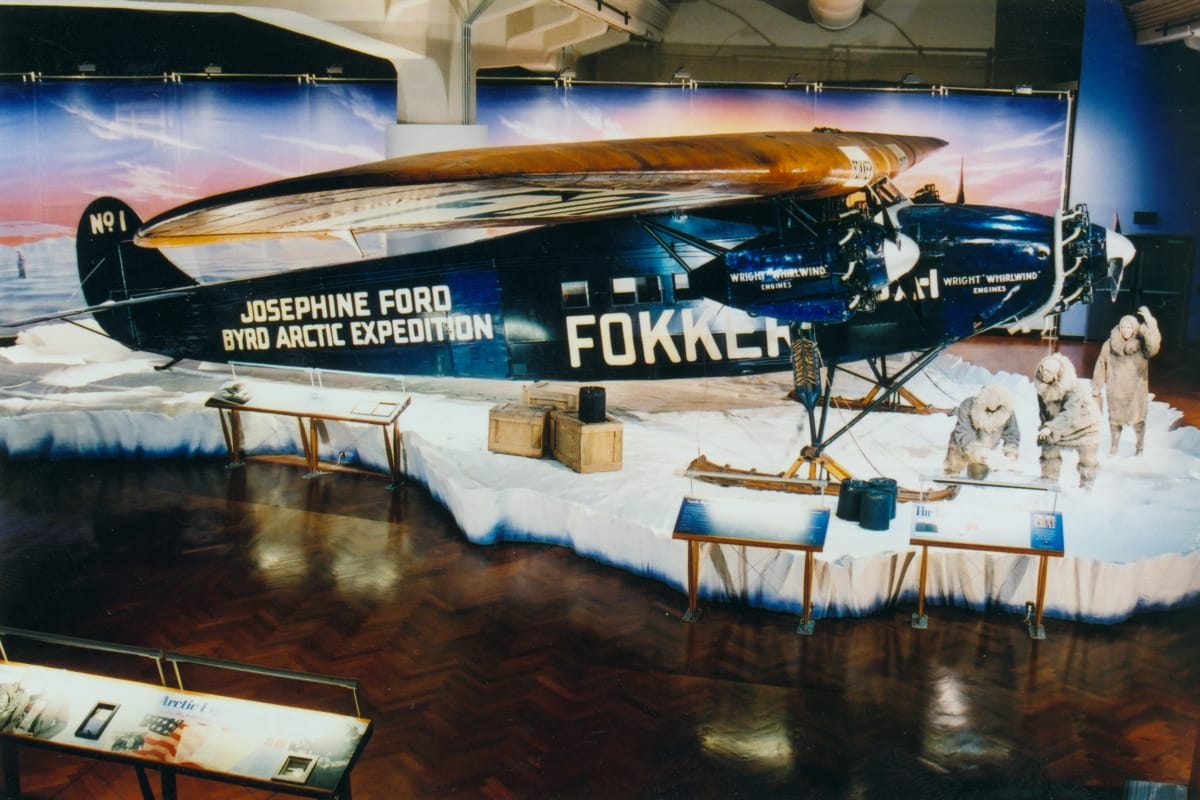 Set
SetRichard Byrd’s North Pole Flight
- 25 Artifacts
On May 9, 1926, explorer Richard Byrd and pilot Floyd Bennett took off from Norway on a round-trip flight to the North Pole in their Fokker Tri-Motor airplane Josephine Ford. Though Byrd is generally credited with reaching the pole, controversy remains over whether he could have made the 1,350-mile journey in the 16 hours he and Bennett spent aloft. Whatever doubts remain today, Byrd was celebrated as a leading polar explorer of his time. Set
SetAirships
- 15 Artifacts
"Airship" refers to any lighter-than-air craft that moves under its own power. Lift is achieved using a gas, like hydrogen or helium, that is less dense than surrounding air. Non-rigid airships — blimps — use the gas's pressure on the containment envelope to maintain their shape. Rigid airships — Zeppelins — support their gas cells with an internal framework. In peace and in war, airships have known triumph and tragedy.