
The "Josephine Ford" Airplane outside the Hangar for Airship "Norge" during the Byrd Arctic Expedition, 1926
THF123647 / The "Josephine Ford" Airplane outside the Hangar for Airship "Norge" during the Byrd Arctic Expedition, 1926
01
Artifact Overview
On May 9, 1926, explorer Richard Byrd and pilot Floyd Bennett flew toward the North Pole in a Fokker F.VII Tri-Motor airplane. Edsel Ford provided considerable financial support to the expedition, and Byrd named his airplane Josephine Ford to honor Mr. Ford's young daughter. Though Byrd is generally credited with reaching the pole, controversy remains.
Artifact Details
Artifact
Photographic print
Date Made
1926
Subject Date
1926
Place of Creation
Collection Title
Location
Not on exhibit to the public.
Object ID
2001.0.107.8
Credit
From the Collections of The Henry Ford.
Material
Paper (Fiber product)
Technique
Gelatin silver process
Color
Black-and-white (Colors)
Dimensions
Height: 6 in
Width: 8 in
Keywords |
|---|
02
Related Artifacts
 Artifact
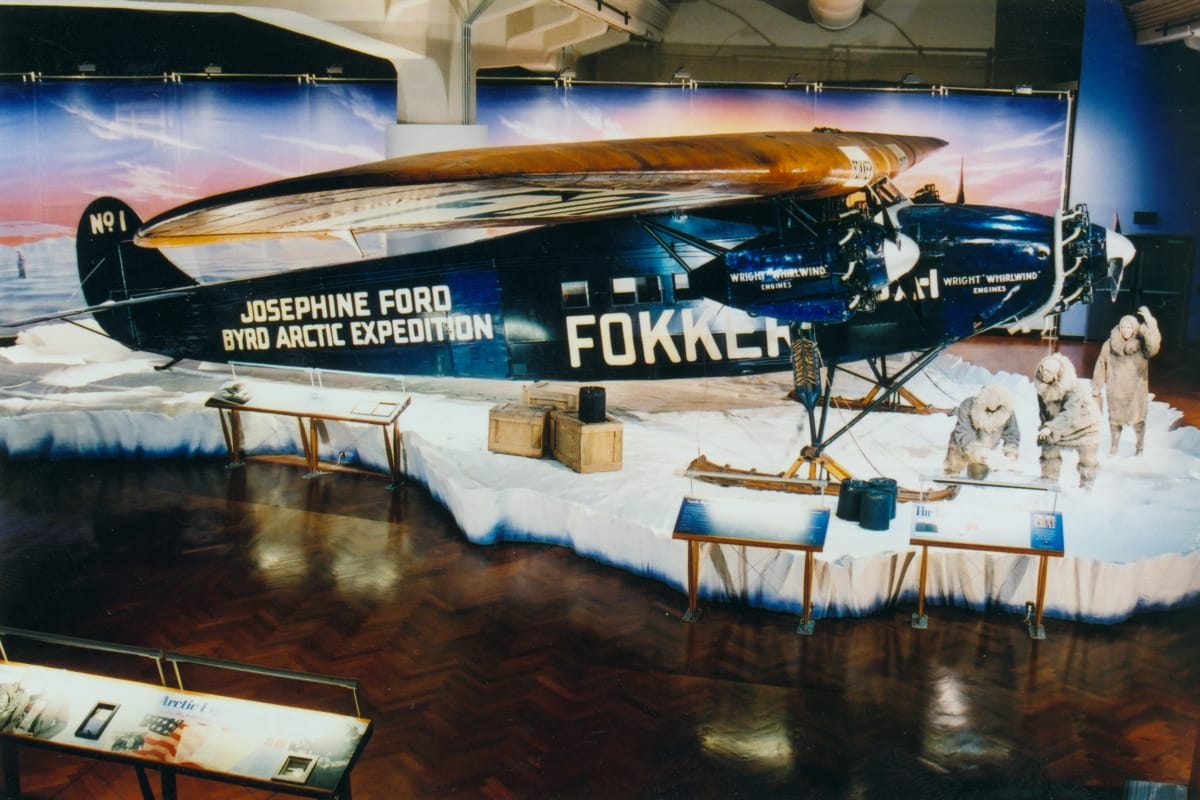
1925 Fokker F.VII Tri-Motor Airplane, "Josephine Ford," Flown Over the North Pole by Richard Byrd
Explorer Richard Byrd and pilot Floyd Bennett flew this Fokker F.VII Tri-Motor airplane toward the North Pole on May 9, 1926. Though Byrd is generally credited with reaching the pole, controversy remains. Edsel Ford financed the expedition, and Byrd acknowledged his patron by naming the plane Josephine Ford, after Ford's daughter.
03
Related Content
 Set
SetPolar Exploration
- 18 Artifacts
In the first four decades of the 20th century, polar explorers set off to discover what lay in the vast cold regions surrounding the North and South Poles. Their expeditions navigated a long-sought-for passage, crossed frozen oceans, charted a continent, and conquered the Earth's poles.