
Portrait of Richard Byrd, 1928
THF123649 / Portrait of Richard Byrd, 1928
01
Artifact Overview
Richard E. Byrd learned to fly while serving as an officer in the U.S. Navy during World War I. In 1926, he led a flight toward the North Pole and is generally credited with success, though controversy remains over whether Byrd reached the actual pole. Three years later, Byrd led a verified flight over the South Pole.
Artifact Details
Artifact
Photographic print
Subject Date
1928
Creators
Place of Creation
Collection Title
Location
By Request in the Benson Ford Research Center
Object ID
2001.0.107.11
Credit
From the Collections of The Henry Ford.
Material
Paper (Fiber product)
Technique
Gelatin silver process
Color
Black-and-white (Colors)
Dimensions
Height: 10 in
Width: 8 in
Inscriptions
attached paper on back:
[C]redit Line [W]ide World Studio [Comm]ander Richard E. Byr[d]
ink stamp on back:
Credit to: WIDE WORLD STUDIO 289 WEST 43RD STREET NEW YORK CITY / Will be Appreciated. [...]
written with pencil on back:
68907 | S3 3928
Keywords |
|---|
02
Related Content
 Set
SetRichard Byrd’s North Pole Flight
- 25 Artifacts
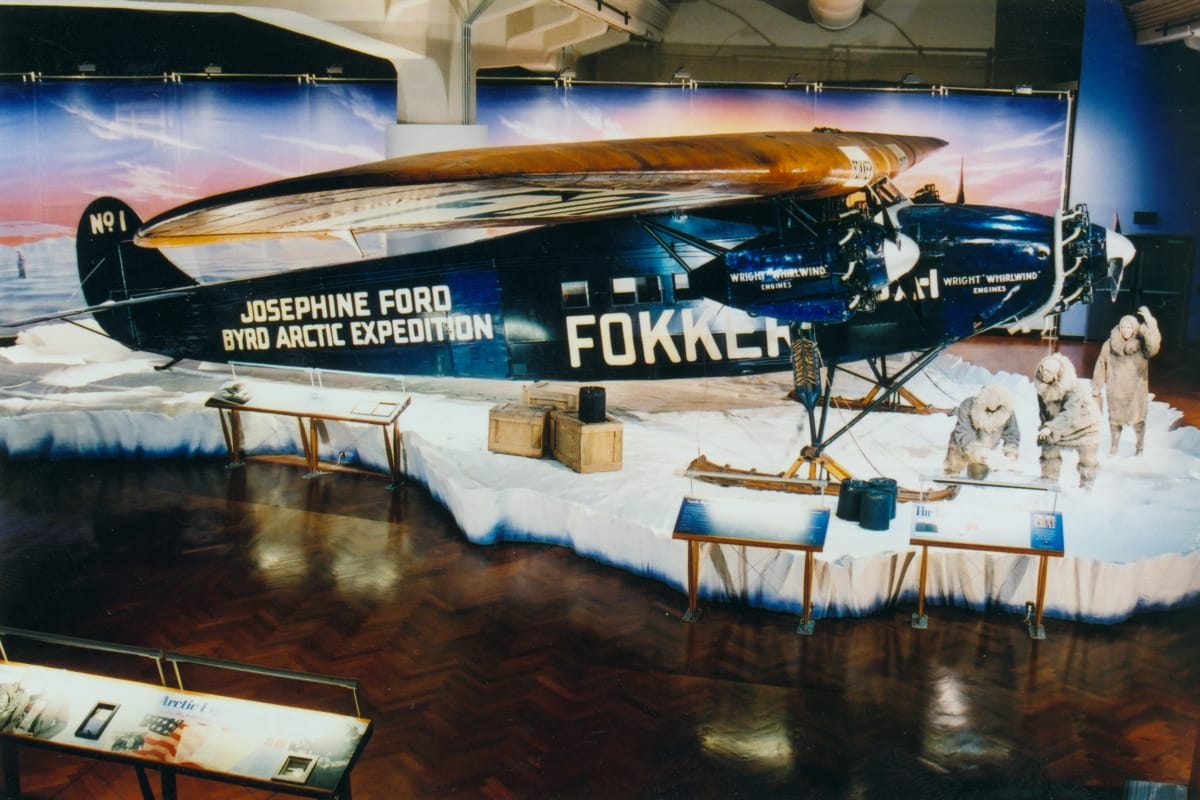
On May 9, 1926, explorer Richard Byrd and pilot Floyd Bennett took off from Norway on a round-trip flight to the North Pole in their Fokker Tri-Motor airplane Josephine Ford. Though Byrd is generally credited with reaching the pole, controversy remains over whether he could have made the 1,350-mile journey in the 16 hours he and Bennett spent aloft. Whatever doubts remain today, Byrd was celebrated as a leading polar explorer of his time.